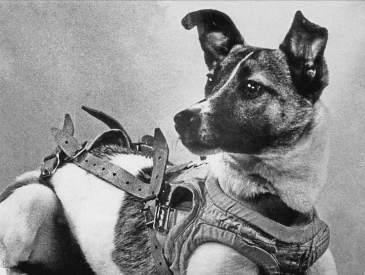
What Happened To Laika, The First Space Dog — A Sacrifice To Science?
This sadistic experiment reveals the truth about human selfishness.
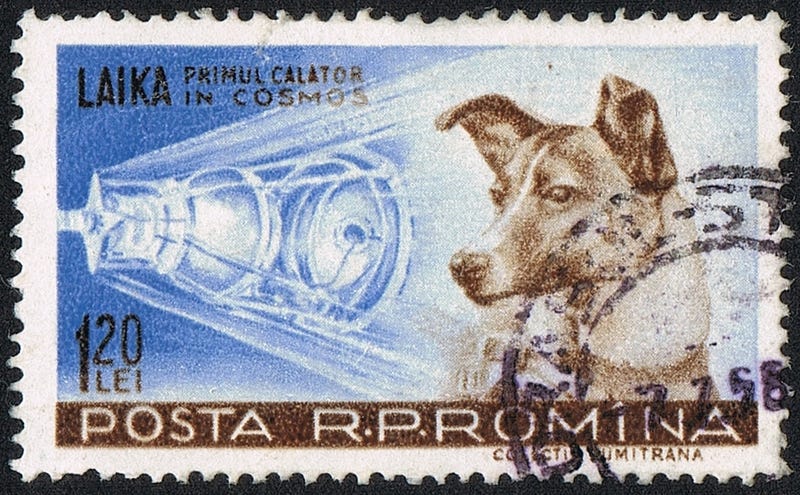
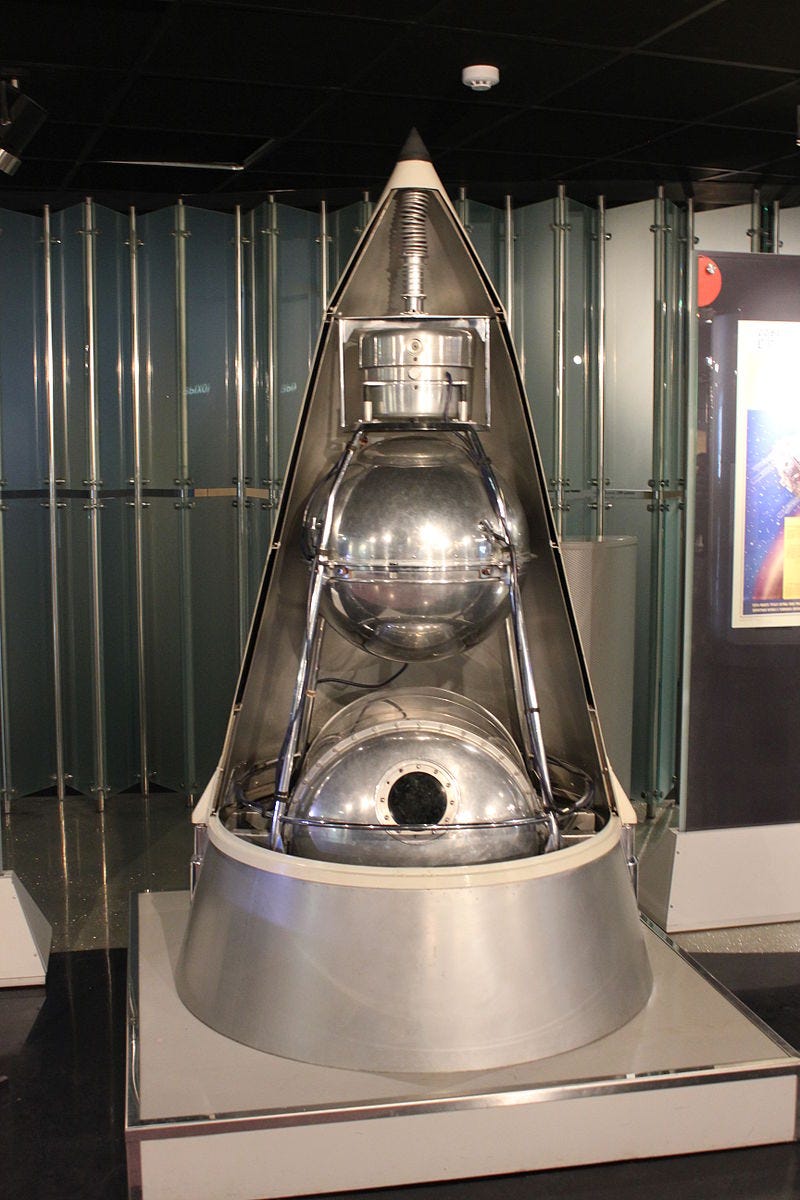
It’s November 3rd, 1957, the 40th anniversary of Russia’s Bolshevik Revolution. Nikita Khrushchev’s request to launch a flight on this day is being fulfilled. The second spacecraft to ever orbit the Earth in space, Sputnik 2, is getting geared up by Soviet engineers to successfully range the Earth’s perimeter.
Inside the tiny capsule of this rather massive aircraft sits someone who belongs to the most faithful of all beings on our planet. A Siberian husky, originally known as Kudryavka was selected amongst two other dogs as the first living being to be sent into space. The intention was mostly to understand the lifespan of a dog in space and improve the spacecraft in ways that can make it suitable for humans to travel as well.
Where did it all begin?
Kudryavka or Laika — a name that means ‘bark’ and was given to the dog by the Russians — has now trained for several days and weeks to learn the environment that will be presented inside the Sputnik 2. The Sputnik 2, contains a small compartment where Laika will be placed and will only have space sufficient to stand or sit down.
In the past few months, Soviet canine recruiters had gathered stray dogs off the street and brought them into the space facility where they were all tested and put into harsh environments.
For every 10 to 15 days, these dogs were repeatedly placed into small cages and were fed a jelly-like nutritious substance. Ranging from variations in air pressure to loud sounds that imitated those that would occur during the rocket’s take-off.
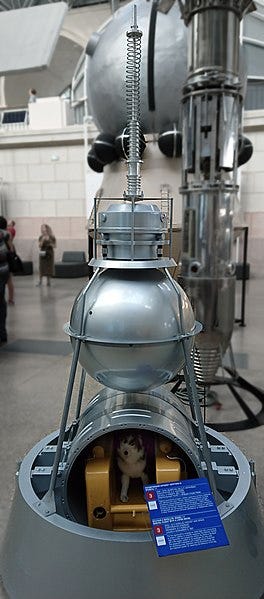
Considering the long duration of sitting inside a tiny capsule, the Soviet physicians wanted to provide a way for the dogs that would allow them to relieve themselves. For this purpose, a specific sanitation device was attached to the dogs around their pelvic area.
However, it took the poor animals a long time to adjust to this new gadget. Many dogs refused to let out bodily waste and had to be fed laxatives. Consequently, they did not pass this specific test.
Unlike the other dogs in the program, Laika had been comparatively very obedient. This is exactly what caught the attention of the Soviet engineers.
A dog that stays calm in congested spaces and eats the strange jelly food without any hassle. Who could be a better candidate to survive the space mission than one that can tolerate the exact two scenarios?
Why was Laiked the best choice?
It is also questionable specifically; why female dogs were selected for this purpose. Female dogs were found to be smaller and more stable when placed together, unlike male dogs that tended to get into a fight or bite each other. The other dog, Albina, was the ace in the room. She had successfully traveled inside a high-altitude rocket and returned home safely.
Although initially planned to be sent off into Sputnik 2 as well, Albina ended up giving birth to puppies. This made the Soviet physicians reconsider her travel and replaced her with Laika. When the physicians started tests on Laika, it was found that she was more friendly towards humans than dogs and easily adjusted to the space-like simulations presented to her.
One day before her departure, Vladimir Yazdovsky, a Soviet space program surgeon, insisted on taking Laika home. So, for the first time ever since her birth, Laika got to experience what a warm and safe environment would feel like. The family of Vladimir Yazdovsky played with Laika, fed her, and tucked her into bed. The next morning, she was brought back to the space facility where the setup process to prepare her for her flight commenced.
Sputnik 2 was a rushed operation. Upon the demand of a political official as powerful as Nikita Khrushchev, the Soviet engineers had no other option than to put together a ship that included the learnings of the successful Sputnik 1.
The only difference was that this new ship contained a pressurized compartment for a dog. The spacecraft was expected to orbit the Earth with its payload weighing 1,120 pounds. The catch was to keep it light-weighted, which meant that Laika was to be fed only once!
The scenario on the 3rd of November
Just like her competitor Albina, Laika is getting small medical gadgets inserted inside her body that would help the doctors and engineers on Earth to monitor her heartbeat, blood pressure, and pulse while she was in space.
Today, on the 3rd of November, 1957, the three-year-old dog, Laika, packed up in a metal spacesuit, is placed inside Sputnik 2’s small compartment. As the rocket started to fire up, Laika’s heartbeat sped up. The sudden changes in her breathing rate were enough to make the monitoring engineer on Earth imagine the scared look on her face.
Sputnik 2 takes off into space and the Soviet engineers on Earth celebrate its successful launch on the 40th anniversary of Russia’s Bolshevik Revolution, while Laika sits in one position inside the capsule of the spacecraft, with her heartbeat still abnormal. Her breathing is observed to stabilize only when she gets out of the Earth’s atmosphere and becomes lightweight.
The spacecraft is now in its fourth orbit and the temperature suddenly starts flaring up. The air conditioning seems to be broken and the temperature rises rapidly.
Although expected to die by eating poisonous food in seven days, Laika’s surroundings perhaps announce her demise even sooner. The extreme heat burns her out and her body lays down as her soul finally drifts away. On Earth, no one except for the Soviet engineers is aware of Laika’s death.
It is the 14th of April, 1958 now. Human civilization has entered a new year and Laika is missed as the first dog to ever travel into space and die there. Sputnik 2 is now observed to be re-entering the Earth’s atmosphere. However, the return is not smooth. The spacecraft is not in fact returning but is falling into the Earth’s atmosphere. At a specific point, it blasts and burns up. The scientists rush to find Laika’s body in the burnt-up remains, only to find ashes and destroyed parts of Sputnik 2.
What Followed After..?
After 64 years, today, the entire event sounds dubious and outrageous. Sputnik 1 had returned safely to Earth and therefore had become a pinnacle of success in the field of astronomy. It was only fair to think that Sputnik 2 was equipped with the same power as its predecessor to complete some specified amounts of orbits and come back to Earth.
Unfortunately, that was not the case..
Although invented by professional scientists who possessed years of study in the space domain, Sputnik 2 was not destined to return back home safely. This technically means that Laika went on a suicide mission to provide information for humans so that they could know whether or not space was livable for them.
Laika’s End
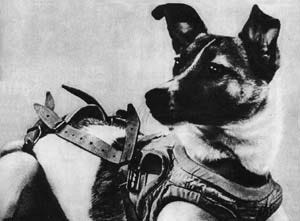
Laika’s death was an ethical issue that in my opinion was left unaddressed for many years. Human experiments don’t justify her death. We need to strongly learn from such missions and condemn involving animals in our assessments.
Despite being given poisonous food, the spacecraft still got destroyed mid-space, which meant that even if the conditions had been fine for Laika, she was still deemed to die.
It was confirmed by the engineers after a few years, that Laika had most probably died during the second orbit due to the high temperature inside the capsule. Sputnik 2 was reported to have orbited the Earth for five months with Laika’s petite lifeless body inside.
Today, Laika’s stories are heard everywhere. Blog posts, children’s stories, poems, art, music, and animated movies, all tell the tale of Laika, a lonely dog that sat in a restricted space, wondering about her journey from the streets to space and whether her demise was always supposed to be this tragic.