
What Forms Effective Assessments in the Classroom?
How to create effective formative assessment tools in any classroom.
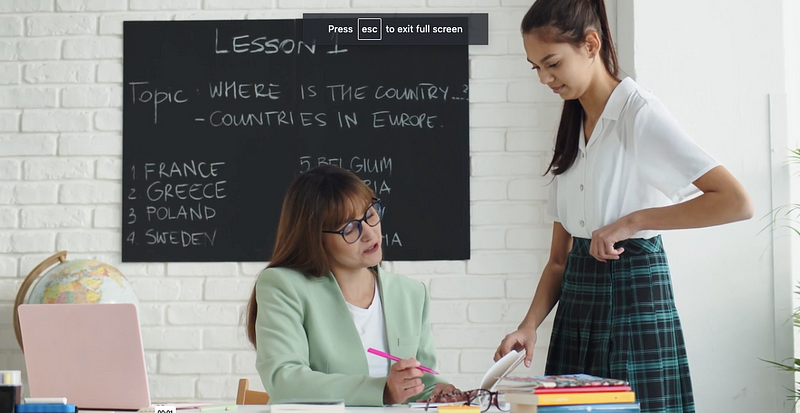
Formative assessments help teachers when guiding learning, and so lesson plans must include references to them in order to be effective.
Building Knowledge through Formative Assessments
In understanding formative assessments, I share with you a look at how they are defined, their purpose and connection to skills building through proper questions, and how best to use them in any classroom.
The Purpose of Formative Assessments
What is meant by the word assessment?
The root word is assess. It comes from the Latin word “sit by” and has evolved to mean “evaluate” or “judge” in today’s English language.
And this word judge is what seems to leave students frustrated sometimes when it comes to traditional forms of assessments given by teachers.
Therefore, teachers need to be cognizant of the kind of assessment they use and when is the best time to use such assessments that don’t leave students frustrated, but instead bring out the best in students and their abilities.
Once teachers use formative assessments to understand their students better, then they can begin to introduce differentiated instruction methods to help students be at their best.
What Do Formative Assessments Measure?
These assessments are done with the purpose of having the teacher “form” an understanding towards students’ strengths and weaknesses.
Using this information teachers can then provide feedback to students to help them succeed academically. They are informal and on-going.
Formative assessments are informal and are given at any point throughout lessons.
These assessments allow teachers to give students feedback on their understanding or work during the lesson.
Examples of Formative Assessments
Examples of formative assessments are wide ranging which may include:
- anecdotal notes made from observations
- questions and answers
- asking students to draw images to show understanding
- asking students to give topic ideas for projects
- responses to class work
- oral readings
- mini-presentations
- pop quizzes on a lesson
which may become part of a student’s portfolio.
Portfolios are collection of students’ work that may be used to give feedback on students’ growth in learning.
Using a variety of formative assessments will helps teachers with lesson planning, and can make students feel more relaxed as they see the progress they are making as it happens.
Assessments In The Classroom
How can assessments be used in the classroom to build better connections between teachers and students?
The one thing is that is a given in any classroom is that students do not want to be stuck doing worksheets all day, so how can teachers make assessment beneficial for students?
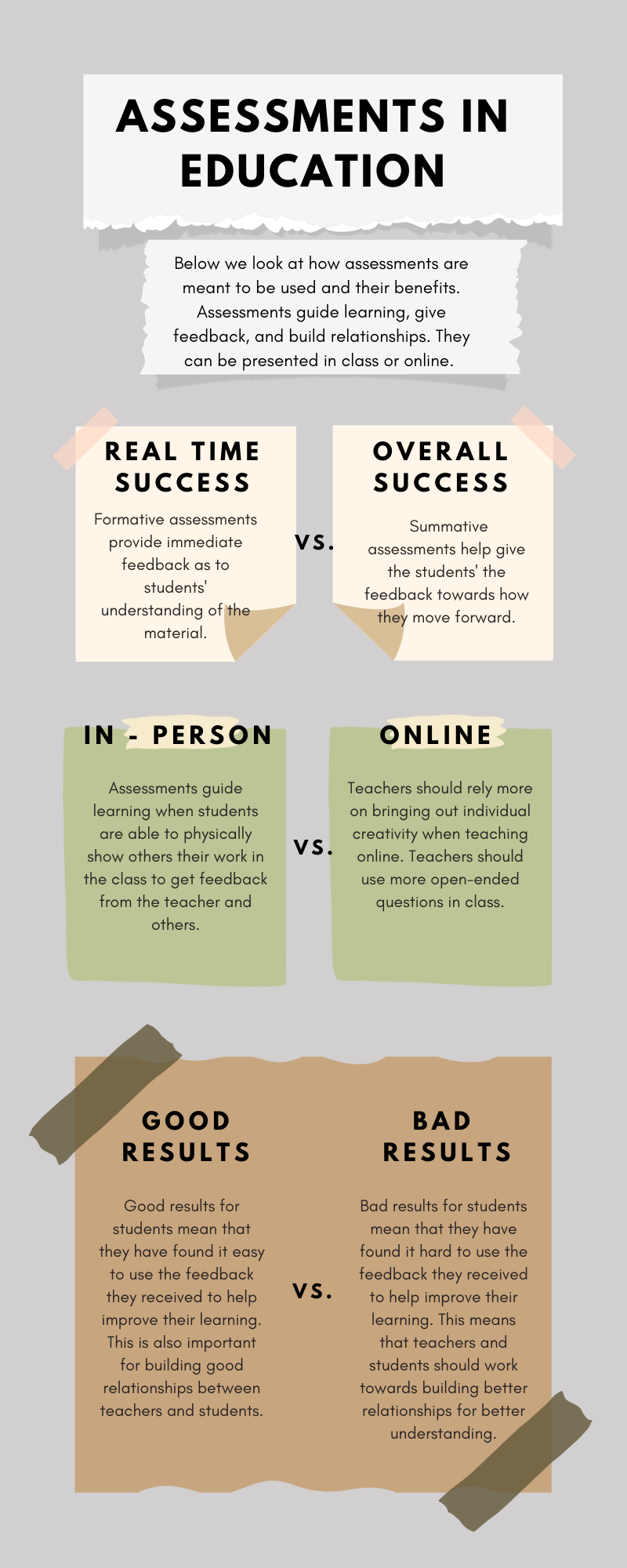
Variety and pace are the keys.
Since formative assessments are so informal and on-going, students need not be aware of just how often they are being assessed.
When teachers assess students quickly and often, teachers build stronger connections to their students by helping to guide their learning through their feedback.
If teachers are slow to offer feedback or don’t offer enough, students may feel lost or disconnected to the subject they are learning and therefore are unable to find the success they are seeking.
Therefore, teachers should not underestimate the value of assessments in helping students be their best.
Language Skills and Assessments
In assessing language skills, how should teachers begin?
There are four language skills students learn to master in their academic career; listening, speaking, reading, and writing.
In creating assessments for these language skills it’s important that teachers keep in mind ways to assess all four language skills in one lesson.
Passive vs. Active Skills
I believe that language building begins with the passive skills and then transitions to the active skills.
Passive skills are ones in which the learner does not need to produce language, just to receive and understand the language.
Active skills, as the name implies, is when learners with produce language in order for others to receive and understand the language.
A fun and challenging exercise teachers can do with students to assess both passive and active skills is to divide the students into two groups and ask one group to give directions to the other group.
For example, one group can use their active skills to:
- give directions to a location,
- build a recipe
- build an an object
and have the other group use their passive skills to assess how well the directions were given to accomplish the task.
Watch the video below to get more on language assessments in the classroom.
Math Skills and Assessments
How can assessments work to enhance math skills?
When students understand how assessment work in building skills, especially problem solving skills, then students will gain confidence when faced such assessments during math lessons.
Math assessments are more defined in that they provide its own form of feedback without the teacher.
Watch the video below to get more on math assessments in the classroom.
How the teacher uses formative assessments in math makes a world of difference for students.
When assessing students knowledge on math topics, teachers should have students communicate their answers in full showing how they got their answer each step of the way.
Teachers and students can then see where mistakes were made along the way, rather than just using the answer as the assessment.
One thing students appreciate is when math teachers recognize their efforts when giving an answer to a math question.
When teachers give students part marks, instead of giving a complete zero on the question because the final answer is wrong. students begin to gain confidence.
Of course, the right answer to math questions is very important.
But in order for students to connect more to the subject and reduce anxiety, how students get the answers using problem solving strategies matters much more.
Assessments In The Online Classroom
The online learning environment is very different to the traditional classroom environment. Methods of assessments need to change. This is one struggle online teachers seemed to have little to no control over.
Why is there such a struggle?
The online environment made cheating much more convenient and harder to recognize.
Teachers in the online classroom found they had less control as to what their students are doing while at home.
And so when they ask a question, how can they be sure this question won’t be shared with others through their mobile phones to help get answers to questions?
Watch the video below to get more on assessments in the online classroom.
So then the question remains, how should formative assessments change in the online classroom?
The answer is to have more open-ended questions over closed-ended questions.
What are open-ended questions? These are questions that begin with “how” or “why”, and are known as thinking questions.
In this case the teacher assess how the students were able to interpret the main points. Closed-ended questions have direct answers and begin with “what”, “where”, and “when”.
Open-ended questions are harder to cheat from than closed-ended questions.
You may ask, how does it work to give open-ended questions in subjects such as math.
Popular questions usually provide the answer and ask, is this the correct answer? Or they may ask, how did so-and-so come to reach this answer.
In the end, if students are going to cheat they will try regardless if it’s in the in-person class or in the online class.
In order to minimize this from happening in either classroom, teachers need to emphasize to students the consequences for anyone caught cheating before beginning the actual assessments.
One other strategy that works in trying to stop students from cheating during an online assessment is to create the assessment with “how easy is it to cheat” in mind!
Final Thoughts…
Assessments in education help guide policy decisions, and are meant to improve on teaching and learning strategies. There is no one size fits all type of assessment as learners have different preferred styles of learning.

Effective assessments, whether they be formative or summative in nature, always do one thing, and that is to motivate and inspire students to be the best they can be with their abilities.
If you enjoyed this article, please consider reading my other articles relating to assessments in the classroom.


