avatarSammy Wan

Free AI web copilot to create summaries, insights and extended knowledge, download it at here

2655

Abstract

oped for myself through integrating mindfulness in my daily life and training as a mindfulness meditation teacher:</p><h2 id="4493">1. Step back and take five</h2><p id="4b60">The moment you start to notice stress or overwhelm, call it out! (It will become easier as you practice and develop self-awareness.) Remember the key here is to not judge yourself but to be objective and observing. Then, take a step back and give yourself some space to ‘time-out’ or ‘take five’.</p><p id="d347">Taking 5 minutes to remove yourself from a stressful situation or breathe space into the current state can save you from dwelling on it for a prolonged time, and reposition yourself to deal with it in a constructive way.</p><h2 id="072f">2. Breathe and connect</h2><p id="7e19"><i>Just breathe.</i> I know for some of us this is exactly what’s difficult! To help us arrive in this moment, you can do so by deepening your breath and creating space within. You can place one hand on your belly and one hand on your chest to connect to the sensations of your breath rising and falling.</p><p id="3015">If you are a visual person like me, it may help to imagine roots of a tree extending from your feet, growing and deepening with each breath. There’s no right or wrong way to approach this, it will require your own creative exploration of what works for you and helps you at different times.</p><h2 id="ce2e">3. Draw a box (with your breath!)</h2><p id="40e2">That said, there are proven techniques you can draw upon to effectively build this practice. One of them I’ve seen being used time and time again in meditation practices is <a href="https://www.medicalnewstoday.com/articles/321805#the-box-breathing-method">box breathing</a>, or what I call — drawing a square with your breath.</p><figure id="cf40"><img src="https://cdn-images-1.readmedium.com/v2/resize:fit:800/1*hix6FDg5MaxJXU9VeiHPBQ.png"><figcaption>Design by Sammy Wan</figcaption></figure><p id="6d4a">Start from the red dot as illustrated in the diagram above, and focus on this sequence of equal breaths of inhaling, equal breaths of holding and equal breaths of exhaling, then coming to a pause before you begin the cycle again. Do this for a few rounds and check in with how you feel. Once you’ve regularly practiced this, it will become a tool you can draw on at any time.</p><p id="6e5c">As you continue to practice this, you can also deepen your relaxation by adding a few more counts when exhaling, slowly lengthening and extending your breath.</p><h2 id="989a">4. Celebrate!</h2><p id="201d">Congratulate yourself every time you do this as you’ve proactively chosen a different path and a mor

Options

e empowering way of being! It will take patience and practice but I promise you, it’s the beginning of a mindful journey that you are setting up for yourself.</p><p id="60a9">Last but not least, I would like to leave you with this quote as I wish for everyone to find more peace in their everyday being, and to begin a journey inwards.</p><p id="4b7f" type="7">“How you do the little things is how you do everything.” — Sharon Pearson</p><p id="2e66">If you’ve enjoyed this piece and would like to learn more about mindfulness and meditation, here are some of my other work:</p><div id="cfa1" class="link-block"> <a href="https://readmedium.com/stop-resisting-what-comes-your-way-45d16c52c78a"> <div> <div> <h2>Stop Resisting What Comes Your Way</h2> <div><h3>The Key to A More Happy and Fulfilled Life</h3></div> <div><p>medium.com</p></div> </div> <div> <div style="background-image: url(https://miro.readmedium.com/v2/resize:fit:320/0*M9adDXqQSq_IN8og)"></div> </div> </div> </a> </div><div id="6721" class="link-block"> <a href="https://readmedium.com/how-to-find-more-peace-with-yourself-each-day-b4240ac92605"> <div> <div> <h2>How to Find More Peace With Yourself Each Day</h2> <div><h3>“Peace is a daily, a weekly, a monthly process, gradually changing opinions, slowly eroding old barriers, quietly…</h3></div> <div><p>medium.com</p></div> </div> <div> <div style="background-image: url(https://miro.readmedium.com/v2/resize:fit:320/1*yEPlJExMY1AwHIo2-x5ypQ.jpeg)"></div> </div> </div> </a> </div><div id="d27c" class="link-block"> <a href="https://readmedium.com/what-is-mindfulness-and-and-how-it-has-helped-me-navigate-challenges-c149fd0a42ec"> <div> <div> <h2>What is Mindfulness and And How it Has Helped Me Navigate Challenges</h2> <div><h3>How to Adopt Mindfulness in Your Daily Life</h3></div> <div><p>medium.com</p></div> </div> <div> <div style="background-image: url(https://miro.readmedium.com/v2/resize:fit:320/0*XKlMZw0hIeKwrfFk)"></div> </div> </div> </a> </div><p id="68ab"><i>Alternatively, you can also support my work by buying me a coffee <a href="http://Ko-fi.com/sammywan">here</a> :)</i></p></article></body>

What Does it Mean to Be Present?

And simple steps to arrive in the here and now
Photo by Dmitry Astakhov

For me, being present means I’m paying attention, observing and witnessing with a curious and non-judgemental attitude in this very moment.

Having been on this mindfulness journey for a while now, it’s been an evolving and opening experience full of discoveries and growth. What I love about mindfulness is that the more you practice it, the more it integrates into your life and becomes part of who you are. Essentially, it’s an embodied practice.

We all love strategies, tools, and tips but there’s nothing more powerful than experiencing, feeling and being. As much as I love all the brain science out there and learning about concrete facts that explain certain behaviours, it’s only through one’s journey of going inward and exploration that brings discoveries and truths that no one can take away from you.

“The highest and most beautiful things in life are not to be heard about, nor read about, nor seen but, if one will, are to be lived.” — Soren Kierkegaard

Having found the moments of peace and inner strength through my meditation and mindfulness practice, I deeply champion the mind-body approach we should take to achieve wellbeing holistically. One of the most powerful tools we have within ourselves is our breath.

“You can never get back a past breath or make a future breath come sooner.” — The Mindfulness Movement

Using our breath as an anchor in our day to day lives is one of the ways you can begin practicing mindfulness and regulate your stress response. If you need a bit of convincing and scientific evidence, the breath is one of the few ways we have access to calm our amygdala (the part of the brain that fires up during stress) and connects us to the frontal cortex that is responsible for problem-solving, logical thinking and self-regulation.

It has been one of the most powerful tools for me in dealing with anxiety and overwhelm. And it’s so accessible, you can do it anywhere, anytime, you just need to set an intention in the mind and open up to creating space for yourselves by connecting your mind and body.

Here’s the framework I’ve developed for myself through integrating mindfulness in my daily life and training as a mindfulness meditation teacher:

1. Step back and take five

The moment you start to notice stress or overwhelm, call it out! (It will become easier as you practice and develop self-awareness.) Remember the key here is to not judge yourself but to be objective and observing. Then, take a step back and give yourself some space to ‘time-out’ or ‘take five’.

Taking 5 minutes to remove yourself from a stressful situation or breathe space into the current state can save you from dwelling on it for a prolonged time, and reposition yourself to deal with it in a constructive way.

2. Breathe and connect

Just breathe. I know for some of us this is exactly what’s difficult! To help us arrive in this moment, you can do so by deepening your breath and creating space within. You can place one hand on your belly and one hand on your chest to connect to the sensations of your breath rising and falling.

If you are a visual person like me, it may help to imagine roots of a tree extending from your feet, growing and deepening with each breath. There’s no right or wrong way to approach this, it will require your own creative exploration of what works for you and helps you at different times.

3. Draw a box (with your breath!)

That said, there are proven techniques you can draw upon to effectively build this practice. One of them I’ve seen being used time and time again in meditation practices is box breathing, or what I call — drawing a square with your breath.
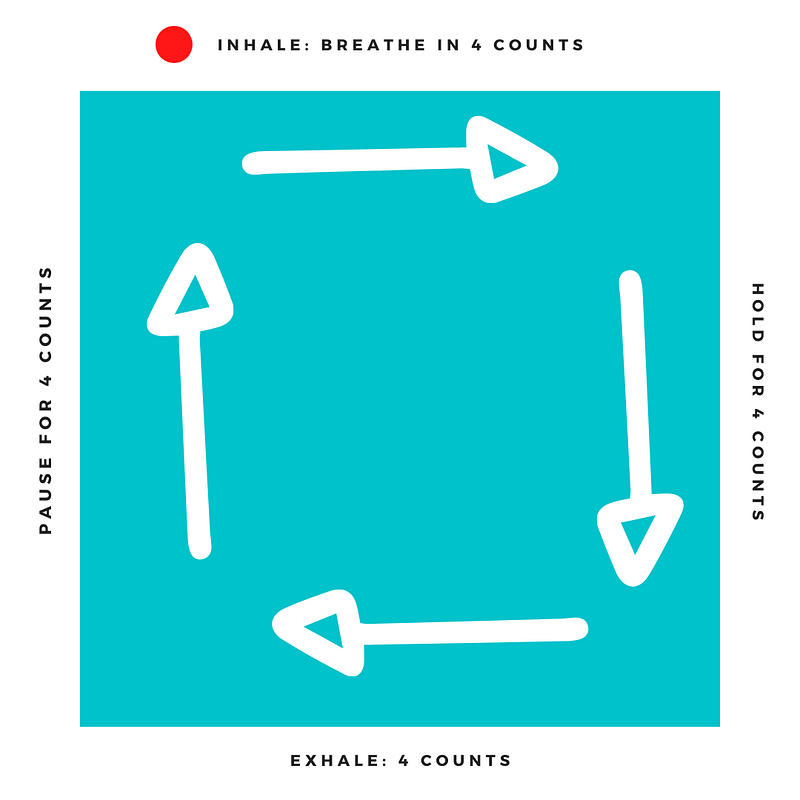
Design by Sammy Wan

Start from the red dot as illustrated in the diagram above, and focus on this sequence of equal breaths of inhaling, equal breaths of holding and equal breaths of exhaling, then coming to a pause before you begin the cycle again. Do this for a few rounds and check in with how you feel. Once you’ve regularly practiced this, it will become a tool you can draw on at any time.

As you continue to practice this, you can also deepen your relaxation by adding a few more counts when exhaling, slowly lengthening and extending your breath.

4. Celebrate!

Congratulate yourself every time you do this as you’ve proactively chosen a different path and a more empowering way of being! It will take patience and practice but I promise you, it’s the beginning of a mindful journey that you are setting up for yourself.

Last but not least, I would like to leave you with this quote as I wish for everyone to find more peace in their everyday being, and to begin a journey inwards.

“How you do the little things is how you do everything.” — Sharon Pearson

If you’ve enjoyed this piece and would like to learn more about mindfulness and meditation, here are some of my other work:

Alternatively, you can also support my work by buying me a coffee here :)

Mindfulness
Anxiety
Life Skills
Life Lessons
Mental Health
Recommended from ReadMedium