
What Do Women Want?
It’s not really strange or mysterious
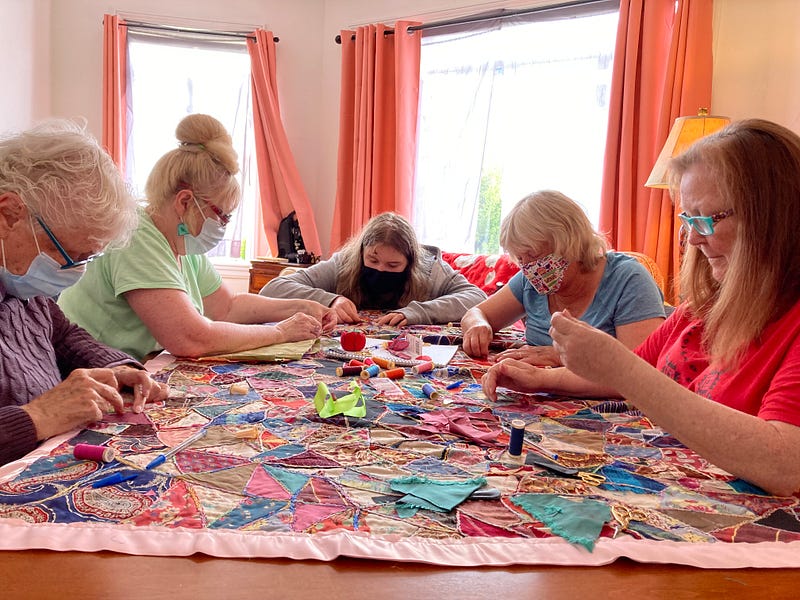
“The great question that has never been answered, and which I have not yet been able to answer, despite my thirty years of research into the feminine soul, is ‘What does a woman want?’” ― Sigmund Freud: Life and Work
What do women want? I’ve heard this question expressed many times over the course of my life. When I was growing up in the ’60s, popular movies and TV shows suggested that women were radically different than men, with mysterious and sometimes strange or even silly needs. Yet the answer is not strange or silly or mysterious. Women want what everyone else wants: kindness, love, respect. Safety and security for their children and family. Opportunity to excel and create. It all seems so obvious, it’s hardly worth mentioning.
But perhaps that ignores the implied part of the sentence: What do women want, in a man? Putting aside the assumed hetero framework, the answer is the same: women aren’t “other” or much different from men. Human desires are universal. If we’re talking about sex, women want attractiveness, sensuality, and energy in a partner. If we’re talking about building a long-term relationship or a family, women want reliability and ability to do your share.
That’s the way I see it, anyway. And naturally, I assume that everyone else sees it that way, too. So imagine my surprise when I read that one of the most celebrated thinkers of the 20th Century didn’t consider these values important — at all.
Bertrand Russel’s Four Basic Desires
According to Bertrand Russel’s Nobel Prize acceptance speech in 1950, we human beings are motivated by insatiable desires.
“Man differs from other animals in one very important respect, and that is that he has some desires which are, so to speak, infinite, which can never be fully gratified, and which would keep him restless even in Paradise. The boa constrictor, when he has had an adequate meal, goes to sleep, and does not wake until he needs another meal. Human beings, for the most part, are not like this.”
So what do humans desire? Russel broke it down to four things.
1. Aquisitiveness
Like the bumper sticker from the ’70s, “The Person With the Most Toys Wins.” Right? That seems to be the credo of Jeff Bezos, the world’s richest man, who apparently needs a support yacht for his superyacht in addition to a penis-shaped rocket to fly off planet for eleven fun-filled multi-million-dollar minutes in, yet still doesn’t feel rich enough to give his employees bathroom breaks.
Russel saw that coming.
“However much you may acquire, you will always wish to acquire more; satiety is a dream which will always elude you.”
And isn’t the whole idea of acquiring a lot of material goods grossly outdated, anyway? Aren’t we currently trying to reduce our carbon footprints and declutter our homes of items that don’t spark joy? That’s certainly true in my own life, where the box of random stuff crammed into my bookshelf is not a source of pride or pleasure, but irritation — a reminder of yet another chore I’ve failed to accomplish.
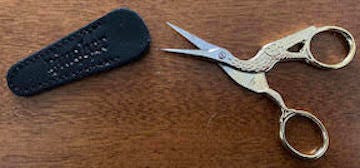
Of course, that didn’t prevent me from acquiring a clutch of magnificent gold-plated stork scissors from Britex for my sisters and me to use at the quilting bee.
2. Rivalry
Russel says besting your peers is a prime motivator, so that 417-foot superyacht Bezos spent more than $500 million on up front (and doesn’t even have a helipad!) is probably going to rankle unless it’s a little longer than Elon Musk’s. That also explains what I’ve read about happiness: how we judge our own circumstances by comparing ourselves to our neighbors. We don’t mind going barefoot as long as everyone else in our community is shoeless, too. But if all your classmates have shoes, and you don’t, that’s a problem.
3. Vanity
Finally, a desire I can relate to! Of course I want to look good. Who doesn’t? And vanity is evidently on everybody else’s mind, too, when you consider the proliferation of photo filters and carefully curated personal “brands” on social media, and that gaining fame via the “look at me!” internet is considered both a laudable and achievable goal.
4. The Love of Power
The sad part about this last one is Russel says people don’t exercise their power by doing good things. The most effective way to display your power (thereby satisfying desires for rivalry and vanity, too) is by harming others, and there’s certainly enough evidence of leaders doing that worldwide to make me believe this is true.
“In any autocratic regime, the holders of power become increasingly tyrannical with experience of the delights that power can afford. Since power over human beings is shown in making them do what they would rather not do, the man who is actuated by love of power is more apt to inflict pain than to permit pleasure.”
All that said, it seems that Russel’s outline of prime motivators in human behavior is outdated, which could indicate that it wasn’t a good list in the first place, or that the human species has changed for the better since the 1950s — at least in some ways.
Abraham Maslow’s Hierarchy of Human Needs
Although it was published around the same time (1943), Abraham Maslow’s Hierarchy of Human Needs makes a lot more sense to me than Bertrand Russel’s Four Desires. It’s commonly taught in education and psychology classes in college, and points out that if you can’t eat, sleep, and shit, then nothing else matters. First things first.
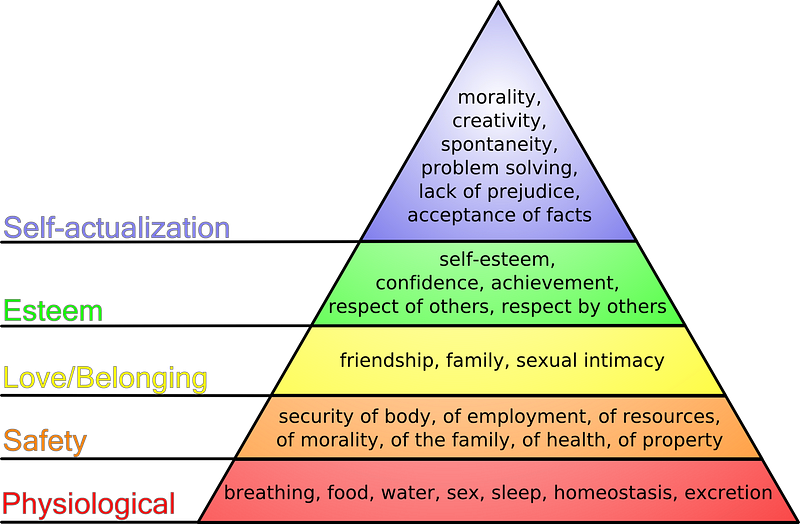
I like that the hierarchy includes the values I identified in the first paragraphs of this essay: safety, love, respect, and creativity. Entering the field when most psychologists were focused on problems and illness, Maslow’s theories were much more optimistic, focusing on achieving the full human potential and suiting “people who see the positive side of humanity and believe in free will,” according to Wikipedia.
Along with fellow psychologist Carl Rogers, Maslow founded the Humanistic Psychology movement. Here are its basic principles:
1. Someone’s present functioning is their most significant aspect. As a result, humanists emphasize the here and now instead of examining the past or attempting to predict the future.
2. To be mentally healthy, individuals must take personal responsibility for their actions, regardless of whether the actions are positive or negative.
3. Each person, simply by being, is inherently worthy. While any given action may be negative, these actions do not cancel out the value of a person.
4. The ultimate goal of living is to attain personal growth and understanding. Only through constant self-improvement and self-understanding can an individual ever be truly happy.
Please note that there’s no mention of women having different, or strange, or mysterious needs.
The Bechdel Test
One reason men like Dr. Freud don’t know what women want is that they don’t ask them — or if they do ask them they don’t believe what the women reply — preferring instead to “theorize” about what really goes on in a woman’s mind. You could argue, for example, that Freud’s decision to interpret one patient’s reports that her father was molesting her not as truth, but as a subconscious fantasy, put back the #MeToo Movement by 200 years. But let’s put aside short-sighted people for a moment.
Have you ever heard of the Bechdel Test? It’s a way to analyze movies to tell if you, a woman or a well-rounded man, might like to watch them. It asks if the movie has three things:
- Two women characters
- Who have a conversation
- That isn’t about men
The most amazing thing about the Bechdel test is that most movies don’t meet that simple criteria. That’s because Hollywood is owned and run by men, who imagine that women are uninteresting characters who have nothing better to do than obsess over men. So here’s another unsurprising thing that women want: more movies about them.
I mentioned the Bechdel Test to my daughter during our annual family reunion this summer. That’s when my four sisters and I and a revolving combination of our extended family members gather at a little one-bedroom beach house in Santa Cruz for two weeks. One way we manage that is by putting up tents in the back yard, thereby expanding the one-bedroom house into a four-bedroom one. And that’s how I happened to be forced to involuntarily eavesdrop on a group of drunken 20-something women celebrating someone’s birthday next door.
I was innocently trying to sleep in my tent. They were innocently drinking and partying in their back yard — a few feet from my head (unbeknownst to them), on the other side of the fence, in the dark of night. They were sloppy and silly and endlessly annoying, but at least, I told my daughter the next day, they passed the Bechdel Test. At least they weren’t talking about men.
“I think most human women pass the Bechdel Test,” she replied, “just not fictional women in movies made by men.”
I thought about the Bechdel Test again when I read Sarah J. Baker’s story in Fourth Wave about Men Going Their Own Way. Apparently, the way they go their own way is by spending most of the time on their forums obsessing over and bitching about women, which begs the question: are men who think women think only of men projecting?
What do Women Want…in a Board Game?
I was thinking about all those things when we broke out the games in Santa Cruz. Over the years we’ve had many favorites, including Magic the Gathering, Mah Jong, Settlers of Catan, Dominion, and Puerto Rico. This year we played a lot of Wingspan.
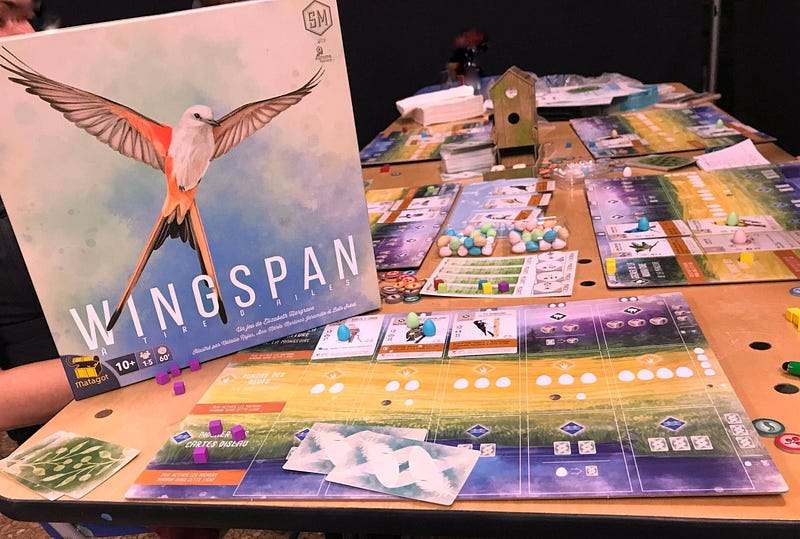
After buying the game to play with my son at the suggestion of gamer, philosopher, and writer Alan Tabor, I fell in love with the ephemera: little eggs of many colors that look like Jordan almonds and are pleasing to handle and touch; a cardboard birdhouse that you carefully construct and deconstruct every time you play which becomes a clever way to roll and contain the dice; a vast supply of playing cards with beautiful pictures of poetically-named birds and interesting details about them like the habitat they live in, the food they eat, their wingspan, and the kind of nest they build.
The game play, too, is all kinds of delightful. Instead of trying to beat out other players to control limited resources, each player works on building their own bird sanctuary while accumulating unlimited points. The instructions specifically say that the resources aren’t limited. If you run out of eggs or food tokens, you’re free to create chits to represent more.
When I got back home to San Francisco, I read a story by Dan Kois in Slate that connected a lot of dots for me. Unlike most games which encourage players to harm others while scrambling to the top, Wingspan, which came out in 2019, encourages the development of nurture and beauty, appealing to the highest point on the pyramid of Maslow’s Hierarchy of Human Needs.
The subtitle says the game is transforming the board game industry.
The origin story of Wingspan is romantic. After falling in love with adult board games on a ski trip in 2005, health policy analyst Elizabeth Hargrave became disillusioned with the repetitive themes.
She and her friends found themselves annoyed that all the games seemed to revolve around medieval villages, or trains, or trading economies in vaguely Mediterranean locales. “At one point we placed a moratorium on games about castles,” she said. This led her to a question: Why weren’t there games about subjects she actually found compelling?
Hargrave subsequently spent years designing and testing and re-designing Wingspan from her home in Washington D.C. before trying to sell it to game companies. Most wouldn’t give even her a meeting. She was unknown, a woman, new to the gaming universe. And the game itself was unusual.
But Stonemeier Games eventually agreed to publish it, and “has now sold 1.3 million copies of the game and its expansions, plus another 125,000 digital editions on Steam, Nintendo Switch, Xbox, and iOS,” according to Slate. It outsells every other game the company publishes combined.
Company executive Jeremy Stegmaier, who took that first meeting with Hargrave and later made the decision to produce the game, says one reason it’s so popular is that it’s reaching a new audience.
[He] doesn’t have gender breakdowns of who’s purchased Wingspan, but he does note that the game’s official Facebook group is 40 percent women — which may not sound particularly high, but the group for Stonemaier’s other bestselling game, Scythe, is 90 percent men. Hargrave, for what it’s worth, says she has received variations on the same email over and over from male gamers: Finally, a game my wife will play with me!”
I hate to contradict my own thesis — that women are not much different from men — but I surely relate to the Slate author’s conclusion that Wingspan is a different, more gentle kind of board game, which if you subscribe to gender stereotypes you might call feminine.
Kois describes a decision he makes during game play that sums up the magic.
The other evening my daughter Harper and I played out on the porch, twinkling Christmas lights illuminating our board, my songs-about-birds playlist soundtracking the experience. As the final round came near its close, I had a choice: I could lay eggs for each of my final two turns, or I could gamble that I’d draw a really cool bird and have the right food to play it.
He gambles on the “cool” bird, because as it turns out, taking a chance on getting one more interesting and beautiful bird into his sanctuary is more satisfying to him than striving to win the game, which brings me back to my original description of what women want, and what I naturally assumed everyone else wants, too: kindness, love, respect. Safety and security for their children and family. Opportunity to excel and create. It all seems so obvious, it’s hardly worth mentioning…
The sad part is, it’s not as obvious as I imagined. Some people don’t choose to create beauty. They’re still stepping on others to hoist themselves higher; chasing rivalry, vanity, acquisition, and power; imagining they must harm others to meet their own basic needs.
But what if it’s not only the world of board games that is transforming? What if the world we live in is changing, too?
It’s hard to see sometimes, amid the constant catastrophes: the wars, the wildfires, hurricanes, and diseases. But there are a few indications: The #MeToo Movement, that seeks to subvert the ongoing oppression of women; the Black Lives Matter movement, that does the same for race; the expanding acceptance of the LGBTQ+ community, as described in this story by John Kruse on Fourth Wave.
And even the popularity of a board game like Wingspan, which provides one answer to the shallow and backwards and unnecessarily sexist question: what do women want?
For further reading…
My writing is free to readers who follow my links from Twitter, Facebook, and LinkedIn, but if you’d like to read more, click here to join Medium for $5 a month and they’ll give me some of that money. (Huzzah!) For an email when I publish a new story, click here. Find more stories about Sex, Love & Family on this List. And for more of the good stuff, follow Fourth Wave, where we’re changing the world for the better, one story at a time. Got one of your own? Submit to the Wave!


