
Data Driven Art
What artist has the most artwork stolen?
Questions Surrounding AI-Generated Art
Nowadays, it is easy to steal talents and use them for free. It is pretty simple. Artists are the first to suffer. The latest machine learning models have taken away the ability of digital artists to create new worlds. Online popularity has become a trap.
“Art is not a machine” — the latest AI art style generator
Online picture scraping is used in developing AI art generators, often without the artists’ knowledge or consent. Thus, they are bringing up complex issues of ethics. In the digital arts community, many are fed up.
Lexica, which keeps tabs on more than 10 million pictures and prompts produced by Stable Diffusion, estimates that the name Wayne Barlowe has been used as a prompt somewhere in the neighborhood of 8,000 times. World-renowned painters like Michelangelo, Picasso, and da Vinci generated a 2,000 suggestions at most.
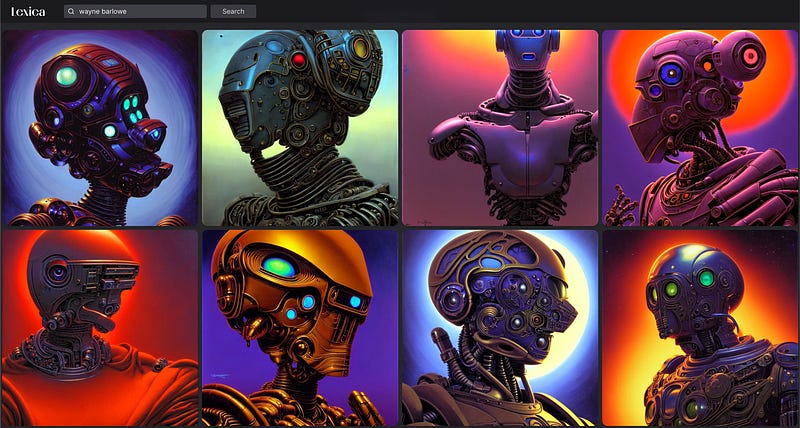
The use of AI art generators has opened up a world of possibilities for the reproduction of every work of art ever made. As an AI art curator, it astounds me that a 4 GB art model was made feasible by the ingenuity and dedication of so many artists over the years. Its potency is now available to everybody. Also, you
Machine Learning (ML) has been used in the digital art industry for quite some time. ML is a set of techniques that allow systems to learn without being explicitly programmed. It includes methods such as neural networks, support vector machines, evolutionary computation, Bayesian networks, decision trees, and model-based learning. AI art generators have become more popular with the increasing performance of computing devices and advances in ML algorithms.
ML models have made digital artists redundant in the creative economy.
The moment to make money off of AI artwork is now.
Check out these simple programs if you need inspiration for your next piece of artificial intelligence-generated art. It’s a free, humongous, publicly available collection of millions of photos and other examples. Discover the most helpful prompts, increase productivity without increasing expenditures, and…
Propose ideas you’ve thought of yourself as a seller Click the link below to get started immediately:
This article is a provocation for further discussions which have been simmering for a while now, growing anxiety within the AI art community. There are many types of art, but digital art is the new shiny thing. Digital creative communities have become so vibrant with their values and norms. But those norms are constantly being challenged in an industry that has been hit hard by the advanced Machine Learning technology.
What artist has the most artwork stolen?
I guess that, in digital art, every artist is equal. Artists are targeted because their work generates income for the platform, and they desire to make money from it. Today’s AI art generators are so powerful that the online creative community is drowning in pictures of artworks that artists did not initially create.
These pictures are stolen with enough time in advance to algorithms can generate a good image based on data. I always thought that stealing was terrible, but AI art thieves are a particular case.
They are not stealing the artist’s livelihood. Instead, they are stealing their talent and labor. This requires a new understanding of the theft of intellectual property. It’s still against the law to steal someone’s work, but AI systems can now do it furtively! AI art generators make money for whoever controls them and no one else.


