
What are the origins of space, time and quanta? (# 9)
One of the challenges of any theory about the origin of our universe is to explain quantum phenomena. This article explores the idea that quantum phenomena could have arisen out of George Spencer-Brown’s Laws of Form. Spencer-Brown’s Laws of Form is possibly the simplest foundation for mathematics and epistemology. It begins and ends with the notion of a Distinction. A Distinction is seen to cleave a domain. A Distinction makes a Distinction. In the context of mathematical singularities in Anti-de Sitter (AdS) space (Article #7 — How could mathematics be the foundation for reality’), content in the boundary in AdS space-time is where a cleavage in a domain occurs.
Laws of Form
Spencer-Brown developed his mathematical theory to investigate the efficient routing of trains. He divided states into ‘marked’ and ‘unmarked’ by attributing value to one state over another. For example, as a train went from one region to another, regions may change from ‘unmarked’ to ‘marked’. As more complicated routing issues were formulated, Spencer-Brown found that re-entry of equations back into themselves resulted in a paradox; ‘marked’ regions needed to be equated to ‘unmarked’ ones.
For example, consider the problem of a train picking up and delivering packages in different regions. The rule for assigning value to a region is to change its current state to the opposite state. The initial state for all regions is ‘Unmarked’.
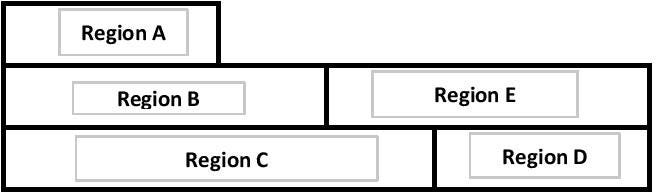
The train starts in Region A with packages to deliver Regions B and C. When the train enters Region B, the state assigned to the region changes from ‘Unmarked’ to ‘Marked’. In Region B, a package is picked up for delivery in Region D. As the train travels through Regions C and D, the state for both these regions changes from ‘Unmarked’ to ‘Marked’. In Region D, a package is picked up for delivery to Region B. When the train re-enters Region B, the rule requires the state to be changed from ‘Marked’ to ‘Unmarked’. In this example, Region B is assigned both ‘Marked’ and ‘Unmarked’ states.
Instead of interpreting this occurrence as the simultaneous presence of contradictory states, Spencer-Brown suggested the system could be interpreted as oscillating between two opposite states in time. Self-reflexive acts of re-entry add a dimension of time to that of space. Over time, both marked and unmarked states can exist in the same space. In the context of AdS boundaries, entry into a boundary, emergence from the boundary and then re-entry into a boundary would be a ‘self-reflexive act’ of re-entry. Re-entry adds a time-like dimension to AdS space.
Francisco Varela, a neuroscientist, extended Spencer Brown’s logic by including re-entry as part of the specification of the initial system i.e. an addition to the fundamental structure which makes a distinction between marked and unmarked states. This addition leads to the dichotomy of marked or unmarked (true or false, black or white) being transformed into a logic where there is no excluded middle between two possibilities. The middle ground is grey. Varela and Humberto Maturana invented the term ‘autopoiesis’ to explain how biological systems self organise. Autopoietic systems function autonomously by remaining functionally closed yet structurally open; they are autonomous systems that have contradictory foundations.
The concept of re-entry can be mathematically described by a fractal equation which is iterated recursively with the value of the equation becoming an input into the same equation. Fractals reside in the complex space between ordinary Euclidean dimensions. For example, a fractal can be used to describe a coastline as a one-dimensional line occupying a two-dimensional place. Similarly a fractal can be used to describe mountains as two-dimensional surfaces draping a three dimensional world. A fractal dimension estimates the rate at which more information becomes available as the size of the measuring device is reduced. A fractal dimension measures the quality of relations between observer and observed. Fractal patterns are self-similar.
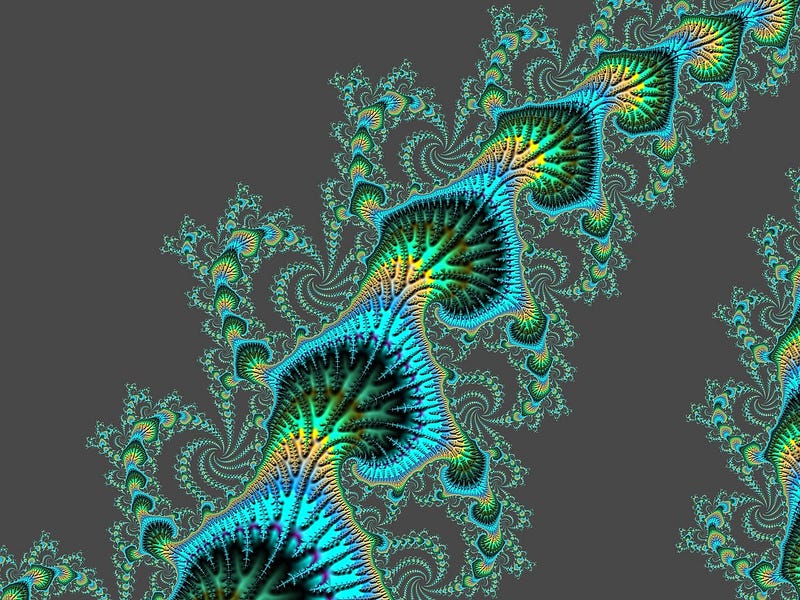
In the context of AdS space, a fractal describes how the content of bulk space is displayed in the boundary. A boundary in AdS space is both holographic and fractal. As content can repeatedly re-enter boundaries, that content will become increasingly complex. The ability for content to become increasingly complex is consistent with the quantum rule ‘What can happen, does happen’ even though a very large number of re-entries may be required before complex structures emerge.
Laws of Form and Klein bottle topology
When applying Spencer-Brown’s Laws of Forms to an AdS space that has the topology of a Klein bottle, a shape changes between being ‘upright’ to ‘upside down’. Once a shape completes a rotation inside a Klein bottle, there would be two shapes; the first shape is ‘upright’ while the second shape is ‘upside down’. After another rotation, the ‘upright’ shape reoccurs. When these shapes are viewed as holograms in a boundary where the time dimension is compressed, the history of identical ‘upright’ shapes could be instantiated in one shape inside a self-similar shape. Mathematically, this process is described as a fractal or a recursive equation where the output of an equation for one point in a sequence becomes an input for the equation describing the next output.
A three dimensional AdS space with a topology of a Klein bottle produces a fourth, time-like, dimension. As discussed in later articles, Professor Carlo Rovelli has developed a cosmological theory called Loop Quantum Gravity (LQG). In his theory, the fabric of space is made out of mathematical substances called spin-foam which, rather like soap bubbles, are joined together in different shapes and sizes thus creating a network. Another feature of LQG is that past information is instantiated in the fabric of space-time. Many of the ideas in LQG seem to be consistent with the fabric of space-time described in these articles.
The five Platonic solids are geometric fractals. Each Platonic solid can fit inside itself, and outside itself, perfectly fitting together. This progression can continue inwards and outwards, theoretically, to infinity. The Platonic solids nest together as a set in many different ways, transitioning between shapes while maintaining self-similarity on all scales.
The fabric of AdS space is made out of shapes and, as a result of many journeys through Klein bottles, the size of the shapes in a boundary in the AdS space gets larger and larger. The size of the shapes could be measured by how many smaller shapes are contained in a larger shape; call this number ‘scale’. Mathematically, scale of shapes at repetition t, xₜ, could be set equal to scale of shapes at repetition (t-1) plus a measure of past growth in scale. Scale which is related to how frequently the same shape reappears must continue to grow because the topology of AdS space e.g. a Klein bottle, produces continuous repetition. One way to set growth in scale over repetitions is to use the same growth as occurred in the past i.e. xₜ-₁ minus xₜ-₃. The repetition differential is between (t-1) and (t-3) because the same shapes repeats after two cycles. This differential is the shortest interval between similar shapes that will produce continuous growth in scale.
Mathematically:
xₜ = xₜ-₁ + (xₜ-₁ — xₜ-₃) is equivalent to:
xₜ = xₜ-₁ +xₜ-₂
This formula describing the growth in scale is the Fibonacci sequence which could be described as a time-like dimension. In other words, a time-like dimension arises in AdS space when the topology of AdS space is similar to a Klein bottle. A four dimensional AdS space includes a boundary where the time-like dimension has been compressed. This boundary displays shapes that are part of a Fibonacci sequence. The boundary displays a hologram of an infinite space where a mathematical singularity arises. The alternation between an ‘upright’ and an ‘upside down’ shape caused by the topology of AdS space provides the basis for content in AdS space-time having quantum-like properties.
As discussed in Article 7 - How could mathematics be the foundation for reality, a Platonic solid and its dual can be represented in AdS space by the same mathematical formula in combination with a (0, 1) bit of information where the value is 0 or 1 depending on which form of the solid is being described. This (0, 1) bit of information is equivalent to Spencer-Brown’s ‘marked’ / ‘unmarked’ distinction.
The ratio of two adjacent numbers in the Fibonacci sequence converges to the Golden Ratio (phi). Each of the Platonic solids contains the Golden Ratio in their construction. The creation of a fourth dimension in AdS space based on the time-like Fibonacci sequence is a natural evolution of an original three dimensional space consisting of Platonic solids.
Ontological interpretation of quantum mechanics
In 2018, Philippe Grangier and Alexia Auffeves published a paper entitled ‘What is quantum in quantum randomness’. As the outcomes of quantum measurements depend on the context of the measurement, instead of asking ‘What value does the variable x have?’ a better question is ‘What is the value of x when measured in context y?’ If a measurement is made in different contexts i.e. based on a different y, there may be different values for x, without any theoretical inconsistency.
Grangier and Auffleves discuss a proposed ontological for quantum mechanics based on contextual objectivity. In their view, quantum randomness is the result of contextuality and quantization. In a world explained by classical physics, epistemic randomness is generally assumed to be the result of lack of complete knowledge about a system. When, as physicists believe, complete knowledge about the quantum world is not possible, there must be a difference between classical and quantum randomness.
Quantum states do not refer directly to the underlying system, but to the system and context as a whole. While systems and contexts exist on their own and are ultimately made of the same stuff, only together do they give rise to states corresponding to repeatable phenomena. The idea that systems alone have states is based on a classical view of the world.
Grangier/Auffeves argue:
… in a contextual world, quantizing the amount of exclusive modalities of a system gives rise to some intrinsic unpredictability signalling ontological randomness. … while epistemic randomness is caused by the ignorance of some hidden state, the cause of ontological randomness can be caught by the following simple sentence: There are less available answers than possible questions. More precisely, the number of possible answers to all possible questions is larger than the number of allowed mutually exclusive answers for the considered system. As a consequence, some of the answers are not mutually exclusive, and thus must be related in a probabilistic way — this probability reflecting by no means a lack of information. (p4)
To give an idea what ontological randomness might mean in a human environment, consider the following experiment.
- You are shown this image (the system).
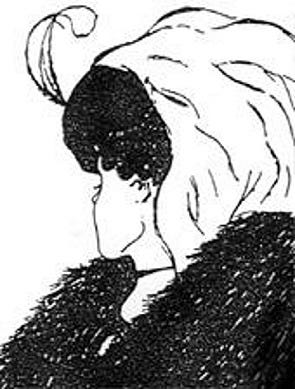
Note: you might see one or more of the following in the image before being told that it is an image.
Some of the possible descriptions (contexts) of this system are:
- random distribution of lines, dots and spaces;
- sketch of an old woman; and
- sketch of a young girl.
2. Choose one context to describe the image. Keep this choice to yourself.
3. When asked a question about the system, you can answer Yes or No (two exclusive modalities). In other words, you have two possible answers to each question.
4. All of your answers need to be consistent but you do not necessarily have to keep the same context. For example, it is possible that the first question might lead you to see a different context. Initially your context may be random marks on a page. When the first question is “Can you see a picture of a young girl”, you may find you can see the young girl. When your answer is ‘Yes’, you no longer see the context as random marks. Such a question changes your perceived context of the system. You cannot simultaneously see the image as random marks and a young girl.
5. Answer all subsequent questions in a manner that maintains consistency with your previous answers i.e. provide Yes/No responses that do not conflict with previous Yes/No responses.
Before the start of the experiment, an administrator does not know what context will be perceived. Theoretically, the number of possible answers to possible questions is greater than the allowed mutually exclusive answers when answers have to be consistent. At the start of the experiment, the context eventually selected is considered to be an ontologically random outcome when a player in the experiment has free will to choose their own context.
The point made by Grangier/Auffeves is that quantum randomness can occur without the cause of the randomness being lack of information. The randomness in quantum mechanics is intrinsic. Professor John Wheeler, a contemporary of Einstein and Bohr, discussed a game that he thought provided insights into how quantum mechanics worked. The game has been called ‘Surprise 20 Questions’. One person always asks the questions; different people take turns in providing answers. Answers that are either Yes or No must also be consistent with previous answers. The questioner’s goal is to guess the object that the person answering the last question has in their mind.
As each respondent can think of their own object without knowing what object the previous respondents had thought of, no one at the start of the game knows what the ultimate object will be. Analogously, before a physicist chooses how to observe an electron, the electron is neither a wave nor a particle. Only after asking a question, can the electron be observed with the chosen answer for the question leading to subsequent possible questions being excluded.
Ontological randomness in AdS space
Combining ontological randomness and Spencer-Brown’s Laws of Form in the context of AdS black holes, the shape of a Platonic solid could be the original solid or its dual depending on how many times that solid has gone through boundaries. In terms of Wheeler’s Surprise 20 Questions, only two answers are possible to questions, namely 0 or 1, but which answer is given could depend on previous questions about how many times a solid has gone through a boundary. As hypothesised by Varela, continuous re-entry leads to a logic where both 0 and 1 are possible as well as values between 0 and 1. As there are more possible questions than answers, the content of AdS space consists of quantum-like bits of information.
The value of the (0, 1) information bit is linked to a Platonic solid’s history. This is history in the sense that there is a ‘before’ and ‘after’ but not an arrow of time. The idea of information bits being associated with history has an important role in testing the ideas discussed in these articles, particular the force of gravity.
The existence of quantum-like bits of information in AdS space is part of the explanation for how new phenomena arise inside a boundary. The second part of the explanation, the Efimov effect, will be discussed in the next article.
The question for this article is:
Can the emergence of quantum phenomena be logically explained through mathematics?
A copy of the book ‘Orbiting Stars’ by Michael Dalton contains the first drafts of all these articles, please visit https://www.amazon.com
To view the headings of all the articles to be published in this series please click on https://readmedium.com/orbiting-stars-and-origin-of-our-universe-338906930f51


