What are the fundamentals of statistics?
Fundamentals of statistics
Hi, if you are started to learn data science? then this article is for you I have already shared my experience of what I Learned in Statistics to kickstart my Data Science career, this is the continuation of the “Learn Statistics for data science” if you haven’t read I would suggest you go for it to have clear knowledge about statistics😃.
Let us see the fundamental of statistics…Variable:
- A variable can take many values like Age is a variable. Remember a variable contains a value.
- for example Gender — male. So we know Gender is a variable that holds the value “male”.
- Variable can be either independent variable or dependent variable an independent variable that can be ‘manipulated or handled’ whereas the measured or limited variables are dependent
Quantitative Variables are measured numerically, In this kind of variable, we can perform addition, subtraction, multiplication, and also division.
Example: Grade, song length.
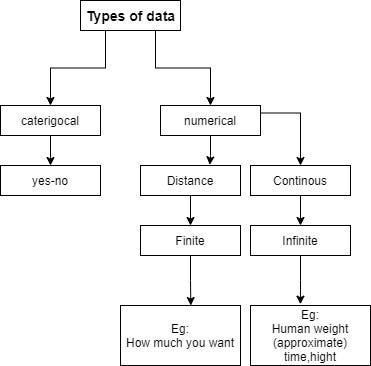
- The quantitative variable can be categorized into Discrete variables and Continuous Variables.
- Discrete variables are finite like rolling a dice.
- Continuous Variables are infinite like temperature or celsius.
Discrete and continuous variables are similar to types of probability distributions. you can refer to this for more ideas 👇
Qualitative Variable also named as Categorical variable where the classification is based on character. Unfortunately, we cannot do addition, subtraction, multiplication, and also division. yes, It is the opposite of the quantitative variable.
Example: pieces of information like gender, marital status.
Levels of Measurement:
They have four data types
- Nominal
- Ordinal
- Interval
- Ratio
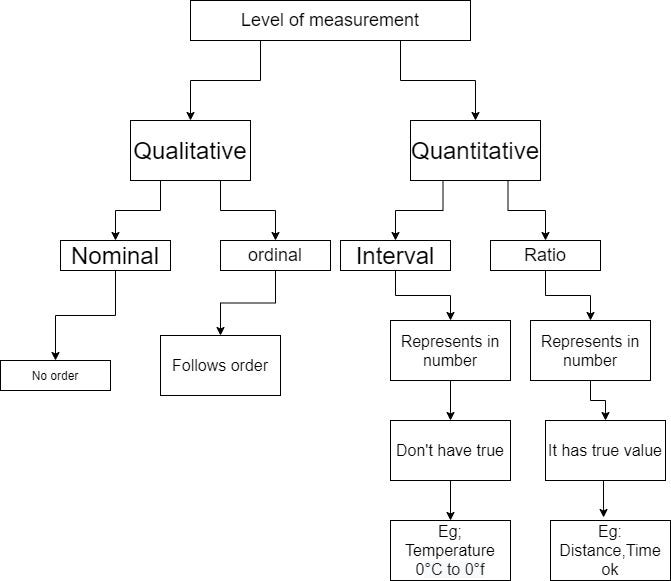
Nominal
A nominal is a qualitative variable that split data into categories. Nominal refers to labels or categories which cannot arrange them like ascending to descending or small to large.
example:- colour — red, blue, yellow, green.
Ordinal
In ordinal data, the data ordering is much important but distance cannot be considered. Ordinal types of data can be ordered into categories, unfortunately, the data value cannot be determined
Example: financial status.
Interval
Ordering of data is considered and distance is equal but no zero is present. eg:- Fahrenheit, shift-based works.
Ratio
Ordering of data is considered also the distance is equal and zero are present.
For example, if you are dead, your platelet count will be zero, so turning off the vehicle speed will become zero.
I have shared something that I learned we will see more in our upcoming articles So, go ahead and start learning more and become a data scientist in future🤠
The way to get started is to quit talking and begin doing — Issac Newton
Thank You :)