
What are Greedy Algorithms Explained For Beginners (+ Example)
The Algorithm Ate My Cookies: A Playful Guide to Greedy Algorithms for Beginners

Ever wondered how your GPS finds the quickest route or how your favorite online shopping site sorts through a bazillion products to recommend the perfect item? Well, let’s dive into the world of greedy algorithms, the unsung heroes behind these everyday marvels. Greedy algorithms, a staple in computer science, solve problems by making the best possible choice at each step. It’s like choosing the juiciest apple from the basket, one at a time, until you’re out of apples!
In this article, we’ll unravel the mysteries of what greedy algorithms are, how they work, and where they’re used.
TLDR; Don’t have time to read? Here’s a video to help you understand what is a greedy algorithm with example in detail.
What are Greedy Algorithms? A Bite-Sized Breakdown
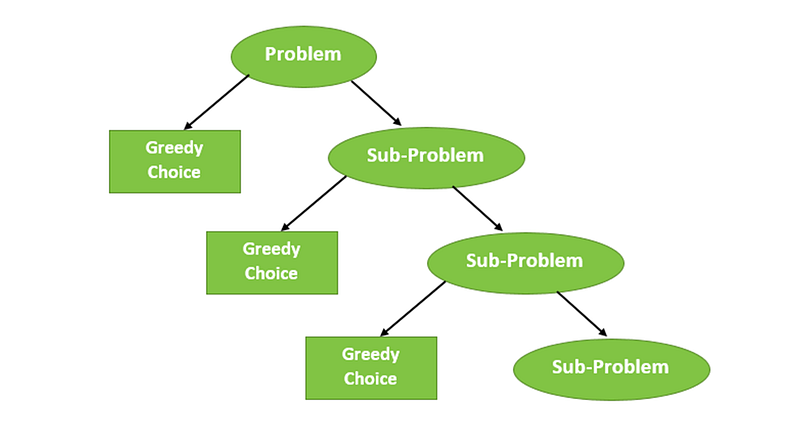
In a nutshell, greedy algorithms are like impatient problem-solvers. They tackle issues by making what seems like the best choice in the present moment, without agonizing over potential future consequences.
In plain English, a greedy algorithm is a problem-solver that makes choices based on immediate “wins.”
It doesn’t look ahead, doesn’t strategize, just zeroes in on the seemingly best option at every step. Hoping that by chasing these individual victories, it’ll stumble upon the overall jackpot.
Think of it like climbing a mountain. A greedy algorithm wouldn’t map out the most efficient path, considering wind chill and energy expenditure. It would simply scale the steepest slope at every turn, assuming that reaching the next peak quickly is the same as reaching the summit.
A few key features of greedy algorithms include,
- Simplicity: They’re easy to understand and implement, even for algorithm newbies. Unlike their complex, long-winded cousins, greedy algorithms follow a straightforward “grab the good stuff now” strategy.
- Speed: They often find “good enough” solutions quickly, making them ideal for problems where fast answers are more important than perfect ones. Imagine needing to make change for a customer — you’re not going to calculate the most mathematically elegant combination of coins, you’ll just grab the biggest denominations first to get the job done.
- Effectiveness: Sometimes, surprisingly, the greedy approach does lead to the optimal solution! Like finding the shortest path between two points on a grid, where choosing the closest neighbor at each step actually gets you there in the fewest moves.
A Basic Example
Meet Byte, our friendly cookie-loving robot. Byte is programmed with a simple greedy algorithm: at each step, he grabs the biggest cookie he can find.
Let’s see how this plays out in our first scenario:
Scenario 1: The Single Cookie Jar
Byte stumbles upon a jar filled with three cookies: a gigantic chocolate chip, a medium-sized oatmeal raisin, and a tiny peanut butter gem.
Guess which one Byte devours first? You guessed it — the colossal chocolate chip! After all, bigger is better, right?
Now, Byte faces a dilemma. The oatmeal raisin is still tempting, but the peanut butter cookie is practically a crumb. Following his greedy rule, Byte happily munches on the oatmeal raisin, leaving the peanut butter morsel for later.
But wait! What if Byte had chosen a different strategy? Maybe he could have started with the smaller cookies, saving the biggest for last. In this case, he’d have enjoyed all three cookies! This scenario reveals the key limitation of greedy algorithms: they often get tunnel vision, focusing on immediate gains without considering the bigger picture.
Scenario 2: The Cookie Buffet
Byte finds himself in a cookie-lover’s paradise — a grand buffet with rows upon rows of delectable treats. But there’s a catch: each cookie has a different “cool-down” time, meaning Byte has to wait a certain amount of time before grabbing another one.
Here’s how Byte’s greedy algorithm might play out:
- He first grabs the biggest, most tempting cookie with the shortest cool-down time, eager to maximize instant gratification.
- While waiting for the cool-down, he scans the buffet for the next best option, considering both size and cool-down duration.
- He continues this pattern, devouring the most appealing cookies while strategically managing the wait times.
By prioritizing cookies with short cool-downs, Byte enjoys quick wins but might miss out on larger, slower-cooling delicacies. This scenario reflects real-world situations where short-term decisions can have long-term consequences.
Also, Byte needs to manage his cool-down time, juggling his desire for more cookies with the need to wait for previous picks. This applies to situations like scheduling tasks with variable execution times or managing resources under constraints.

Scenario 3: The Cookie Conveyor Belt
Byte faces a new challenge — a conveyor belt delivering a continuous stream of cookies. Each cookie has a different “value” and a different “speed,” representing how quickly it moves along the belt.
Byte’s greedy algorithm might approach this scenario as follows:
- He focuses on cookies with high value and relatively slow speeds, ensuring he can snatch them before they disappear.
- He might ignore less valuable cookies, even if they’re moving slowly, prioritizing those that offer the most reward.
- He continuously adjusts his strategy based on the value and speed of incoming cookies, aiming to collect the highest-value treats within his reach.
While high-value cookies are tempting, slow-moving ones might be easier to grab, requiring Byte to prioritize based on both factors. This applies to situations where both the reward and the effort or time needed to obtain it must be considered.
Scenario 4: The Cookie Maze
Byte enters a perplexing cookie maze, where each junction offers a cookie reward and different paths lead to different cookie stashes.
Here’s how his greedy algorithm might tackle this challenge:
- At each junction, he chooses the path leading to the biggest cookie reward, even if it’s not the shortest path overall.
- This leads him to collect some impressive cookies along the way, but it might not always guide him to the most efficient route through the maze.
- He might miss out on hidden cookie treasures or end up taking longer routes than necessary, highlighting the potential downsides of his greedy approach.
In this scenario, Byte’s focus on immediate rewards might lead him down longer paths or miss hidden treasures, demonstrating how greedy algorithms can overlook alternative options that might be more beneficial in the long run.
Additionally, this scenario introduces the idea of exploration vs. exploitation. As Byte could explore different paths to find hidden cookies, sacrificing immediate gains for potential future rewards. This reflects real-world situations where balance between exploring new options and exploiting currently known solutions is crucial.
Overall, these scenarios paint a nuanced picture of greedy algorithms. While they offer efficient and straightforward solutions, they also have limitations, particularly in complex scenarios with dynamic elements or long-term considerations. Understanding these strengths and weaknesses allows us to choose the right tool for the job and apply greedy algorithms effectively in various situations.
By analyzing Byte’s cookie-chomping adventures, we gain valuable insights into the world of optimization.

Greedy Algorithms in Action: Beyond Cookies!
Here are a few real-world problems which use greedy algorithms for their functioning.
- Activity selection: Imagine planning your weekend. You have a list of movies, concerts, and hikes, all happening at different times. A greedy algorithm might pick the activity with the earliest start time, then the next, and so on, hoping to maximize your fun.
- Knapsack problem: You’re a treasure hunter with a limited-capacity backpack. Greedy algorithms can help you choose the most valuable items to fill your bag, ensuring you get the biggest bang for your buck (or doubloon, in this case).
- Huffman coding: This algorithm is used to compress data, like images or text files. It works by analyzing the frequency of different characters and assigning shorter codes to the most frequent ones. By prioritizing the most common characters, greedy algorithms can significantly reduce file size.
Greedy or Not-So-Greedy? When to Use (and Avoid) This Approach
Greedy algorithms are like enthusiastic friends — always eager to find the quickest, most satisfying solution. But just like overzealous pals, they can sometimes lead you astray. Here are some things to consider before using a greedy algorithm:
Pros:
- Simple and efficient: Greedy algorithms are easy to understand and implement, making them a good choice for beginners.
- Fast solutions: They often produce quick results, especially for smaller problems.
- Guaranteed optimal solutions in some cases: For certain problems, greedy algorithms can guarantee finding the absolute best solution.
Cons:
- Not always optimal: As we saw with Byte’s cookie jar, greedy algorithms can sometimes lead to suboptimal solutions, especially for complex problems.
- Sensitive to input order: The order in which you present options to a greedy algorithm can affect its output.
- No guarantee of optimality: Unless you can prove it mathematically, there’s no guarantee that a greedy algorithm will always find the best solution.
- Local vs. global: Their shortsightedness can lead them astray if the “best” local choice doesn’t translate to the best overall solution. Imagine taking the quickest detours in your maze, only to end up further away from your destination.
- Dependence on the problem: Greedy algorithms work best for specific types of problems with well-defined “greediness” criteria. They’re not the swiss army knife of optimization, but rather specialized tools for specific tasks.
But wait, not all problems bow to the allure of immediate gain. Just like that tempting, ultimately poisonous mushroom in the forest, some situations expose the limitations of greedy algorithms. Some examples include:
- The Knapsack Problem: Imagine packing a knapsack for a hike, limited in weight but eager to bring the most valuable loot. A greedy algorithm might grab the heaviest, most valuable items first, only to discover at the trailhead that it can’t fit the tent — a classic greedy trap!
- Scheduling Jobs: Assigning tasks to workers with a greedy approach — always giving the “best job” to the most qualified person — can leave other workers idle and the overall project behind schedule.
- The Coin Change Conundrum: Remember that change-making example? While it works for small amounts, a greedy algorithm might struggle with larger sums, potentially missing optimal combinations that involve smaller denominations.
So, are Greedy Algorithms Worth It?
The answer, like everything in life, is a delicious “it depends.”
Greedy algorithms are powerful tools, but they’re not Swiss Army knives — they work best for specific situations. Here’s a cheat sheet to help you decide:
Reach for the Greedy Spoon When:
- You need a fast and simple solution, even if it’s not perfect.
- The problem exhibits the “greedy property”, where making locally optimal choices at each step guarantees the overall optimal solution (think shortest path on a grid).
FAQs or Frequently Asked Questions
Still hungry for knowledge? Let’s tackle some common questions about greedy algorithms:
Q: Are greedy algorithms always the best choice?
Not always! They’re efficient and fast, but they can be shortsighted. Analyze the problem and see if dependencies or local optima might be lurking before diving into the greedy feast.
Q: Can you give me an example of a real-world greedy algorithm?
Finding the minimum number of coins to make change! The algorithm picks the highest denomination coin first, then the next highest, and so on, until the desired amount is reached.
Q: Are there ways to make greedy algorithms smarter?
Absolutely! Combining greedy strategies with other techniques like backtracking or branch-and-bound can help them avoid the pitfalls of greed and find truly optimal solutions.
Q: What are some alternatives to greedy algorithms?
Dynamic programming, branch-and-bound, and genetic algorithms are just a few. They take different approaches, like considering all possible paths or simulating evolution, to find the optimal solution.

Conclusion
So, what are greedy algorithms? Well, Greedy algorithms, in essence, are the quick-thinking strategists of the algorithmic world. They’re incredibly useful in a variety of settings, yet they’re not without their flaws. Their approach offers a valuable lesson in both computing and life: sometimes, what seems like the best choice now may not be the best in the long run, and vice versa.
As we continue to delve into the depths of computer science, these algorithms remind us of the ongoing need for balance between immediate gains and long-term planning. Keep exploring, and you might just find the perfect situation where a greedy algorithm is exactly what you need!
You may also like,


