What about …. Whataboutism! Part 2
The Power of Comparison and the Chain of Fallacy

Intentions
David Hume in his famous passage on the rising of the Sun illustrated the difference between logic and rationalism, induction and deduction. The Sun has risen billions of times, that is both factual and undeniable. Nevertheless, there is nothing in the billions of preceding instances that makes it a logical inevitability that the Sun shall rise a subsequent time. Induction can only give us patterns or rules of thumb, albeit that some are all but immutable. For instance, in the case of the Sun, we have a rule of thumb that we can all happily live by for many millions of years. In fact, it is far far far more likely that the human species will perish before the Sun draws its last mighty breaths.
Yet, the statement — A has happened a million times in succession, therefore A will happen a million and first time — is illogical because there is nothing in the original premise that makes the conclusion inevitably true. It is not like the syllogism — All people die. Joan of Arc was a person. Therefore, Joan of Arc died. The conclusion is true because it is impossible for it not to be true. In the case of the Sun we do not have logical inescapability. It is at least conceivable that the Sun may not rise for some mad and infinitesimally improbable reason. Logic and reasonable probability are not the same thing — they are not coterminous even if they often overlap (to presume they are is a fallacy called the appeal to probability).
There is no way to deduce the intentions of any other human being with perfect infallibility. One cannot know with sure fire accuracy what lies behind the acts and words of another. But we do have some things to go on. We do have reasonable probability and a number of rules of thumb. Thus, it is often reasonable, sometimes extremely reasonable, to presume neither malice nor mendacity.
These rules of thumb are, in no particular order and certainly not exhaustive — emotional closeness, shared genetics, consistency of character, historical experience, general social decency, and societal norms and values.
A few illustrations of these in action are called for:
The First — Myself and my father disagreed on the war in Ukraine about a week into it. The war should be condemned in the strongest possible terms and there are many things that are happening in the country at present that are beyond horrifying. Concurrently, disinformation is rampant, the demonisation of Russia is like nothing we’ve seen for a very long time (I attach Caitlin Johnstone’s revealing investigation of Western journalistic practices), and certain extremely unsavoury elements do exist on the Ukrainian side, with the question being not if they are there or not but rather what influence they exert on government. All the while, from afar and on high, the world’s most powerful state does everything it can to punish the criminal instead of doing everything possible to stop the crime and save the victim (the US eschews any negotiated resolution to the war: Senator Tom Manchin speaking at the World Economic Forum Annual Meeting of 2022 just a few days ago, 16.30–1700).
I hold the position that we should condemn the war in no uncertain terms but also not lose sight of the fact that a long chain of events that could have been prevented has led us here. Indeed, these events continue to be daily occurrences. From my perspective, the lion’s share of the blame for how we got here should go to the Atlanticist powers. Almost all of the blame for the war itself should go to Russia.
I understood that my father was being bombarded by a mainstream that had decided there was only one way to see things, and any addenda or contextualisation constituted a crime against truth and morality. All was black and white with little or no backstory of any relevance to speak of, and to speak of anything other than this narrative was to be a stooge or a patsy or worse. How could a person not succumb to such a deluge, at least partially? My reading of it was nuanced and nuance was not what was called for. In fact, the will to understand compromised the purity and potency of the condemnation. And, I am certain, my father couldn’t help but think I had been exposed to some strange materials and that these were the sources of my views.
However, at no point did we, either of us, suspect the other of something sinister or untoward. We merely believed that the other was ill-informed or unread on this particular topic. Why? Genetics, emotional closeness and consistency of character. All of these have given us a very sturdy base in terms of essential goodness and trustability, which isn’t a word but how and ever. We may disagree on this or that but we do not doubt the essential honesty and integrity of the other.
The Second — I lose phones more often that I should. My wife loves me, trusts me (in other capacities than those relating to phones), and knows me very well. She is also well aware that I have the capacity to lose a mobile or two on occasion. A consistent inconsistency of character has provided her with this perception and she is quite right in holding it for the reason that it has happened enough times to make it reasonable to expect it to happen again.
The Third — I have a good mate who has some right-wing or rightish views. He doubtless would take issue with my classification of his views but that’s how I see it. We agree on some things and disagree on others. Having known and observed him for many years I am very assured in believing that there is neither maliciousness nor disingenuousness behind what he says. He has no specific agenda or will to protect one party over another or muddy the waters. For him, if it makes sense, he can criticise anyone, and the positions he takes are perfectly open to criticism. Emotional closeness and consistency of character have given me this high degree of belief in his person.
The Last — History does not bequeath her bounties and burdens with an egalitarian hand. An example of this is Russia itself. A plenitude of wars, invasions, attempted invasions and turbulent periods coupled with seemingly boundless borders have made Russians wary of strangers. There is even a word for the other in Russian with negative connotations чужой (chuzhoy). A stranger is more like a potential enemy than a potential friend. This is very sad of course but has been born of repetition and historical experience which humans use to induce certain general truths about the world in which they live. And so it has become a rule of thumb for Russians to not trust the motives and intentions of strangers until proven otherwise.
Whilst clearly not a great sign for the internal cohesion and well-being of society, this pre-emptory lack of trust may be rather quite useful for ensuring your very survival if you are to suffer a great many assaults on your nation.
The Thin Crust of Trustworthiness

Emotional closeness, genetics, consistency of character, historical experience, social decency and societal mores all help to foster trust between people. Varying combinations of these allow us to know that a person’s words and acts will be administered with good intentions, or, at the very least, with non-malicious motives behind them.
As we have established in Part 1, the public sphere, where emotional distance between actors, opaque intentions, and controversial subject matter are all omnipresent, is the natural habitat of whataboutism. So, do any of the above factors for creating trust offer us guidance as to when we are justified in claiming whataboutism and when we are not?
Emotional closeness? Not really. With a friend on Facebook, Twitter or Instagram, sure, it can exist. You may know them beforehand or get to know them online, but either way, I would argue that your interactions are not really public. Why? Often times, you will be chatting in restricted social circles, private groups with limited access — these are not public spaces. Secondly, your interactions, wherever they may take place, will be shaped by a degree of intimacy and closeness which diverges sharply from a typical public interaction between strangers.
Genetics? No. Same as the above but to an even greater degree.
Consistency of character? Sometimes, for sure. You can learn something about a person based on how they communicate: what they say, don’t say, and how they say it over time. You can see a by-line in a paper and know enough about the writer to believe that ulterior motives and deceitfulness are unlikely. The same goes for a public page or forum online. The same goes for writers on Medium. However, very often you don’t have the luxury of seeing what a person says more than once, be they professional writers or people commenting online, hence, consistency of character can only serve as an occasional guide.
As for historical experience, social decency and societal norms and mores, these all heavily shape how one perceives people they don’t know — their words and deeds, the net core goodness of the common person or lack thereof, whether it’s safe to buy this or that, whether it’s safe to say this or that, whether laws will be applied as they are written and whether society will generally work the way it is supposed to.
This interpersonal trust is crucial for how well a society functions. Crucially, though, we are not talking here about a trust that is particularly deep, rather, we are talking about some type of shallow but society-wide seal of approval that says you can trust what’s in the tin.
Even in Scandinavia where social trust is uncommonly high, we are not talking about the sort of emotional bedrock that would prompt a person to open their door to a complete stranger, let them stay in their house and use their things. For deep trust, trust that someone will be there for you through thick and thin, protect you, support you, care for you, love you, you need things like emotional closeness, shared genetics and consistency of character.
Hence, for the public arena, online and offline, we are speaking solely of a thin crust of credulity that mediates how we experience society. The question often asked in polls is ‘can most people be trusted?’. In Scandinavia the answer is mostly yes, whereas in many other parts of the world the answer is 50.50 or more no than yes.
Not having much to go on apart from values, norms, a sense of decency and some other seemingly vague bits and pieces, it may appear that claiming whataboutism as you see fit is both reasonable and justified. After all, those qualities that engender deep trust are not possible in the public sphere. For instance, with a writer on Medium like myself what do you have to go on? A few articles and some crappy picture. And what about (whataboutism!) the billions commenting in every nook and cranny of the internet that you will see but for a few fleeting seconds of your life? All you got is a little white screen, bags of distance and the tiniest bit of surface tension to keep you skating along believing in the human race.
Nonetheless, the thin crust of essential human decency is more solid than may first appear. And the claim of whataboutism is itself fraught with peril. I will explain why in the next section.
Why you shouldn’t claim Whataboutism
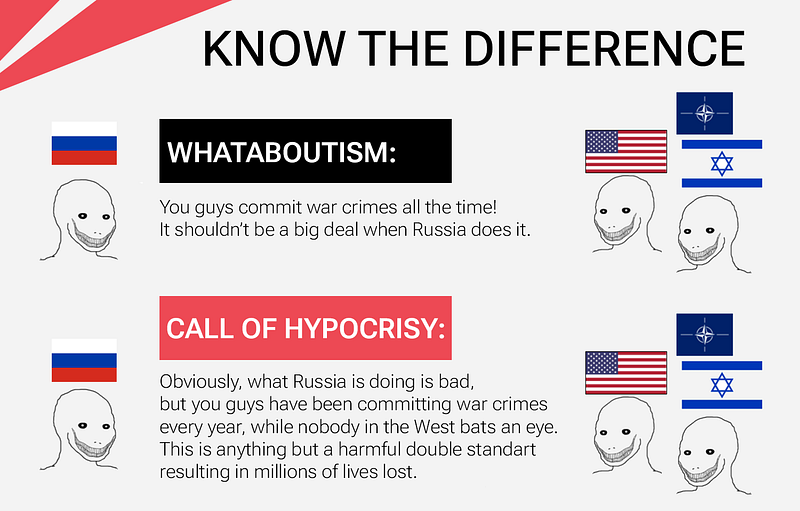
There are two central and interconnected reasons why you should only charge someone with whataboutism in select situations and should refrain in all others. The first is all about proportionality — with strong claims requiring strong evidence, the amount of trust being asked of you small, the likelihood of genuine malice low, but the dangers of wildly claiming whataboutism being quite great. The second relates specifically to these dangers, how whataboutery functions much like the fallacy it purports to address, and the fundamental importance of that which it destroys.
First to the first. The Sagan Standard states that extraordinary claims require extraordinary evidence. Whataboutism is not an extraordinary claim to make but it is a strong charge to level at someone. Why? Because of the damage it does to free thought and dialogue, its power to discredit, and the powerful implications it would have were it to become the norm. The very fact that we don’t have much information about most people in most cases, most especially online but also generally with regard to public life, means that a powerful tool for discrediting the voices of others should only be used where some powerful piece of evidence exists. Whataboutism is bringing a gun to a knife fight in the far larger part of cases.
Moreover, the thin crust of essential human goodness is supported by the axiom that there are more net good people than net bad. Humans are groups animals, meaning that we follow norms and rules far more than we don’t. This is true of all societies. There is no society I know of that inculcates the virtues of lying and manipulation as a rule over being honest and trustworthy. The former exist everywhere but are always aberrant. Society would not survive were the larger part of its populace to set out as a rule to deceive and misdirect.
Public discourse is galvanised in western societies by a fairly well-ingrained belief in freedom of expression, with a plurality of views being not only tolerated but even seen as a sign of vitality and health. The majority of folks just want to have their say, which isn’t always pretty or palatable, but they don’t set out with a will to deceive and distract.
Hanlon’s razor further strengthens the essential non-maliciousness of humanity. It states that one should never attribute to malice that which may reasonably be explained by stupidity. I don’t believe that most people are stupid all things being equal. But I do believe that everyone is capable of their fair share of silly moments. If you see something that seems to unduly depart from the matter being discussed, it is far more likely that the culprit is a lack of context or clarity, or an innocent misunderstanding, or honest disagreement about what should and shouldn’t be included. Or, quite possibly, some momentary lapse of reason on your own part. These are far more plentiful and common than something truly minacious.
This patina of essential human goodness is sustained by a healthy sense of proportion. If you’re going to discredit someone’s contribution, you best have some evidence for it — claims require evidence. Honesty and decency are also more abundant than their antonyms. Furthermore, and thankfully, malice is in shorter supply than stupidity. You are not being asked to trust someone with your life. You are being asked to trust that honesty is more plentiful than mendacity. You are being asked to suspect stupidity before malice. And lastly, you are being asked to have evidence commensurate to your claims.
If you have strong feelings and some evidence that all is not well, call whataboutism, call that person on their bullshit. And really you should go beyond that and truly excoriate them for their bad faith and bad behaviour to let others know of what’s going on. However, be aware that coming to the table with the mindset of sniffing people out, is a dangerous and counterproductive thing to do in the majority of cases.
And that is the second reason why you should avail yourself of whataboutism only sparingly — the danger of the charge and the fallacy of this particular fallacy.
In Part 1 of this article I outlined just how fundamentally important the comparison is to all human thought. Scientific experiment, induction, legal precedent, comparative analysis, knowledge of self, morality, and really the entire fabric of thought — all require the weighing up of one thing with another: The only means of measuring existence is existence itself. Hence, the the greater the acceptance and normalisation of whataboutism, the greater the destruction done to thought, analysis, dialogue and conversation.
Furthermore, there is a peculiar self-realising component to the whataboutism fallacy. Purporting to shut down commentary given with the specific intention of distracting, deflecting accusation, diluting the matter at hand and muddying the waters, whataboutism itself distracts, deflects accusation, dilutes conversation and muddies the waters in a very similar fashion. Thus, the charge functions much like the supposed crime— a bit like fighting fire with fire.
An example or two is in order:
A: Trump’s immigration policies are draconian.
B: What about Obama, did he not deport 3 million during his presidencies?
A: Whataboutism!
B has not dealt with the original statement: they have not commented directly on whether Trump’s policies are draconian or not. I can answer for him or her and say that they definitely are and were. However, in lieu of commenting on this as well as referring B back to the original statement, A has called whataboutism. We do not know enough about their intentions to say what they’re trying to achieve here — widen the net beyond Trump to American presidents and immigration (which is completely legitimate if done in good faith), distract, absolve Trump of criticism, or simply converse without any great malice or depth of thought — but both B’s supposed whataboutism and A’s claim of whataboutism do much the same thing. They sidestep comment and criticism.
The claim of whataboutism is concatenative, meaning it works like a chain, simply adding another link to the original fallacy, and is for this reason very much like fighting fire with fire. If you have good reasons to suspect someone’s motives, then you are justified in shutting things down in this less-than-subtle-two-wrongs-make-a-right manner. Otherwise, to break the chain you must address what is being said by the supposed whataboutist whilst also referring them back to the original comment or topic.
A second example, from Medium this time:
Corinna Nita has written an article on Medium about US invasions, their consequences and denials, in light of what is happening in Ukraine.
Comparing Russia’s present war and the US’s forever wars makes a lot of sense for 4 reasons. 1. These wars are recent, ongoing and waged by competing powers (one global, one regional). 2. There is a high degree of causation and correlation with regard to American foreign policy and these conflicts — Russia’s war in Ukraine has been made more likely as a result of US policy; this is undeniable for anyone who cares about history (I feel I need to clarify the ‘more likely’ element — Russia is responsible for this war. The US has made it more likely to happen and harder to stop.) 3. There are huge issues of moral consistency for anyone who cares about moral consistency. 4. The slim chance of détente between Russia and the US and the much more likely continued deterioration of relations have huge implications for us all — understanding their relationship is of the utmost importance.
Getting back to Corinna’s article, one of the people responding makes a claim of whataboutism and I quote verbatim, ‘what aboutism doesn’t excuse Putin’s bloody war. We need to oppose evil acts whoever performs them’. Corinna responds with, ‘that’s my point.’
Notice how the person responding doesn’t deal with the content of Corinna’s article. They make the claim in lieu of engaging with what she has said. I do not know enough about the responder to suspect them of foul play and I would give them the benefit of the doubt for the reasons outlined above, but I can say that if Corinna’s article fails to directly address what’s happening in Ukraine, similarly does their comment fail to address anything Corinna has said.
The claim of whataboutism serves to deflect criticism and destabilise dialogue in the same way as the supposed crime of whataboutism
If there is reason to suggest that Corinna’s opinions were given in bad faith (which there aren’t) with the specific intention of deflecting criticism from Russia and its war, then we can call whataboutism. Otherwise, such a claim is firstly illegitimate because of an absence of evidence, and secondly dangerous because of the damage it does to thought and dialogue and the clear appropriateness of what is being compared and analysed.
And if you don’t agree with me on the appropriateness of these comparisons, that’s fine, but you are still not justified in calling whataboutism without strong evidence. To do so simply adds links to the chain of any perceived fallacy and does damage to thought and discourse.
When you should claim Whataboutism

First you need the public sphere, as discussed. Then you need some potentially controversial or debatable subject matter, as discussed. And then it’s a bit like murder — all about the intent behind the act.
Politicians are the prime example of where whataboutism can be very justifiably levelled. This is for three reasons. The first is that we tend to know a lot about them, how they hold themselves, what they will and won’t stoop to — essentially the consistency of their character.
Secondly, politicians may style themselves as servants of society as a whole, but they have their own fealties and allegiances: which is to their party or a particular demographic. The more trustworthy and credible a politician can be considered, the more they will have certain lines they will not cross, certain values they will not sacrifice. Regardless, they are all spinners of webs.
Thirdly, they live by an instrumentalist truth: which is to get into power by whatever means will not destroy their reputations in the long run. A little legerdemain, a large dollop of distraction — all items no cook can cook without.
For the above reasons, I would trust a hyena more than Bill or Hillary. I would trust in a centipede more than Donald Trump. These animals consistently do what they do and do it consistently. Whereas some members of the political species lie, renege and backtrack in the same way a fly flies.
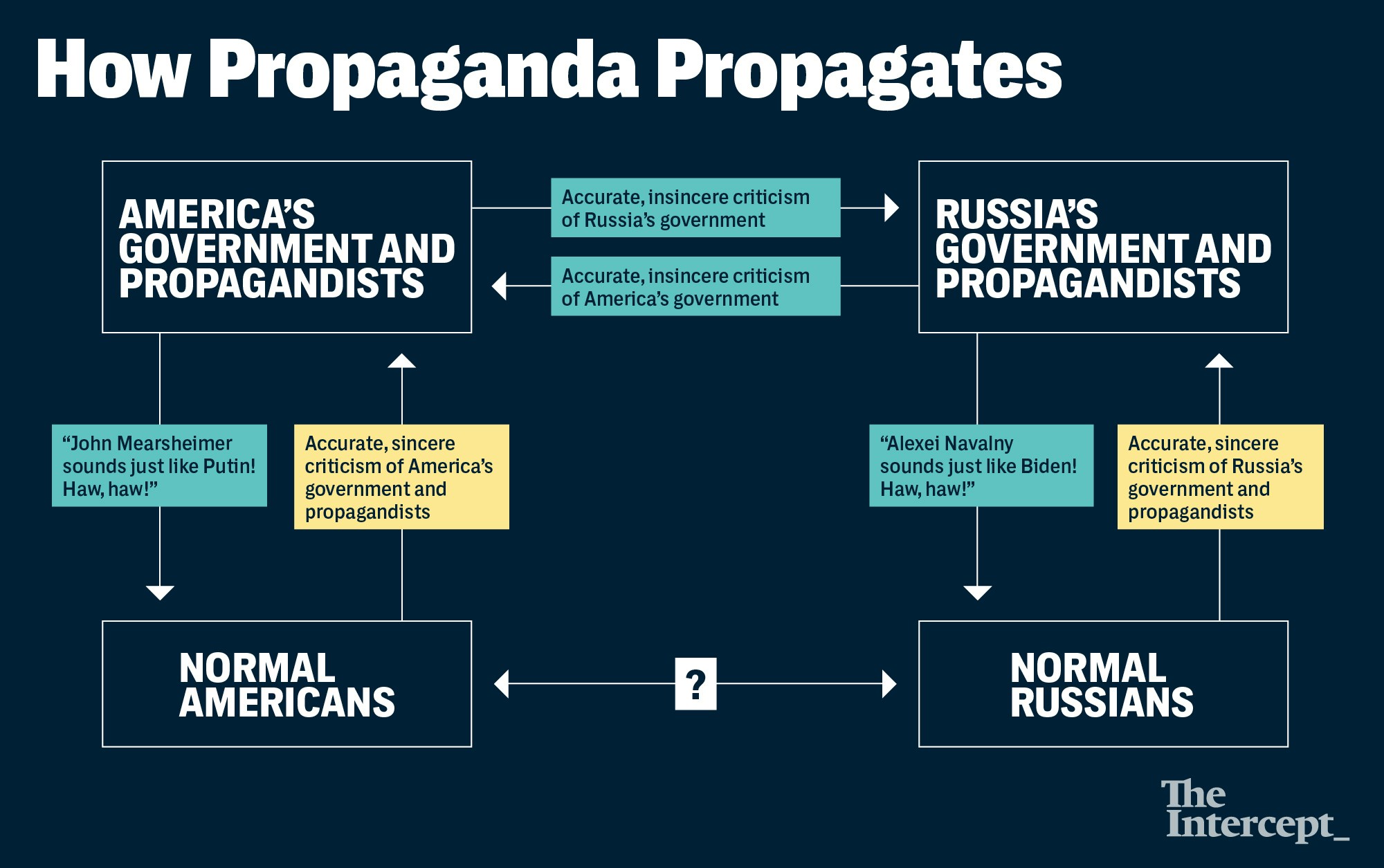
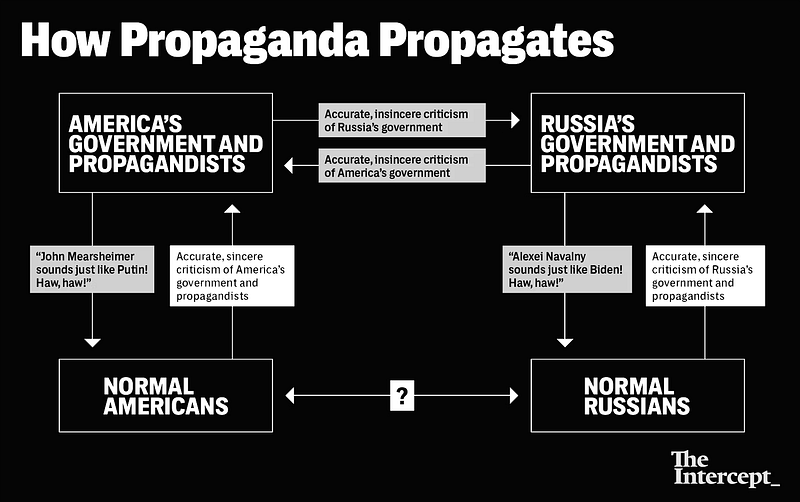
An especially germane illustration of how important the person or actor behind an opinion is to how we perceive that opinion was dissected recently in Jon Schwartz’s perspicuous article in the Intercept.
The main actors are John Mearsheimer, Anne Applebaum, and the Russian and American Governments.
John Mearsheimer is one of the world’s leading political realists with numerous books, articles and videos discussing US foreign policy, Russia, and liberal hegemony. Anne Applebaum is a neoconservative journalist who writes extensively on Russia and Eastern Europe. And I presume you are familiar with the governments of the U.S and Russia.
In an article of 2014, ‘Why the Ukraine Crisis is the West’s Fault’, Mearsheimer convincingly lays out the reasons why much if not most of the blame for how bad things had got even at that point, 8 years ago now, lays squarely at the feet of the Atlanticist powers. I don’t agree with him on everything. For instance he calls the Maidan Revolution a coup. I believe this is only partially true and that the events that exploded in Ukraine around that time were partly fomented by the machinations of the USA, but partly a function of real and pervasive grievances. That said, Mearsheimer’s on the money for most of what he suggests.
The Russian Ministry of Foreign Affairs tweeted Mearsheimer’s article in 2022 as evidence that the crisis has primarily been caused by the US and its allies with the enlargement of NATO the major issue.
Anne Applebaum reacted to the tweet, sneering, ‘and there it is’, and ‘now wondering if the Russians didn’t actually get their narrative from Mearshimer et al. Moscow needed to say West was responsible for Russian invasions (Chechnya, Georgia, Syria, Ukraine), and not their own greed and imperialism. American academics provided the narrative.’ You would hope a person sending out a message on a very serious topic for the whole world to see would take the time to check how to spell the name of the person whom they’re pillorying but there you go.
John Mearsheimer, sorry Mearshimer, has been a public figure for a long time and we can examine his character quite easily. He is fallible and perfectly capable of making blunders as evidenced by his prediction of the recrudescence of German aggression (p32–33). He is also lucid, insightful and consistent in his positions over time. To prove this I can adduce his articles and interviews with regard to Ukraine. He has been saying much the same thing for many years now. I can find little in the way of pettiness, venality or turncoat politics.
His criticism of different countries, including US foreign policy and the ideology of hegemonic liberalism (this is discussed at length in the two parts of my article), is his genuine take on the world. You may not agree with him on how the war in Ukraine and the actions of the US-led West are related. You may think the broad picture he paints and the fact that he holds up the US to understand what Russia is doing at present wholly misses the mark or absurd. But it’s pretty clear that he calls it as he sees it.
We could not accuse John Mearsheimer of whataboutism.
What about Anne Applebaum?
Well, it’s clear there are some rather large blind spots in her thinking. However, as Hanlon’s razor prescribes, we should not attribute to malice what can be attributed to stupidity. I would not say Anne Applebaum is stupid. She definitely isn’t. But what and who she doesn’t talk about speaks volumes. As does her tendentious fetish for liberal hegemony. All this makes her far from a polished thinker.
But being not-the-world’s-most-astute analyst doesn’t make one’s intentions suspect. But are they?
Well, firstly and obviously, the Russian’s Ministry’s posting of Mearsheimer’s article is completely self-serving and in bad faith. Politicians and government officials are to be taken with a large pinch of salt at the best of times, and this is all the truer when it comes to international politics and competing states.
Anne has tried to use this truth against John Mearsheimer. If your analysis is endorsed by the Russian Government, it is ipso facto null and void. If an odious party happens to agree with your perspective, both you and your point of view are fatally sullied.
Except that such reasoning makes no sense and holds no water. As Jon Schwartz points out, ‘what makes propaganda propaganda is often not its lack of factual basis, but its bad faith’.
All governments, good and bad alike, are charged with forever favouring the interests of one group over all others. What makes them good or bad is how much they care about this charge. This particularism runs so deep that, sometimes, bad faith equals good governance.
But John Mearsheimer neither works for the Russian Government nor favours Russia’s interests over anyone else’s. He has never shown anything but good faith and honest intentions in his commentary and criticisms.
Anne Applebaum has to tried delegitimate legitimate criticism by besmirching John Mearsheimer and his work with neither grounds nor evidence. She has attempted to do this by conflating Mearsheimer and the Russian Government. This is clearly ratty, underhanded and shows the kind of duplicity she is capable of.
Thus, if Anne Applebaum seems to be excoriating or exculpating one actor or another by introducing certain choice items, we have enough to go on to charge her with whataboutism.
Anne Applebaum can be charged with whataboutism.
Last Thoughts
I hope in the preceding I have shown why claiming whataboutism is fraught with hazard and peril. Our species grows and develops by comparing and contrasting, arguing, debating, discussing and pooling its knowledge. Whataboutism can have the effect of throwing a large spanner in the works and stifling these processes. Moreover, giving people the benefit of the doubt until you know something is afoot is fundamental for freedom of speech. Lastly, the claim of whataboutism can be easily weaponised to shut people up and shut down dialogue, and oft, merely adds additional murkiness to the fallacy it purports to address.
For these reasons, you best have some solid evidence of malice and ill will to justify the use of this clumsy, blunt-force instrument.