
PRO TIPS FOR AUTHORS
What A Top Editor Learned From Writing A Book
Judy Culbreth ran a national magazine and appeared regularly on the ‘Today’ show. Why did she choose a small press instead of looking for a Big Five publisher?
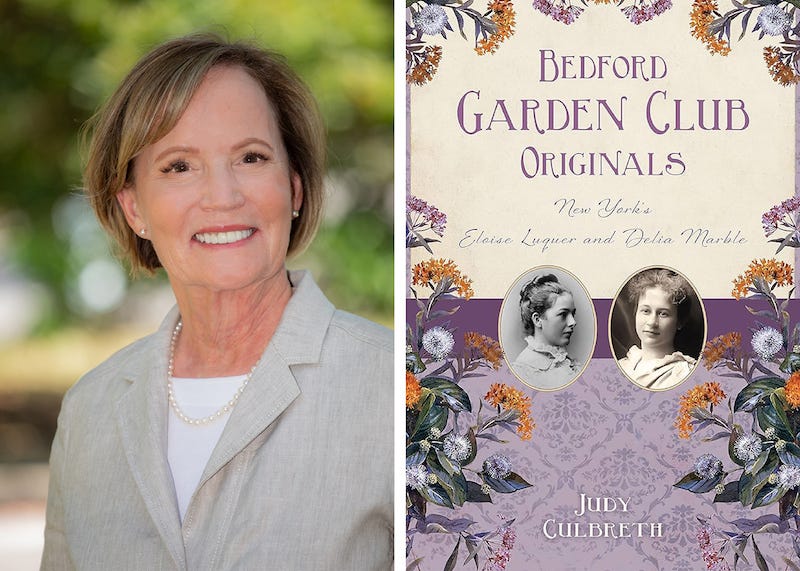
Judy Culbreth’s high-flying career might have opened doors for her at any Big Five publisher. She’d been the executive editor of Redbook and editor-in-chief of Working Mother, and she had a regular spot on NBC’s Today show in the Katie Couric and Matt Lauer days.
But Culbreth chose a small independent press for her dual biography of two remarkable women who blazed trails in art and environmentalism, Bedford Garden Club Originals: New York’s Eloise Luquer and Delia Marble, just published by the History Press imprint of Arcadia Publishing.
Why did Culbreth go with a small press? What did she learn from the process? What advice would she give to writers looking for a good home for their books?
Her answers involve the book itself, the inspiring story of two female friends who lived early in the 20th century in the small town of Bedford, New York. Culbreth learned about them from relatives in the area, including a daughter and son-in-law who own Delia’s house.
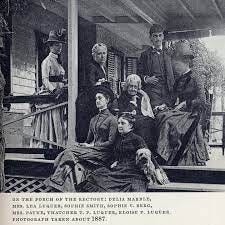
Eloise Luquer was a gifted artist who whose elegant watercolors earned her the title of “the Audubon of Wildflowers,” and Delia Marble helped organize a pioneering group of women created to replace farmers going off to war. Both were charter members of the Garden Club of America and played a pivotal role in that group and others devoted to conservation and historic preservation in America.
Culbreth, who lives in Fairhope, Alabama, answered 10 questions about the decisions she faced in bringing to market the story of two women whose vision, intelligence, and a sense of civic duty helped to change their town and nation. She also spoke about how personal challenges — including Hurricane Sally and her mother’s death — affected her writing.

1 You must have met many literary agents who’d have been happy to look at your book. Did you work with one?
I talked to a literary agent who lived in Bedford. She was enthusiastic about the proposal, but it was too small a project. I feel I saved a step by figuring out the right publisher on my own.
2 How did you know what to put in your proposal?
I read many successful pitch letters online before composing a lengthy proposal that included story highlights, my professional experience, and sales opportunities. That helped to keep the narrative on track as I was writing the book and in my later dealings with Arcadia.
3 How did you decide Arcadia was the right publisher for your book?
Arcadia is a leading publisher of local and regional history. It is best known for its sepia-toned Images of America series of oversized paperbacks, known in the industry as “trade paperbacks” (as opposed to the smaller-format “mass market paperbacks”).
Each book in the Images of America series tells the history of a community, from its beginnings to today, in stories and archival photos. You often see those books in point-of-purchase displays at bookstores and elsewhere.
Looking at my bookshelf right now, I spot five Images of America books I’ve purchased. So from the get-go, I felt this was a company that appreciated biographical subject matter.
However, a major subject of my book was an artist, and I knew the standard black-and-white format of Images of America would not do justice to someone known as “the Audubon of Wildflowers.” Fortunately, Arcadia’s History Press imprint also handles color exceptionally well.
4 You document your sources so clearly in your endnotes and bibliography, a university press might have been interested. Did you consider one?
I sent proposals to a few university presses. A women’s magazine editor and history major from the University of South Alabama were not credentials that interested them. I flirted with the idea of a coffee-table-book publisher, but my subjects were too undiscovered to sell $75 books. I kept circling back to Arcadia, which has mastered price points and nontraditional sales outlets, such as historical societies and hardware stores.
5 How long did it take you to get a signed contract once you approached Arcadia?
About three years. That is on me.
I was preoccupied with freelance work and personal issues, such as my mother’s illness and death right after Hurricane Sally destroyed 28 trees and part of my home, and my husband’s diagnosis of fourth stage lung cancer. The acquisitions editor at the History Press remembered my proposal after a 30-month hiatus. The project moved quickly when I was able to focus.
6 Your book has 84 photos, a lot, even for a history book. How did you find them?
I submitted about 200 images, more than the press required, but this is where my publisher’s expertise in local history was especially helpful.
During the layout phase, Arcadia winnowed out the photos that would not reproduce well. The result is a much more attractive product than it would have been without that process. It also helped that all Arcadia books are published on a very high-quality paper, known as Forest Stewardship Council (FSC) paper.
7 Who had to obtain — and pay for — the permissions to reprint all the photos?
At Arcadia, the writer is in charge of finding and paying for the images. Some were easy to acquire — anything from the Library of Congress is in the public domain, for example. Wikimedia Commons is a good source for finding out about rights.
I was surprised that the New York Public Library and Smithsonian are somewhat expensive. The well-endowed Frick Museum did not charge for reproduced material. One charming photo of Irene Castle, one of the original flappers, cost about $100. I felt she was worth it. Having the photos of Eloise and Delia cleaned up and repixelated were also necessary expenses.
8 Many scholarly or other publishers of history books don’t pay advances. Did you get one?
No. Arcadia isn’t a vanity press or self-publishing company. It’s provided the kind of editing and support you might get from a traditional publisher.
But I had to buy 200 copies at the author’s discount. I believe that was fair. The deal lowers the publisher’s risk in a small market and the financial outlay has incentivized me to sell (I carried as many books as would fit into my biggest purse to a high school reunion, for example). I’ll be earning royalties for years to come that should enable me to make a profit.
9 What advice would you give to other authors?
All communication with your publisher needs to be polite, lively, and informative with the goal of building relationships. I even have a nice rapport with the head of shipping at Arcadia.
At Arcadia — as with most publishers that aren’t vanity presses or companies for self-publishers — you have to be willing to compromise and trust your editor’s judgment. Arcadia has strict requirements and some limits in terms of the number of words and photos required.
Delia and Eloise lived during the late Victorian/early Progressive era, and I’d like to have said more about their times. I had to reduce fascinating friends and relatives of the women to captions and notes.
I had a working manuscript ready at the proposal stage. Completing the bibliography on time was the main challenge. I did it after I’d written the book, and I wish I had kept better notes at the research stage.
10 What did you like about working with Arcadia Publishing?
Arcadia has the nurturing spirit of a small press, but a vast amount of experience at what it does. Its titles show up everywhere: your pharmacy, grocery store, favorite museum. Every department — from copyediting to sales — has been cordial and immediately responsive when I worked with them on Bedford Garden Club Originals.
Meanwhile, the value of personal fulfillment is considerable. The legacy for my grandchildren who live in Delia’s house is beyond gold.
@JaniceHarayda is an award-winning critic and journalist in Alabama. She has been the book columnist for Glamour, the book editor of Ohio’s largest newspaper, and a vice president of the National Book Critics Circle.
You might like my story about another female pioneer of the same era:


