
Wendy Wood: 6 Easy & Proven Ways to Build Good Habits and Break Bad Ones
Only dead fishes go with the flow.
“Self-discipline is the mother of success.”
— Topsy Gift
I read the above quote a few weeks ago. From that day onwards, I have deeply tried to maintain self-discipline while reading, eating, sleeping, etc. Unfortunately, I don’t know how to build nugget habits or feed them to my mind.
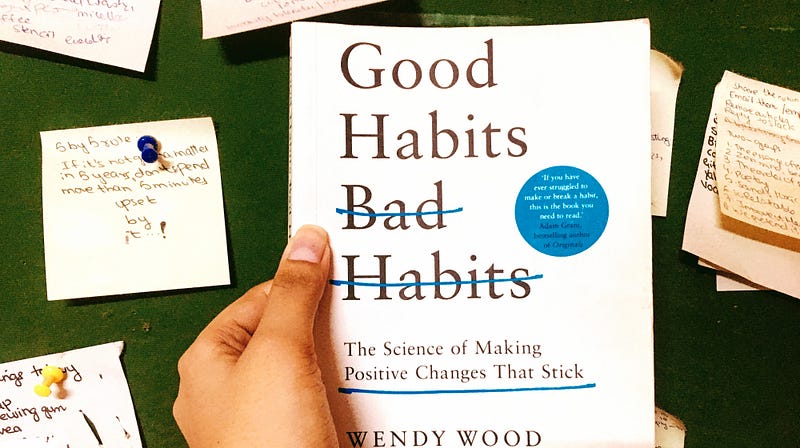
That’s when I found Wendy Wood’s book: “Good Habits, Bad Habits.” As this book had psychology chunks, it made me question my habits on the ground of scientific knowledge.
But that’s just one part of the book. Using three parts, this book clarifies habit formation tactics.
It’s time to review Wendy’s manual to make guilt-less habits.
Let’s get started.
1. Repetition Is Its Own Reward
Most of us act habitually, for suppose:
- Drinking water before taking a meal
- Checking petrol before riding the motorbike
- Saying “Hi” when we meet anyone new
- [Etc]
Most of these habits are contingent — noncausal, and accidental. We continue to perform our unintentional habits because they feel fluent, relaxed, and comfortable.
Wendy Wood writes: “Rituals” is a prominent example we’ve been following without testing its relevancy.
Take, for example:
- Decorating trees on Christmas
- Blowing candles on birthdays, and
- Wearing gowns and tuxedos at weddings
Wendy believes that rituals are a universal human impulse.
But did you ever think about what makes these rituals stick even though it’s 2022 and people are more educated than ever?
Without logical explanation, rituals and traditions provide comfort in uncertain times.
That’s why people trust rituals.
There’s no magic. People spend a lot of money trying to buy the perfect wedding gown and ordering the perfect themed birthday cake. All this for whom?
“It’s the psyche,” suggests Wendy. Rituals make people believe it’s working. So here, repetition is the reward.
The next thing we know, rituals are glued to our daily lives.
2. The Autopilot Mode
Wendy introduces a new term:
Introspection illusion: A cognitive bias in which we overestimate our habitual performance.
Meaning that we’re overconfident in what we do.
Suppose:
- You might light the fire before placing the hot pan on the stove
- Inspect your room before going out
- Binge-watching Netflix when cutting vegetables
When we excel at something, we become overconfident — we switch to autopilot mode, says Wendy.
We cut vegetables when watching Netflix because we think we’re skilled. Fat Lie.
Another example is when you start driving hurriedly and forget to message your employer. You took out your phone, and bam, you hit a tree.
Figures provided by the National Highway Traffic and Safety Administration Of the United States reveal: Approx 52% of deadly accidents occur within five miles of the home.
Why?
- Because overconfidence rides our minds.
To avoid that, be conscious and don’t overestimate your power to fly out of the car when an accident occurs.
Because yes, accidents happen!
3. Reward Is a Mental Shortcut
Reward plays a main role when building a habit — crucial when we first do something.
William James writes in “Principles of Psychology:”
The first step is important, and then we can act on habit.
Rewards have worked effortlessly for major occupations for many generations. As a writer, I have too found some habits that ensure I write every day, such are:
- Getting a mint chocolate cupcake in the end
- I also get to buy a new dress
- A new body buffer flavor from Treehut
I mostly opt for [number 3], which makes me feel relaxed and calm. Although my rewards are not deeply connected with my goals, they help me repeat the habit.
I get the rewards when I complete one whole week of writing without quitting, also known as the “Streak Method.”
We are all familiar with Snapchat’s Streak system. So why don’t we utilize it in real life? For suppose, when building a beneficial habit, you can place a reward at the end of each task, like:
- Getting 1 brownie of your choice
- 1 hour+ binge watching
- [Etc]
The basic logic: We get rewards when we keep performing the habit.
4. White Knuckle Tactic
We all know that our habits are correlated:
- Our resting time is connected to social media
- Waking up to breakfast
- Eating to consuming fast foods
- Night time to check discounted shopping offers
If you feel you’re white-knuckling (not making real changes), exert self-control to downsize habits.
Once we can forgo the habit, it no longer messes with our brain. People with strict self-control live healthier lives because we are solely masters of our day.
- We’re the ones that can build & change habits.
If we don’t exercise control and take charge of our habits, they will end us. Instead, reflect on your habits — write them down on paper and analyze if self-control is due.
If it’s eating a chocolate bar or buying clothes from Zara, self-control always benefits.
Self-control takes the effort of your hands and maximizes balance.
4. Remove Friction
We all have bucket lists of things we want to do.
For example, I have a keen interest in riding roller skates.
Mostly in winter, I almost forget or don’t have the urge to ride skates. And then, one sudden day, winter is gone!!
No, winter doesn’t pass one sudden day. Nor am I lazy. The actual problem is friction.
Wendy Wood advices: If you want to read a book, maybe try placing it where you can see it every time.
When building a healthy diet habit, place the fruit bowl on your table counter.
For rollerskates habit, try placing them near the door, so skates hint every time you go out.
By removing friction, we pursue actions.
Frictions like the book in the bag, skates in the basement, and no fruit bowls make it difficult to notice.
- Instead, make things decorative.
- Place your cues in the right direction in a fancy manner.
So each time you see them, you instantly get reminded of tasks you wanted to do.
Easy-peezy.
5. Set Successful Cues
Sharp musicians commonly use “muscle memory.”
A simple motor learning way through which musicians record movement patterns through repetition. — BBC.COM
Also, high achieving students use an acronym method to learn vocabulary.
Wendy Wood says: With authentic cues, we can stack and piggyback new habits.
Such as, when trying to mop the floor, check for dusty windows, refilling bottles, and empty trash cans.
We can do all this through one stable behavior, which in the above case is “Mopping The Floor.” Mopping the floor reminds us of habits necessary for complete cleaning. In short, cues provide a successful way to stack good habits.
Piggyback and stacking are techniques marketers have been using for a very long. For example:
- Paypal gained so much popularity because it got integrated into eBay.
- Toothpaste companies earned more when they placed dental floss and paste together.
- Facebook triggers Instagram and WhatsApp.
Means that one successful habit creates new ones.
6. Discontinuity Is a Blessing
Remember when Walmart underwent a restoration and had to shift grocery lanes to the right?
- That was a simple disaster.
Even though I went to buy items I always buy, some portion of me was not (satisfied). Little changes disturb our process. It stops us and challenges our mindset.
The grocery aisle shift was the first time I realized why I had been buying sugar-free droplets. I never repurchased it!
Wendy Wood says: Change in locations, objects, and items often questions why we’ve been doing it for so long.
Change in a context we’ve probably been doing forever challenges our minds. Change in context, in other words, is friction. Hence, habit discontinuity happens.
Habit discontinuity occasions:
- Internet failure,
- Packaging changes
- Broken mobile
- Banned tv shows, etc
Habit discontinuity is a blessing as it stops majorly performed habits from re-happening.
Wendy advises using habit discontinuity in relationships:
“Most couples feel bored in the middle of their relationship. To spice things up, you can add a few fixtures to your habits. Maybe switch places. This time, let your husband cook, and you make the sauce.”
Habit discontinuity serves as a wet blanket to control bad habits — like a brick in the pathway.
Final Thoughts:
According to Wendy Wood: habits are the blueprint for success.
When used rightfully, we can turn good habits to our advantage. Good habits, one made can be used to stack more habits.
Mark Zuckerberg and Obama have been doing this for so long that they wear similar outfits daily.
One mastered habit is a [long shot] at pursuing new ones.


