
Well Educated High Performing Women Actually Get Married the Most
Stop it with the antiquated horror stories already!

There was a time about 30 years ago when the story was circulating that an unmarried woman over 35 was more likely to be killed by a terrorist than she was to ever get married. Even then, it wasn’t true, but today, it’s even less the case. Can we please just stop with these horror stories left over from the 1950s already? “More women than ever before are marrying for the first time at age thirty, forty, fifty, and even sixty. Feminist icon Gloria Steinem married for the first time at the age of sixty-six. It is simply not true that high-achieving women are especially at risk for a lonely old age.” Marriage, a History (p. 284).
There was a time in America when nearly everyone got married, and at a fairly young age. Women, in particular, didn’t have a lot of other options, and so they made the best match they could, whether or not that meant they even really liked the guy. Historian Stephanie Coontz has noted, “In the past, a bad marriage was usually a better option for a woman, especially if she had a child, than no marriage at all.”
And, in the first part of the 20th century, women with a lot of education did often find it more difficult to marry, in large part because the appropriate role of women was considered to be that of mother, homemaker, and helpmate to her husband. This was something that was touted not just by popular magazines, but by therapists and other mental health professionals as well. Women who sought higher education and jobs outside the home were often just not seen as “marriage material.”
But this has been changing for some time and pretending that it hasn’t been seems to me like a way to police women back into their own historical lane. The truth is, for the past several decades in America, highly educated professional women have actually led the pack with the highest rate of marriages amongst women — a statistic that continues to rise.
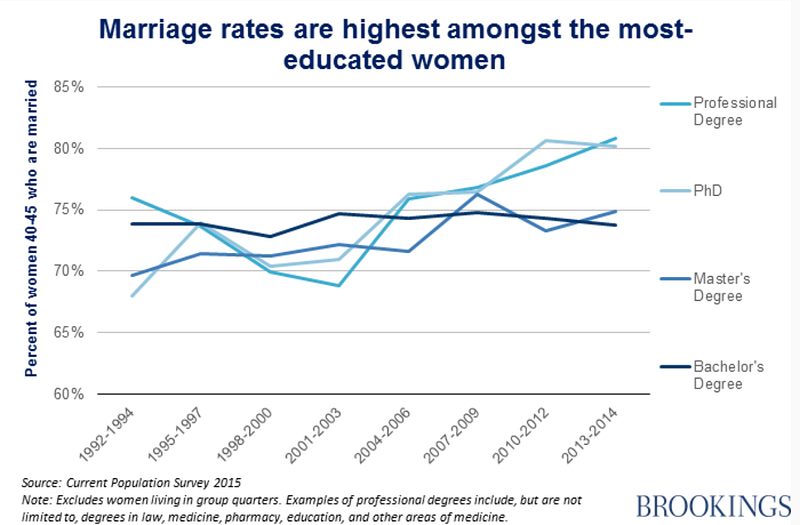
Poorer and less educated women are the least likely to marry, which accounts for much of the drop in overall marriage numbers. In-depth interviews with low-income mothers revealed that most of them believed that they simply could not afford to marry a man who was not financially stable or who might become an economic drain on them. Source
For more financially secure women, a potential mate’s earning power has become less important in recent years and many more women are even in relationships with younger men. “Analysis of collated data from the US Census Bureau proves to be revelatory. Out of 100 U.S. marriages, 12 involve an older woman and a younger man.” Source Today in societies where women are approaching equality with men in economic and political affairs they are much less likely to seek older, high-earning men as husbands than in ones where women have fewer options for independence. Source
A 2001 poll in the United States found that 80 percent of women in their twenties believed that having a husband who can talk about his feelings was more important than having one who makes a good living. Source What is increasingly apparent to me is that more and more women want to be married to an equal, and if they can’t find one, they would rather stay single.
Gerson found that when the demands of daily living and the organization of work make it hard to live out egalitarian ideals, men and women have different fallback positions. Of the young men who wanted egalitarian marriages, 60 percent said that if this was out of reach, they would choose some kind of modified male breadwinner marriage, in which they earned the bulk of family income and their partner took care of most family obligations. The reaction of young women, however, was strikingly different. Eighty percent of them told Gerson they would rather go it alone than be in a traditional or even a modified traditional marriage.
Coontz, Stephanie. Marriage, a History (p. 300). Penguin Publishing Group. Kindle Edition.
We see this with older women as well. Despite the still pervasive cultural narrative that women are only complete people if they become wives and mothers, many middle-aged and older women are discovering that they are just fine living alone — some of them as never-married people and some of them as never-again divorcees or widows. The trend seems to be related to a desire for greater independence and autonomy and to have the kinds of love relationships that do not inhibit that.
But, despite a general decline in marriage, with some women having no interest in it, and some others feeling they just can’t risk it, successful older women can find mates if they want them. It is an antiquated narrative that has been out of date for several decades that a well-educated career-oriented woman is more likely to be killed by a terrorist than to find a husband.
There are still some men who are threatened by a woman who earns more than they do, but given the fact that today in America in 20% of couples, the woman does earn more, and in another 30% she earns the same as her husband, this is not the factor that it once was. Source Greater economic stability and independence means that women no longer have to settle for just anyone. They have more latitude to wait to find the right partner, and increasingly this means a man who is looking for a relationship between equals. Even being a poor single mother is now viewed as preferable to being married to “the wrong man,” — a huge departure from just a few decades ago.
These tropes from a bygone era about women wanting to marry a man primarily for security and running out of time if she doesn’t lock one down by her early 30s just aren’t borne out by the data. As more women make economic gains, more and more they want a man who not only pulls his own weight but who is also a true partner. Perhaps the persistent stories about women who are too educated or too successful missing out on love are being passed around by the segment of men who don’t want to come into the 21st century and act like the partners that so many women want.
© Copyright Elle Beau 2023