
Why Are the 1950s Looked At as the ‘Golden Age’ When Clearly They Weren’t?
‘Merchandise Plus Marriages Equals Our Economy’
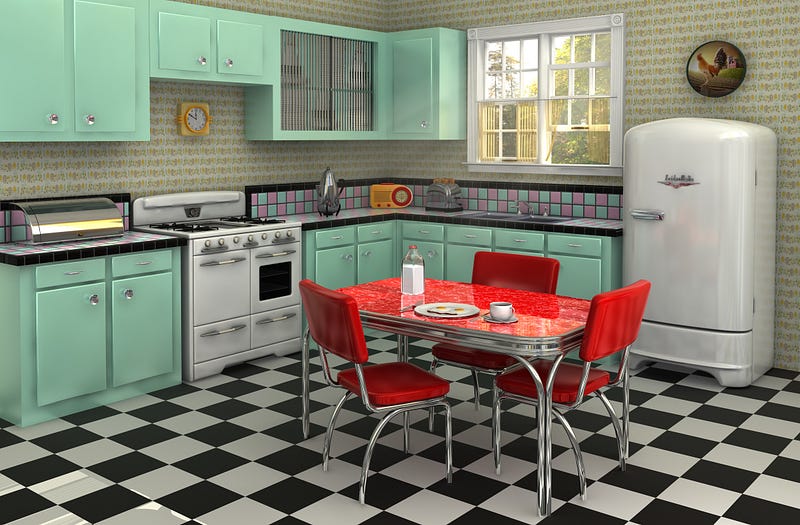
For many Americans, the 1950s are enshrined in our brains as a sort of Golden Age — the pinnacle of both family life (as showcased in TV shows such as Leave It to Beaver and Happy Days) as well as the height of economic stability and growth. To better understand this, we need to first look at the decades that came before.
The 1920s may have been roaring, but perhaps a bit socially destabilizing as Americans recovered from the first World War and truly left the Victorian age behind. Women began cutting their hair and going on unchaperoned dates — scandalous! But then the crash came, and the years of deprivation from The Great Depression. After that was the upheaval of WWII, which included more women than ever before in the workforce as they helped to manufacture war supplies and filled the jobs left by men who had gone off to fight.
By the time the 1950s rolled around, Americans were hungry for both stability and prosperity. All sorts of new gadgets and appliances were being invented and people were ready to both nest together in the newly minted marriages based on love and companionship and to feather that nest with all that was now on offer to buy. Being an avid consumer was very much a part of the postwar family.
“In the five years after World War II, spending on food in the United States rose by a modest 33 percent and clothing expenditures by only 20 percent, but purchases of household furnishings and appliances jumped by 240 percent. In 1961, Phyllis Rosenteur, the author of an American advice book for single women, proclaimed: ‘Merchandise plus Marriage equals our economy.’” (pp. 232–233).
Until the turn of the century, marriage had been typically viewed as a construct intended as the bulwark of society — to birth and raise legitimate children, and to support economic and social connections for the good of the entire extended family — and not so much for the pleasure or enjoyment of the couple themselves. Unlike the more tumultuous decades that preceded it, the 1950s allowed Americans a stable enough stage to fully try out this idea of marriage for love and personal fulfillment and they flocked to it. Women who weren’t married by 22 might well be considered old maids and the consumer aspect was one of the great attractions for new families.
“By the mid-1950s nearly 60 percent of the population had “middle-class” income levels, compared with only 31 percent in the “prosperous twenties.” By 1960 nearly two-thirds of all American families owned their own homes, 87 percent had televisions, and 75 percent owned cars.” (p. 231)
For the first time in history, the family was envisioned as being made up of a “breadwinner” man, his “homemaker” wife, and their children — the nuclear family. Grandparents and aunts and uncles now lived somewhere else, and working married women were either pitied or looked down upon. Child labor, once a common way for a family to supplement its income, was now illegal.
“Any departure from this model — whether it was late marriage, nonmarriage, divorce, single motherhood, or even delayed childbearing — was considered deviant. Everywhere psychiatrists agreed and the mass media affirmed that if a woman did not find her ultimate fulfillment in homemaking, it was a sign of serious psychological problems.
In Canada, says historian Doug Owram, “every magazine, every marriage manual, every advertisement . . . assumed the family was based on the . . . male wage-earner and the child-rearing, home-managing housewife.” In the United States, marriage was seen as the only culturally acceptable route to adulthood and independence.” (pp. 229–230).
After so many decades of privation and upheaval, Americans craved a life that promised stability, abundance, and happiness, and this is what was being promised to them. The new medium of television not only told people what to want through advertisements, but it also showed them on programs such as Father Knows Best how the world ought to work and what it ought to look like. A kind of societal mental note was made: This is how things ought to be and therefore must have always been — before the wars, before the crash — even though that was not remotely true.
The widespread belief in this nuclear family makeup and distinct genderized roles was so strong that even the obvious problems with it were often glossed over. The Cold War may have contributed to this by painting any shirking of marriage or gender roles as vaguely communistic.
“But even when marriage and family experts acknowledged that the male breadwinner family created stresses for women, they seldom supported any change in its division of labor. The world-renowned American sociologist Talcott Parsons recognized that because most women were not able to forge careers, they might feel a need to attain status in other ways. He suggested that they had two alternatives. The first was to be a “glamour girl” and exert sexual sway over men. The second was to develop special expertise in “humanistic” fields, such as the arts or community volunteer work. The latter, Parsons thought, was socially preferable, posing less of a threat to society’s moral standards and to a woman’s own self-image as she aged. He never considered a third alternative: that women might actually win access to careers. Even Komarovsky advocated nothing more radical than expanding part-time occupations to give women work that didn’t interfere with their primary role as wives and mothers.” (p. 234)
Many men felt the weight of their expected role as well. The pressure to provide for an entire family, be a loving husband, and constantly consume the latest products was a heavy burden. A man was still the head of the family, but no longer the king in his castle. He had to learn to relate to his children, be a good mate, and bring home the bacon. But it was something that was continually stressed as normal and desirable, particularly on TV.
Meanwhile, “At every turn, popular culture and intellectual elites alike discouraged women from seeing themselves as productive members of society. In 1956 a Life magazine article commented that women “have minds and should use them . . . so long as their primary interest is in the home.”
“Women were compensating for their lack of occupational status by expanding their role as consumer experts and arbiters of taste and style. First Lady Jackie Kennedy was the supreme exemplar of this role in the early 1960s.” (p. 237).
Not everyone was happy, but after the Great Depression and the two World Wars, everyone felt like they ought to be. Valium and Librium use were on the rise, particularly for women, who although they wanted to embrace their role and do their part in creating the idyllic “normal” family, often found the realities of it to be uninspiring. “Mother’s Little Helper” was what got them through the day, and since women who weren’t completely fulfilled by homemaking and child care were viewed as aberrant, they had no trouble getting doctors to prescribe for them.
For the most part, the entire cultural identity was an idealized facade that never quite lived up to the hype. Poor women, including most Black women, always had to work outside the home as well as in it. They weren’t vacuuming in shirtwaist dresses and high heels like June Cleaver, but then really who was? Marriage boomed, and at a younger age in the 50s, but in the decades to come, a third of those marriages that took place in the 1950s ended in divorce.
The pressures of a marriage where you were supposed to not only love each other but fulfill each other, both emotionally and sexually, never quite lived up to the hype that the rigid rules had promised. The unfulfilled promises of the 50s lead directly to the social upheaval of the 60s and 70s. Songs like Another Pleasant Valley Sunday (sung by the Monkees) skewered what had been the dream of the 50s.
See Mrs.Gray, she's proud today
Because her roses are in bloom
And Mr.Green, he's so serene
He's got a TV in every room
Another pleasant valley Sunday
Here in status symbol land
Mothers complain about how hard life is
And the kids just don't understand

Creature comfort goals, they only numb my soul
And make it hard for me to see
(Ah ah ah) ah thoughts all seem to stray to places far away
I need a change of scenery
And a lot of people forget that part and still find the shiny facade of the 1950s alluring, perhaps because it was sold to us so heavily on television and in the cultural narrative. If you want to be happy, if you want to be successful, look and act like this. Social conservatives today reminisce about when men acted like “real men” and the economy was booming so that more people could play the game of “keeping up with the Jonses.” But they never talk about how what was happening in everyday American homes didn’t necessarily look like Father Knows Best and how that paradigm might come with downsides or might not appeal to everyone.
“In 1953 Hugh Hefner founded Playboy magazine as a voice of revolt against male family responsibilities. Hefner urged men to “enjoy the pleasures the female has to offer without becoming emotionally involved” — or, worse yet, financially responsible. By 1956 the magazine was selling more than one million copies a month.” (p. 252).
Certainly, there were many good aspects to the 1950s, not the least of which was the strong economy, but it wasn’t really a Golden Age for many, many people. Idealizing this era to the point that it becomes a template for most of human history in many people’s minds means that we aren’t dealing with actual history and the things that really took place.
The nuclear family with a male breadwinner, a female homemaker, and their children really was only a dominant family model for less than 20 years. By the 1970s there were more single-parent households, and more women working. In the years before the 50s, wives often helped their husbands run the farm, or the corner store, and children often worked to supplement the family’s income. This new model was a blip in human history.
Maybe we tend to idealize the 1950s now because it’s when consumer culture first really took off. Maybe it’s because, for the first time, we watched how we were supposed to be on television. The strict division of gender roles was envisioned as being both orderly and optimally functional, even though in practice it didn’t really turn out to be that neat and tidy. Nonetheless, this era is still lionized with great nostalgia by many. Forget the real story, let’s have the televised version!
*All quotes are from Marriage, a History by Stephanie Coontz
© Copyright Elle Beau 2023


