
Web 3.0: The Internet Revolution You Can’t Afford to Ignore — A Developer’s Perspective
Welcome to the dawn of a new era — an era where the internet isn’t just a tool, but a living, evolving entity that’s reshaping our world in ways unimaginable.
As web developers, we are at the forefront of this revolution, shaping the contours of this new landscape, unveiling the potential of Web 3.0.
If you’ve ever wondered about the next big thing in the world of web development, or if the term ‘Web 3.0’ leaves you scratching your head, you’ve arrived at the right place. In this article, I will guide you through the rise of Web 3.0, its potential to revolutionize industries, its current limitations, and why, despite these hurdles, it holds the promise of a brighter internet future.
So, fasten your seat belts, because we’re about to embark on a journey into the future of the internet!

Setting the Context — The Emergence of Web 3.0
A Brief History
The World Wide Web, or as we know it, the internet, has undergone significant transformations over the past few decades.
The journey began with Web 1.0, a static information repository that was read-only for the average user.
Then came Web 2.0, the participatory and social web, where users became contributors, shaping the content and the services available online.
But the internet is evolving again, breaking free from its limitations and embracing a new paradigm — Web 3.0.
Web 3.0 originated from the quest to create a more intelligent, connected, and trusted internet. It is a vision of the web where data is linked and processed seamlessly by machines, and human-computer interaction becomes more natural and intuitive.
Web 3.0 is also synonymous with the decentralized web, where peer-to-peer networks and blockchains replace centralized servers and authorities. Blockchain technology underpins cryptocurrencies like Bitcoin and Ethereum and offers a new way to handle transactions and data storage — without intermediaries.
The Creation of Bitcoin
A significant milestone in the journey to Web 3.0 was the invention of Bitcoin, the first decentralized cryptocurrency, in 2009.
Amidst the economic turmoil of the global financial crisis, an anonymous entity known as Satoshi Nakamoto published the Bitcoin whitepaper.
It introduced the concept of a peer-to-peer electronic cash system, free from the control of any central authority.
Bitcoin was a direct response to the failing and inflationary traditional banking system that had led to the financial crisis.
It introduced a revolutionary technology — blockchain — a decentralized, distributed ledger that records transactions across multiple computers so that the record cannot be altered retroactively.
Blockchain technology, the backbone of Bitcoin, offered a new way of handling data and transactions. Instead of relying on a central authority like a bank or a payment gateway, transactions could be verified and recorded by consensus among participants in the network.
This decentralized approach provided greater transparency, security, and resilience, forming the foundation of Web 3.0.
The inception of Bitcoin blockchain set off a ripple effect, inspiring the birth of other cryptocurrencies and decentralized applications (DApps), and propelling us towards a new era of the internet. The quest for a more intelligent, connected, and trusted internet had found a new and powerful ally.
The era of Web 3.0 was on the horizon.
The Potential of Web 3.0 — Revolutionizing Industries
A New World Full of Promises
The decentralization aspect of Web 3.0, empowered by blockchain technology, has the potential to disrupt many industries, particularly those that require trusted intermediaries.
For instance, in finance, blockchain can remove the need for banks in transactions, enabling peer-to-peer payments and lending.
In supply chain management, blockchain can trace products from origin to consumer, ensuring authenticity and transparency.
In the realm of digital identity, blockchain provides a way to own and control personal data securely.
Web 3.0 also promises a more equitable internet. In the current web economy, giant tech corporations monetize user data, often without explicit consent or rewarding the users. Web 3.0 can turn this on its head, allowing users to own their data and even profit from it.
The Ethereum Revolution and Smart Contracts
While Bitcoin opened the doors to decentralized transactions, it was Ethereum that truly unlocked the potential of blockchain technology and paved the way for Web 3.0.
Created by Vitalik Buterin in 2015, Ethereum expanded on Bitcoin’s capabilities by introducing the concept of smart contracts.
A smart contract is a self-executing contract with the terms of the agreement directly written into lines of code. It is stored on the blockchain and automatically executes transactions when predefined conditions are met.
This functionality allows developers to build decentralized applications (DApps) on the Ethereum platform, extending the scope of blockchain beyond just financial transactions.
Ethereum’s smart contracts have the potential to revolutionize numerous industries. In legal contracts, for instance, smart contracts could automate the execution of a contract, reducing the need for intermediaries and making the process more efficient and less prone to human error.
In real estate, property ownership could be tokenized and exchanged through smart contracts, simplifying the buying and selling process.
With Ethereum and smart contracts, blockchain technology can be leveraged to build a whole ecosystem of decentralized services, expanding its impact to virtually every sector of the economy.
These innovations are driving us closer to the vision of Web 3.0, where users have more control, and interactions are transparent.
The Limitations of Web 3.0 — Challenges to Overcome
Despite its enormous potential, Web 3.0 is not without challenges.
Transaction Fees
One significant issue is that transactions on the blockchain are not free. They require a transaction fee or “gas,” which could be a barrier for mass adoption. Imagine having to pay a fee to like a post on social media or to update your profile picture.
But let’s not forget — even with Web 2.0, users are not getting services for free. They pay, but the currency is their personal data. Tech giants monetize this data, often without the users’ explicit knowledge. The business model is based on providing free services in exchange for personal data, which is then used for targeted advertising.
Most users don’t mind this exchange because the cost is invisible. It’s not a direct financial transaction; no money is deducted from their bank accounts.
Moreover, many users are not aware of how much their data is worth.
This lack of transparency allows Web 2.0 platforms to profit massively from data while the users, the actual data owners, receive no financial benefits.
Web 3.0 aims to shift this paradigm, giving users ownership and control over their data. However, the challenge remains to make this model as frictionless and user-friendly as the “free” model of Web 2.0.
A Promise of Decentralization
One other significant issue is that, the promise of decentralization is often not entirely fulfilled.
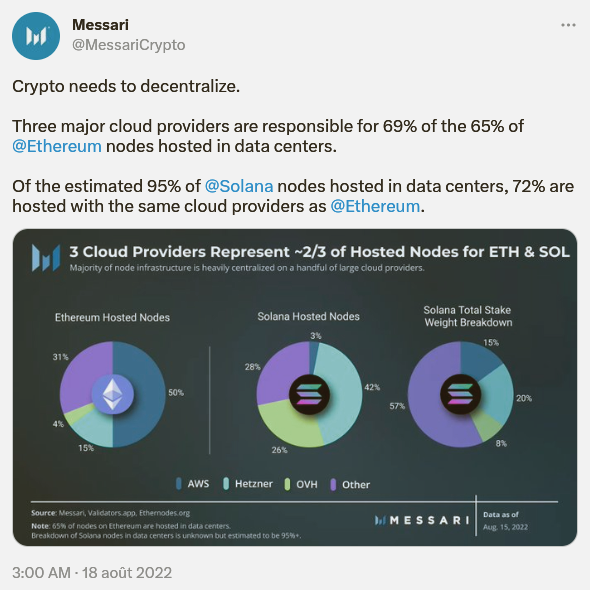
Many Ethereum nodes, for example, are run on Amazon Web Services (AWS) servers, bringing into question the true extent of its decentralization.
The idea of decentralization is to distribute power and control across a broad network of participants, preventing any single entity from dominating the network.
However, if a substantial number of Ethereum nodes are hosted on AWS, this could potentially undermine the decentralization principle.
Why is this a concern?
Because, in this scenario, Amazon indirectly becomes a central point of control. If AWS experiences downtime, or if Amazon decides to stop providing services to these nodes, a significant portion of the Ethereum network could be impacted.
This not only contradicts the ethos of decentralization but also introduces a vulnerability that could be exploited, both of which are contrary to the spirit of Web 3.0.
Moreover, it also raises concerns about data privacy and censorship. If AWS, or any single entity, has control over a significant portion of the nodes, they could potentially manipulate the network or censor transactions, which fundamentally undermines the trustless nature of blockchain technology.
True decentralization requires a diverse and distributed network of nodes, where no single entity has excessive control or influence. Achieving this is a challenge that the blockchain community must address to realize the full potential of Web 3.0.
Scam and the Lure of Gain
The last problem we’ll talk about is scams.
Lastly, like any emerging technology, Web 3.0 has become a fertile ground for scams. As people rush to get in on the ground floor, many fall prey to fraudulent schemes, leading to significant losses.
The promise of high returns and the hype surrounding blockchain and cryptocurrencies often cloud judgement, making individuals susceptible to fraud.
Scammers take advantage of the lack of understanding in this new space to launch fraudulent projects or manipulate cryptocurrency prices.
From Ponzi schemes disguised as investment opportunities to fake Initial Coin Offerings (ICOs) that vanish with investors’ money, scams are rampant in the Web 3.0 landscape.
It’s a reminder that while the decentralized nature of Web 3.0 provides many benefits, it also requires users to be more responsible and vigilant.
This underscores the need for better education about Web 3.0 technologies. It’s crucial for those diving into the Web 3.0 world to do their due diligence and be aware of the risks involved.
After all, the promise of decentralization also means there’s no central authority to turn to if things go wrong.
Nevertheless, it’s essential to remember that these challenges are part of the growing pains of any emerging technology. As Web 3.0 matures, we can expect improvements in security and the mechanisms to protect users against fraud.
The Promise of Web 3.0
Web 3.0, with its vision of a decentralized, intelligent, and user-centric web, holds tremendous promise. Despite its challenges, it has the potential to disrupt traditional business models, redefine data ownership, and create a more equitable internet.
The road to Web 3.0 is undoubtedly fraught with challenges, but remember, the same was true for Web 2.0, and look how far we’ve come. The trials of today are the stepping stones for tomorrow’s revolution.
As web developers, we must embrace this change, familiarize ourselves with new tools, and continue to innovate. The future of the internet is exciting, and I can’t wait to see what we will build together in this new era of Web 3.0.
After all, as the saying goes:
“The best way to predict the future is to create it.”
Let’s come together as developers, entrepreneurs, and enthusiasts to shape the future of the internet — the era of Web 3.0. It’s a thrilling ride, and I can’t wait to embark on this journey with all of you.
Here are some resources that you might find helpful to deepen your understanding of Web 3.0:
- Ethereum Whitepaper — Vitalik Buterin’s original whitepaper explaining the Ethereum platform and smart contracts.
- Bitcoin: A Peer-to-Peer Electronic Cash System — The Bitcoin whitepaper by the anonymous creator, Satoshi Nakamoto.
- Decentralized Web Primer — This guide provides an overview of the decentralized web, including its potential benefits and challenges.
- Blockchain and Web 3.0 — A YouTube video that provides a comprehensive overview of how blockchain technology is paving the way for Web 3.0.
- Web3 Foundation — The Web3 Foundation’s official site with many resources on the development of the decentralized web.
- What Is Web3? — This Harvard Business Review article provides an executive summary of what Web 3.0 is and how it might change the world.
- What is the Proof of Stake (PoS)? — An article from Medium that dives into the concept of Proof of Stake, a consensus algorithm used in many blockchain networks.
- What is the Proof of Work (PoW)? — A comprehensive article that explores the concept of Proof of Work, a foundational consensus algorithm in blockchain technology.
- Create and Deploy Your First Next.js Blockchain DApp with Solidity in Minutes — A practical guide for developers interested in creating decentralized applications on the blockchain using Next.js and Solidity.
- Master the Art of Ethereum Gas: Boost Your Blockchain Skills and Save Money on Transactions — An article that provides an in-depth understanding of Ethereum gas, an essential aspect of Ethereum transactions.
Enjoyed the read? For more on Web Development, JavaScript, Next.js, Cybersecurity, and Blockchain, check out my other articles here:
If you have questions or feedback, don’t hesitate to reach out at [email protected] or in the comments section.
[Disclosure: Every article I pen is a fusion of my ideas and the supportive capabilities of artificial intelligence. While AI assists in refining and elaborating, the core thoughts and concepts stem from my perspective and knowledge. To know more about my creative process, read this article.]