
What is the Proof of Stake (PoS)?
A few weeks ago, I talked about the PoW algorithm and I ended my article, What is the Proof of Work (PoW), by briefly describing the PoS. Today, I’d like to take a moment to talk about it.
If you didn’t already know, the most famous blockchain using PoS consensus is Ethereum.
Ethereum is a decentralized blockchain that runs smart contracts, which are self-executing code that can be used to automate the transfer of digital assets, among other things. Ethereum, like most other blockchain networks, relies on a consensus mechanism to ensure that all nodes on the network agree on the state of the blockchain.
The consensus mechanism used by Ethereum has evolved over time, from the original Proof of Work (PoW) algorithm to the current Proof of Stake (PoS) algorithm. This evolution was called “The Merge” and took place in September 2022.

Now, onto the question at hand. What is a PoS algorithm?
In a PoS algorithm, validators (i.e., nodes on the network responsible for verifying transactions and adding new blocks to the blockchain) are chosen to validate transactions based on the amount of cryptocurrency they “stake” or lock up as collateral.
The main idea behind this approach is that validators who have a larger stake in the network have a greater incentive to act in the best interest of the network.
Validators are rewarded for validating transactions by earning transaction fees and newly minted cryptocurrency.
To become a validator in a PoS network like Ethereum, you need to stake a certain amount of cryptocurrency. The more cryptocurrency you stake, the greater your chances of being chosen to validate transactions and earn rewards.
However, if you act maliciously or in violation of the network’s rules, you risk losing your stake.
Okay, so now let’s say you want to create your own blockchain. Which consensus should you choose? PoW? PoS?
A comparative analysis of PoW and PoS
Each consensus has its advantages and disadvantages. I will not try to convince you that one is better than the other. I am just trying to provide an objective comparison. Of course, I encourage you to do your own research in these complex areas.
- Security
PoW has been used successfully for over a decade on several major blockchains, demonstrating that it is a secure and reliable consensus mechanism when implemented properly. PoW makes it difficult and expensive for an attacker to create enough computational power to control the network, as the attacker would need to control a majority of the network’s hash power.
This is what we call a “Sybil Attack”. In practice, this attack is unthinkable on the Bitcoin network because of the amount of energy it would require. If you want to learn more about it: https://academy.binance.com/en/articles/sybil-attacks-explained
One criticism of PoS, is that it is more reliant on financial stake than on computational power. It has been suggested that a large number of validators could potentially collude to control the network and engage in attacks, known as a “nothing-at-stake” attack.
If you want to learn more about the “nothing-at-stack” problem: https://vitalik.ca/general/2017/12/31/pos_faq.html#what-is-the-nothing-at-stake-problem-and-how-can-it-be-fixed
2. Energy consumptuion
PoW requires a lot of energy to solve the mathematical puzzles, which can lead to high electricity costs and environmental concerns. This is the main criticism of the Bitcoin network. But, as I said just before, this is also the reason why the Bitcoin blockchain is unbreakable.
PoS is much more energy-efficient than PoW, as it does not require miners to solve computationally expensive puzzles. This reduces the environmental impact of the blockchain.

3. Scalability
This point is debatable since it depends on the number of validators on the network. PoS can be more scalable than PoW, as it can handle a higher TPS (Transactions per second) without requiring as much energy or long block times. However, PoS can be less scalable than PoW if validators do not have enough financial stake to handle the network’s transaction volume.
4. Decentralization
PoW is generally considered more decentralized than PoS, as it does not depend on financial stake. This means that anyone can mine or validate blocks, regardless of their financial resources. However, PoW can be susceptible to centralization if one mining entity controls a significant portion of the network’s hash power.
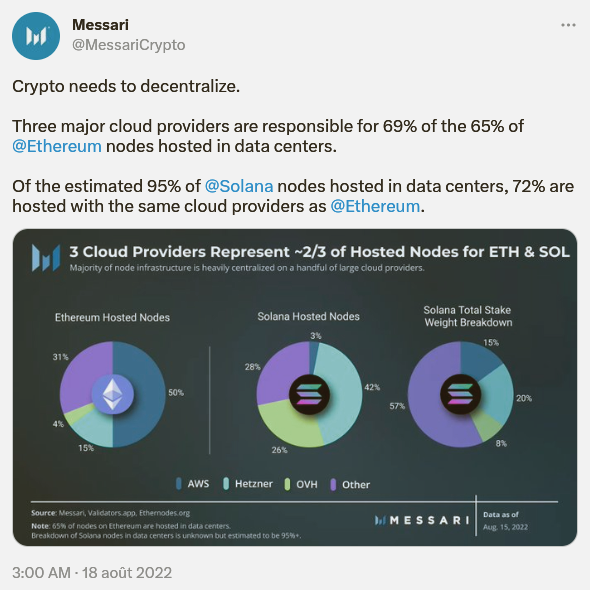
Note also that the majority of Ethereum (PoS) nodes are hosted centralized web providers like Amazon Web Services (AWS), which could “expose Ethereum to central points of failure,” according to crypto analytics platform Messari.
Well, as we see, both PoW and PoS have their advantages and disadvantages.
Personally, as a developer, I am very interested in the possibility that Ethereum offers to work on the blockchain with Smart Contracts and Solidity. But I must say that I feel more in tune with how the proof of work works. And you?
Enjoyed the read? For more on Web Development, JavaScript, Next.js, Cybersecurity, and Blockchain, check out my other articles here:
If you have questions or feedback, don’t hesitate to reach out at [email protected] or in the comments section.
[Disclosure: Every article I pen is a fusion of my ideas and the supportive capabilities of artificial intelligence. While AI assists in refining and elaborating, the core thoughts and concepts stem from my perspective and knowledge. To know more about my creative process, read this article.]