
Show Me the Data
We Need to Investigate the Anomaly
Since the U.S. government now agrees UAP exist, what will it take for scientists to take the phenomenon seriously?
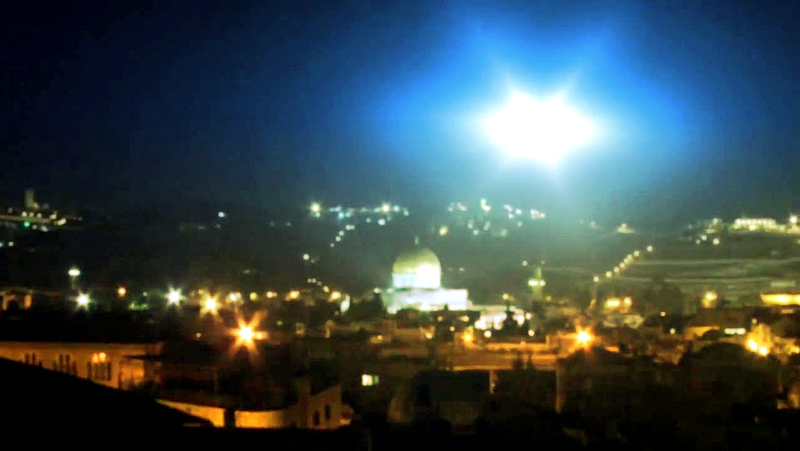
A series of clips from 2011 now circulates online showing a ball of white light floating over Jerusalem. The light ball slowly descends, hovers, and then shoots up vertically at incredible speed. Many people saw it, and even CBS News featured the event in a segment, a video that went viral on social media.
What was it? A balloon, an aircraft, a drone, the planet Venus reflected through swamp gas, a religious experience, aliens, or a hoax?
As is wont to happen with viral UFO videos, there was much speculation, but there was no clear answer. The episode was eventually forgotten. Yet another page from the annals of UFOlogy.
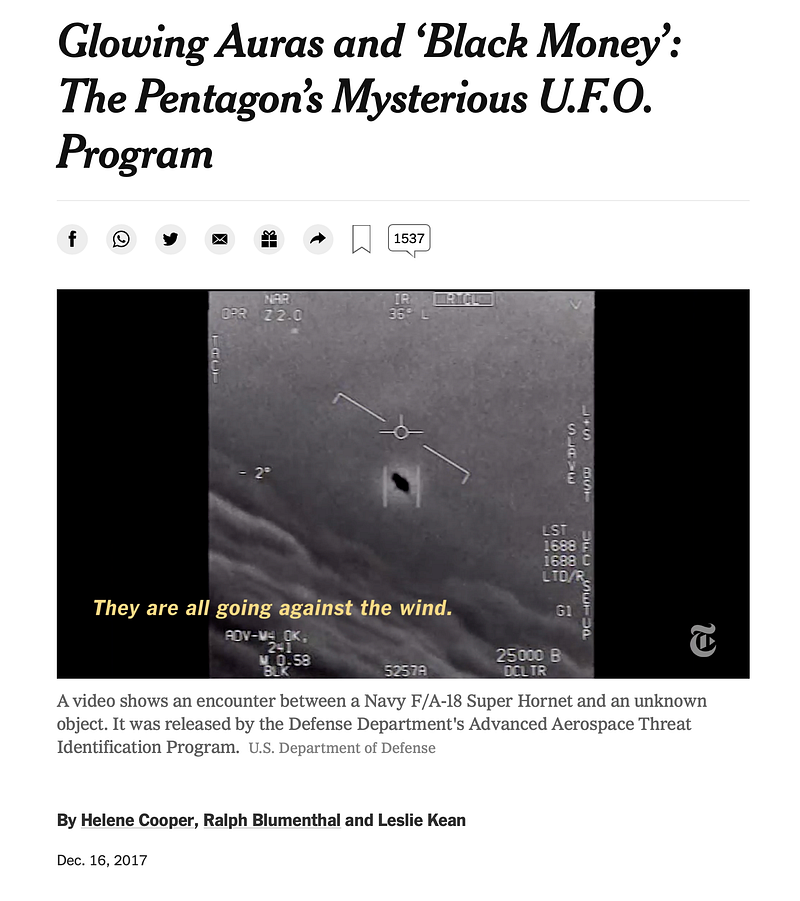
Fast forward to 2017. The New York Times publishes an article on the front page about the existence of a secret program to search for UFOs, accompanied by a black-and-white image of an object captured on video. Online, the newspaper also published videos released by a private company called To The Stars Academy. The Pentagon subsequently confirmed that the videos are authentic; they were taken from the forward-looking infrared system of an F-18 fighter jet.
Shock, excitement … then silence. Again.
An Anomaly that Refuses to Go Away
It’s now 2021, and after the pilots, who were direct witnesses to the events depicted in some of the videos, discuss and confirm their experiences on 60 Minutes and many other outlets, the Pentagon itself issued a report indicating that they have 143 such unexplained cases that were recorded not only by human observers, but also by radar, infrared, and possibly other classified sensors. The public got a few pages; a classified report went to Congress.
What now? Still a lot of speculation. And still no clear answers.
Why is that?
Modern societies have an institution for producing answers about phenomena observed in nature. That institution is called science and the people who serve it are called scientists. So what are the answers that scientists have on this subject? Let’s grab that 3000-page snoozer on UFOs and UAPs from the shelf of established science.
Oh wait, there is no such 3000-page snoozer.
Established science did not say much of anything on the topic and, with one exception, there are no plans to do that either. Neil de Grasse Tyson, who is often depicted as the public voice of the scientific community in US media, raised the bar considerably when he claimed on CNN that he would think it a worthy topic of investigation only if an alien would invite him to dinner. A curious approach from a scientific mind, to say the least. Do aliens even eat dinner?
More recently, in response to the UAP report, Tyson opined that UAPs recorded by the U.S. Navy could be due to a malfunction of the infrared sensors. In fact, the object was picked up by multiple sensors including radar and the eyeballs of several pilots. Also, the Advanced Aerospace Threat Identification Program revealed by The New York Times in 2017 had ten years to investigate (and four more before this year’s UAP report); does Tyson really believe they didn’t check the equipment?
Tyson then provocatively asked that, given we all have mobile phones in our pockets, why don’t we have high-definition images of UFOs already?
Except that we do actually have those images, but they are very fuzzy, and even multiple images snapped by several people at one event don’t hold sway, as seen in the 2011 Jerusalem episode.
Others, this time practicing scientists, opined that “they want to believe,” but were ambivalent about the results of the Pentagon report. Some proposed that the navy videos released were not impressive enough.
That segment of the public that pays attention to developments in the UFO world may think that these reactions from scientists are the sign of a vast conspiracy to deny us the reality of UFOs or alien visitation. Scientists seem to behave as if they would prefer us to ignore these events and unsee any evidence that warrants investigation.
But, in fact, there is a much more plausible explanation for what is happening in science. The history of science helps to clarify matters a little bit, at least in this one regard.
Time for a Paradigm Change?
Thomas Kuhn, who wrote the classic The Structure of Scientific Revolutions, proposed that when scientists are faced with an anomaly — defined as an event or phenomenon that does not conform to their theories and practice — their first reaction is to dismiss it.
That is counterintuitive. If there is an anomaly, why not actually investigate it? In popular depictions, science is all about that.
Just check how many times the line “we need to investigate the anomaly” is spoken in Star Trek, a science fiction phenomenon that has driven many geeks into the halls of science.
But in real science, anomalies are things to avoid. The anomaly cannot be accepted as a worthy topic of study because investigating might demolish the core articles of faith of a scientific discipline or disciplines.
If we have an anomaly, something is not quite right. Why do we have an anomaly and why is it anomalous if our theories are right and our instruments work correctly? If we have an anomaly, it’s either that we are wrong, and we can’t be wrong, or we haven’t done a good enough job. Either way, someone is going to lose their job, reputation, or legacy, or all of them at the same time.
Hearing about an anomaly is like getting a spoonful of salt in your morning coffee instead of the sugar you expect; it can seriously ruin your whole day. That’s why scientists prefer to keep the status quo and defend it tooth-and-nail and use mundane explanations to “save the phenomena.”
For example, when the physicist Wilhelm Roentgen discovered X-rays by fiddling with a cathode-ray tube in his laboratory that displayed the very first radiography of the human hand (of his wife Anna Bertha Ludwig), Lord Kelvin, the preeminent scientist at the time, pronounced it an elaborate hoax and scoffed at the idea that X-rays were real.
Yet, Kuhn also showed that ignoring and dismissing the anomaly can only work for so long. Radiographies are not a hoax and X-rays are real.
Ultimately, the anomaly becomes so obvious that scientific disciplines enter a moment of crisis that lead to their radical revolution and the foundation of a new scientific paradigm.
This crisis usually has important social, economic, and cultural consequences, as business-as-usual simply cannot go on. Think Galileo versus the Inquisition. This involved the shift from geocentrism, the theory of Earth occupying the middle of the solar system in a finite spherical universe, to heliocentrism, the theory of the sun resting in the middle of the solar system in an infinite universe. Galileo made observations with his telescope and found that the moon had a rugged surface and the sun displayed spots. These irregularities went against the idea that the sublunar and supralunar spheres were of different natures, a core crede of the Ptolemaic theory supporting geocentrism.
Because of Galileo, Earth could be understood more easily as just another planet spinning around the sun, a fact everybody willing to look through a telescope could verify.
So are UFOs or UAP an Anomaly?
Well . . . it’s complicated. Science never really acknowledged UFOs as a problem thus far, so how could they be an anomaly since they are not even considered “real”?
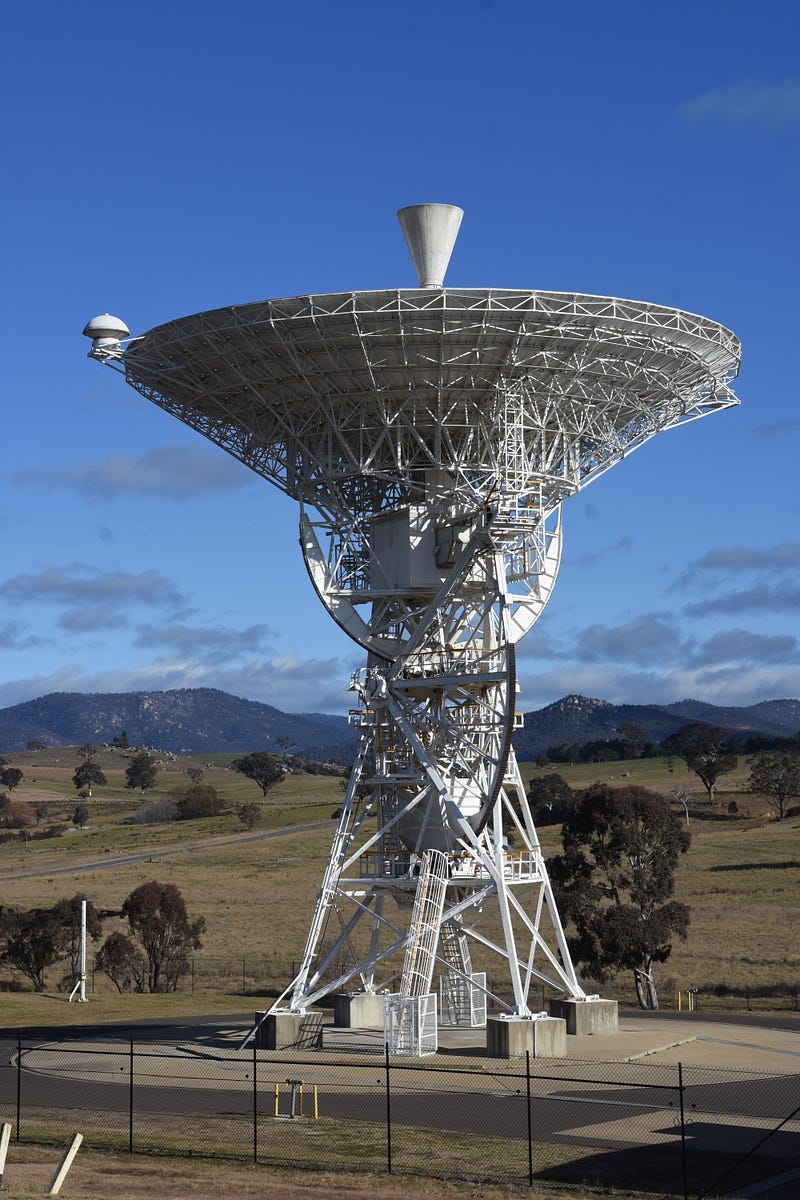
At the same time, astrophysicists want to see aliens. The problem is that they want to see them only in a way that they consider acceptable. Bacteria on Mars? Acceptable. Intelligent beings using radio 50 or 60 light years away? Acceptable. A technological artifact such as a Dyson sphere meant to capture the light of a star for the benefit of an interstellar civilization? Acceptable. Intelligently controlled craft, moving fast in interstellar space or Earth’s own atmosphere? Absolutely unacceptable.
It is unacceptable because of the large distances involved that would involve the possibility of altering known physics. And also, because astrophysicists base their understanding of extraterrestrials on the development of terrestrial technology — see, for example, the notion that an advanced extraterrestrial civilization would use radio waves.
But all that aside, there is nothing in astrophysics that would prevent the UAPs from existing and from being signs of nonhuman or extraterrestrial technology. Cosmology even allows for it: If life appeared on Earth — chemistry being chemistry — it must have appeared somewhere else as well.
Plus, other stars formed before our sun. Those stars might have civilizations possibly three billion years older than us. So, it’s not inconceivable that those aliens would be more advanced and had once set out to explore the universe.
This possibility, plus the new data released by the US Navy showing detection on multiple sensors, qualifies UFOs as an anomaly in need of explanation. But we still do not have enough data to know whether they are indeed real, even as the data and pilot testimony do in fact indicate that possibility. We end up awkwardly with an important would-be anomaly. The question is: what to do about it?
There is a Southern European proverb that goes like this: if you want to remove a snake from a hole, someone needs to put their arm in the hole. The question is, who would do that and survive the snake bite?
At the moment, our only ray of hope is the aptly named Project Galileo at Harvard. The project aims to build new types of instruments to detect extraterrestrial artifacts in interstellar space and in Earth’s atmosphere. It seeks to produce compelling and openly available evidence that would pass the muster of science.
While these goals are ambitious and important, the intention of Project Galileo is not be to trigger a scientific revolution and a paradigm shift. It would be more fundamental: to certify an anomaly. Taking a reliable picture and capturing sensor data of a UAP and showing it to the world would prove that this is a phenomenon that needs to be explained. All the other questions will come after. Where is it from? What does it do here? How long has it been here and how does it influence us?
Only answering those questions (after having the courage to ask them) would finally enable someone to write that 3000-page snoozer. It’s good to at least start by writing page one and putting that picture on the cover.
Trail of the Saucers is edited by writer/producer Bryce Zabel and published by Stellar Productions. Zabel co-hosts the popular new podcast Need to Know with Coulthart and Zabel that can be found on all major platforms.
