
UFOs and History
A Tale of Two Scientists
Cold War-era physicist James E. McDonald argued that UFOs represented the most urgent scientific problem in history. Today’s Neil deGrasse Tyson is ‘fine’ with taking a pass.
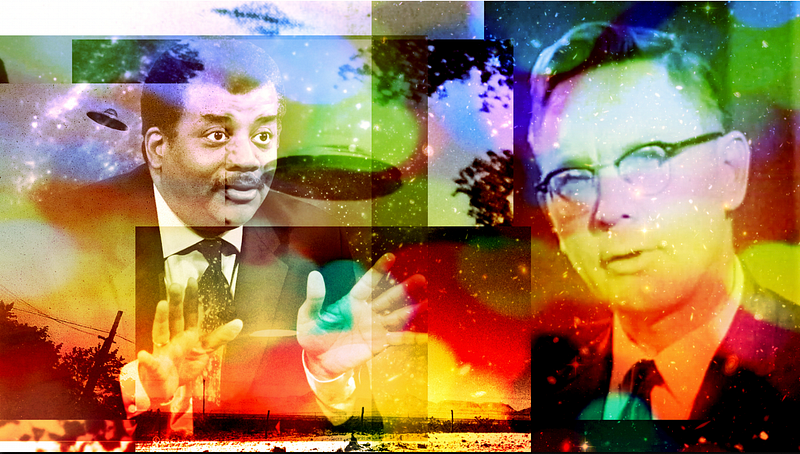
While the Pentagon and Congress hide behind the fig leaf of “national security” on UAPs, it would be refreshing to have a respected, credentialed scientist go on national television — or better, formally address Congress — and just come out and say what Christopher Mellon and Lue Elizondo clearly want to, but can’t or won’t: We’re not alone.
Alas, that already happened — more than half a century ago.
Ufology occupies an unusual, contradictory place in American culture. It’s a relatively young discipline that has more in common with journalism than with science. It continues to expand, drawing new talent and excavating a growing body of data, eyewitness testimony, and research from both the field and government archives. Obviously, the nature of the phenomenon goes far, far beyond anyone’s “national security.” It goes straight to the nature of reality itself. The implications are staggering.
And yet at the same time, many of its fruits vanish down the memory hole — sometimes, as we’ll see below, within just a few years — and/or are ignored by mainstream science and media.
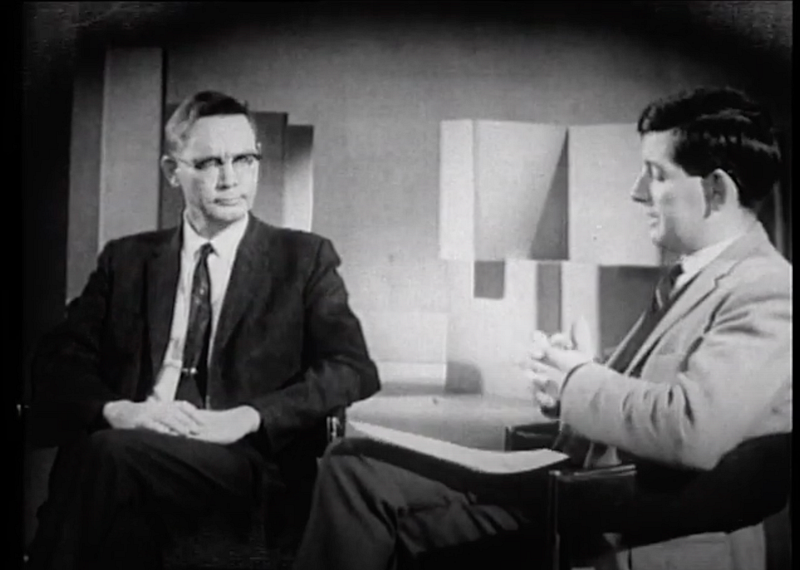
American physicist James E. McDonald was painfully familiar with this problem, and on July 4, 1967 fifty-four years ago this holiday weekend, he sat down with an Australian Broadcasting Company journalist for a televised interview on the program This Day Tonight and took stock of the situation:
Project Blue Book, the U.S. Air Force-run UFO research program launched in 1952 that would be terminated two years later, he said, was “superficial and incompetent.” The UFO phenomenon, which he had carefully researched on his own for years, was clearly global and showed no signs of hostility. Those who described sightings (of saucers, cigar-shaped craft, hovering lights, etc.), seemed to him credible. When the totality of the evidence was considered, an extraterrestrial source was well within the realm of possibility. And yet, he told ABC interviewer Brian King, the scientific community was blowing it off.
“To have this possibility, that the world is under something resembling reconnaissance, possibly from some extraterrestrial source, and to go on about our petty ways collectively, doesn’t seem to me to be a wise situation.”
Given that the current explosion of news about UAPs is largely presented as one where “national security” looms large, it is refreshing to hear a scientist — speaking then at the height of the Cold War, no less! — describe the phenomenon as one that didn’t appear to represent a threat. But McDonald went further, chastising colleagues in the scientific community and even governments all around the world from taking UFOs seriously:
“They all seem to take the view that there’s nothing to it, that there’s a lot of nonsense, that people see things and that it is not a real scientific problem at all, and I most heartily disagree with that.”
McDonald’s buttoned-down seriousness and calm, almost sleep-inducing delivery stands in marked contrast with the animated tirades of astrophysicist and science popularizer Neil deGrasse Tyson, who claims to be uninterested in the phenomenon and yet obviously takes great delight in mocking those who have concluded that an E.T. hypothesis is the only one that makes sense.
Tyson’s UFOs-and-aliens rants are bewildering. Delivered with bemused exasperation, turning UFO researchers into the butt of jokes, they often begin (and end) with a triumphant reminder that the “U” in UFO/UAP stands for “unidentified.” “If you don’t know what it is,” Tyson thundered in one video I saw a few years ago on YouTube, “that’s where your conversation should stop!”
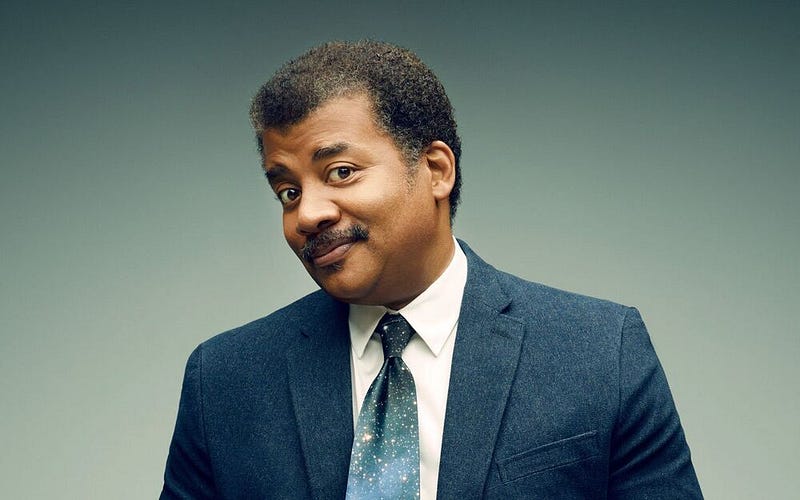
With rumors buzzing in Washington of Navy-shot UAP footage that looks like scenes from Hollywood science fiction films and mainstream journalists now chasing a Pulitzer, Tyson is setting himself up for a fall worthy of Shakespeare. The scientist who obviously regards himself as an intellectual heir of Carl Sagan brings to mind the German education minister who in the early 1800s declared that the physicist Georg Ohm was “unworthy to teach science.” Tyson is surely able to explain Ohm’s Law and electricity — but he probably doesn’t remember the education minister who gave Ohm an “F.”
Taking it to Congress
When McDonald died in June 1971 of a seemingly self-inflicted gunshot to the head in an Arizona desert, the New York Times reported his passing. The respected physicist was affiliated with the University of Arizona, where conducted cloud research at the Institute of Atmospheric Physics. But he was nationally known, the Times noted, “as the most outspoken scientific proponent of the possibility that unidentified flying objects might be under control from beyond the earth.”
Nearly 47 years later, the New York Times would report that the Pentagon was secretly running a $22 million program to study the very thing that McDonald believed represented the most urgent scientific problem in history.
The Arizona physicist said as much in 1968, when he submitted 56 pages of testimony to the U.S. House Committee on Science & Astronauts, which held a Symposium on Unidentified Flying Objects in the Rayburn Building on July 29 of that year.
McDonald said he “leaned strongly” towards the extraterrestrial hypothesis by “a process of elimination of alternative hypotheses.” He based this position on years of his own research — interviewing hundreds of witnesses and collecting weather and radar data that could corroborate sightings and provide context. His papers (which include his UFO case files and one box of “restricted” material) are now part of the Special Collections kept by the University of Arizona Library.
Imagine, a scientist whose curiosity about a mysterious unknown leads him to study it! What, one wonders, is Dr. Tyson’s UAP hypothesis? Does he have one? Has he spoken to any of the pilots or other U.S. Navy personnel who saw things in the sky they couldn’t explain? Has he ever examined McDonald’s case files or asked Jacques Vallee if he might have access to the French scientist’s vast collection of UAP data? Has he discussed his theory about malfunctioning electronics with the sensing equipment operators who use that equipment?
Inexplicably, Tyson is simply uninterested in the phenomenon. In a recent interview with podcaster Sam Harris, he summed it up this way: The universe is full of mysteries, UAPs are just one of many, and he’s “fine” with that, but he’d rather study other things. If others want to dive in, okay — but he won’t.
In terms of scientific seriousness and intellectual curiosity, the chasm between the two men could not be wider. And to be blunt, Tyson is disingenuous on a crucial point: He conflates those who say they’ve decided or “know” aliens are real with those who, like McDonald, have concluded that non-human intelligence is the most reasonable hypothesis. Clearly, he’s not up for this.
To be sure, McDonald was familiar with this blind spot among colleagues. He put it this way in his report to the House committee:
“From time to time in the history of science, situations have arisen in which a problem of ultimately enormous importance went begging for adequate attention simply because that problem appeared to involve phenomena so far outside the current bounds of scientific knowledge that it was not even regarded as a legitimate subject of serious scientific concern. That is precisely the situation in which the UFO problem now lies. One of the principal results of my own recent intensive study of the UFO enigma is this: I have become convinced that the scientific community, not only in this country but throughout the world, has been casually ignoring as nonsense a matter of extraordinary scientific importance.”
McDonald also deserves credit for acknowledging that much of the work of investigating the phenomenon is carried out by people who are not scientists. For years, the press has referred to such people as UFO buffs, enthusiasts and conspiracy theorists. Tyson, for whatever reason, feels compelled to mock then and poke at them with his Twitter stick.
McDonald provides a refreshing contrast:
“I wish to put on record my indebtedness to these ‘dedicated amateurs,’ to use the astronomer’s genial term; their contribution to the ultimate clarification of the UFO problem will become recognized as having been of basic importance, notwithstanding the scorn with which scientists have, on more than one occasion, dismissed their efforts.”
McDonald’s testimony highlights another way in which the times and the government’s approach to the UAP phenomenon has changed. In 1968, you had a scientist talking to a House science committee about UFOs in public. The same topic in 2021? Intelligence officials briefing the Armed Services committees of both chambers behind closed doors. This is not progress.
The History of Forgetting
History has always been subject to tension between the hard work of remembering and the far easier practice of forgetting. With regard to UAPs, the latter is driving the discussion, or at least steering it into a cul-de-sac. UAPs appeared in American skies in the 1940s, but to read much of the current reporting, you’d think that this all started in 2004.
Part of that is by design; officials would rather not acknowledge their complicity in keeping secret information that belongs to all the planet’s citizens. Mainstream media is also part of our collective forgetting: How many reporters covering the UAP story today have even heard of James E. McDonald? How many have ever read a book about Roswell?
Here’s the most perplexing case of forgetting of all:
It’s been only four years since The New York Times story by Helene Cooper, Ralph Blumenthal and Leslie Kean that the Pentagon was secretly studying UFOs. That was the story that blew it open. Thanks to that and subsequent reporting, there’s a growing consensus that UAPs are, in fact, real. That’s our new baseline, and that’s a good thing. It’s a step forward.
But that wasn’t the most remarkable fact the Times reported.
The bigger story came in the thirty-first paragraph. Having reported earlier that a large chunk of money went to billionaire entrepreneur Robert Bigelow, the Times goes on to state (with our italics added for emphasis):
“Under Mr. Bigelow’s direction, the company modified buildings in Las Vegas for the storage of metal alloys and other materials that Mr. (Luis) Elizondo and program contractors said had been recovered from unidentified aerial phenomena.”
Elizondo has not backed off that claim. Asked directly by retired NASA astronaut Terry Virts on his Down to Earth podcast on Wednesday if the government was in possession of a UAP, the Pentagon’s former UAP hunter declined to elaborate and repeated what he’s said previously: “It is my belief that the U.S. government is in possession of extremely exotic material, and that’s about all I can say about that right now.”
Here’s another piece of the puzzle that seems to have vanished down the nation’s memory hole. In May 2017, Bigelow told 60 Minutes that he was “absolutely convinced” that aliens were visiting Earth.
Why might he say that, Dr. Tyson?
Trail of the Saucers, edited by Bryce Zabel and David Bates, focuses on UFO/UAP news, culture, and analysis. Here are some related articles: