We Need to Find Capital-R Reasons for What We Do
The logic of productivity or capitalism is not enough

Our addiction to expansion, growth, and transcendence derives from our hubris and need for control. We mistake colonizing a new region of the planet or dominating some aspect of nature for an expression of our creative power. We act as if we were gods, capable of creation and immune from the value systems that might otherwise restrain our will. And because this path is ultimately so unsatisfying, it is also addictive.
Like initiates in a 12-step program, those of us suffering from wettiko must turn to a higher power if we want to stop our destructive behavior. It’s difficult for many of us to believe in God, much less some divine wisdom or order to the universe. We may never accept the prehistoric sensibility that everything we do merely reenacts some archetypal gesture of a deity. But it’s probably necessary that we at least accept that humans are best guided by some higher, universal ideals. These ideals may be preexisting laws of reality or principles of life with which we resonate. They could be morals discovered or invented by human beings through some innate sense of good. Whatever their origins, we need these ideals to guide our choices.
If we’re not going to follow the commands of a king, a CEO, or an algorithm, then we need unifying values in order to work together as a team toward mutually beneficial goals. Even that idea — the notion that things should be mutually beneficial — is itself a higher-order value. It’s an assumption about what’s right, baked into not just our evolutionary history but also into the structure of a moral universe.
We do have a more profound sense of right and wrong than is suggested by the Industrial Age logic of productivity or capitalism. Those are functional values, but they don’t really inform an ethic. They don’t animate us in any real way, or give us an alternative to the self-destructive path we’re pursuing. They lead us to dominate nature, which ultimately includes subjugating the natural within ourselves. Our goals for human happiness and well-being become metrics within an industrial or economic system — over-rationalized and disconnected from the natural world.
We need a Reason for what we do: enduring values toward which we strive. These are not the reasons we do things — the practical, utilitarian purposes for our many activities — but the big Reason to be taking action at all. For example, the reasons for education are certainly important. Students gain skills, increase their cognitive abilities, and absorb facts. But the Reason for education? Learning, period. It is an ideal in itself.
What matters is that without Reasons, we are subject to an entirely utilitarian logic, which doesn’t leave much room for humans or nature. It’s a logic that tells us humans to just be reasonable and submit to compromise, rather than Reasoned and principled. It’s the logic of might makes right, where utilitarian power outweighs greater good.
The ideals through which we combat such logic are not distanced or abstract. They’re as close to the core of our being as Peace, Love, Unity, and Respect. They can’t always be justified or rationalized, but that’s not because they don’t exist. We have simply lost our capacity to relate to them.
This innate, natural, effortless connection to ideals was surrendered to the market, to colonialism, to slavery, to extraction, and to technology, then justified with applied science, utilitarianism, and public relations. We reduced ideas to weaponized memes, and humankind to human resources. We got carried away with our utilitarian capabilities, and lost touch with the Reasons to exercise those capabilities in the first place. That’s how we came to see ourselves as separate from nature, and capable of bending reality itself to our will no matter the cost to everyone and everything in our way.
It’s time to rebalance our reasons with Reason, and occupy that strange, uniquely human place: both a humble part of nature, yet also conscious and capable of leaving the world better than we found it.
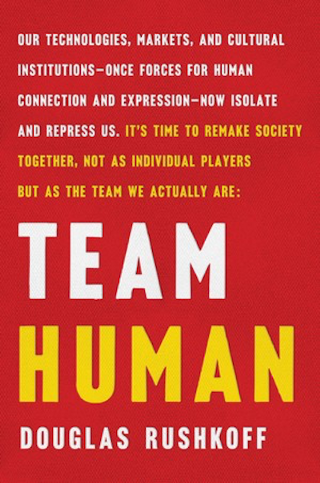
This was section 72 of the new book Team Human by Douglas Rushkoff, which is being serialized weekly on Medium. Read the previous section here and the following section here.