
We Made the Economy, We Can Change Her
The challenge of our time is to redesign our economies within the planetary boundaries. It can be done! And you can be part of the process…

People often think that ecology and economy are each other’s opposites. When you want to protect nature, you harm the economy. When you grow your economy, you harm the ecology. Apparently, there’s a connection between the two.
So why don’t we explore how to grow the economy ánd restore and maintain the ecology? They aren’t that different! The two words have the same Greek root: oikos, which means household.
‘Ecology’ means knowledge of our planet home. ‘Economy’ means the management of our planet home. So why not teach economy and ecology together and find new ways, new solutions?
Linear thinking
Where do we go wrong with our current economy? I wrote about it in my article Business Models: from Linear to Circular to Regenerative. We are thinking linear whereas the world is systemic.
We created business models that leave out any resulting negative influences. Businesses are allowed to limit the price of their products to resources and added value. We do not calculate the problems we create, they are thrown over the wall into our societies.
Let others deal with pollution, social injustice, health issues, and degradation. Therefore, our products are cheap, are economies are based on growth and our problems are now turning into a real crisis of multiple issues.
Thinking in values
Capitalism needs to be redesigned. I am a great advocate of thinking in values instead of money. If you consider life, there are many values that are way more important than money. Love, health, and peace, to name a few. But also working ecosystems that will provide drinking water, clean air, healthy soil, living oceans, etc.
The Stockholm Resilience Center and it’s former director, Johan Rockstrom, has published several papers on the planetary boundaries. And they give a good framework for new economic thinking.
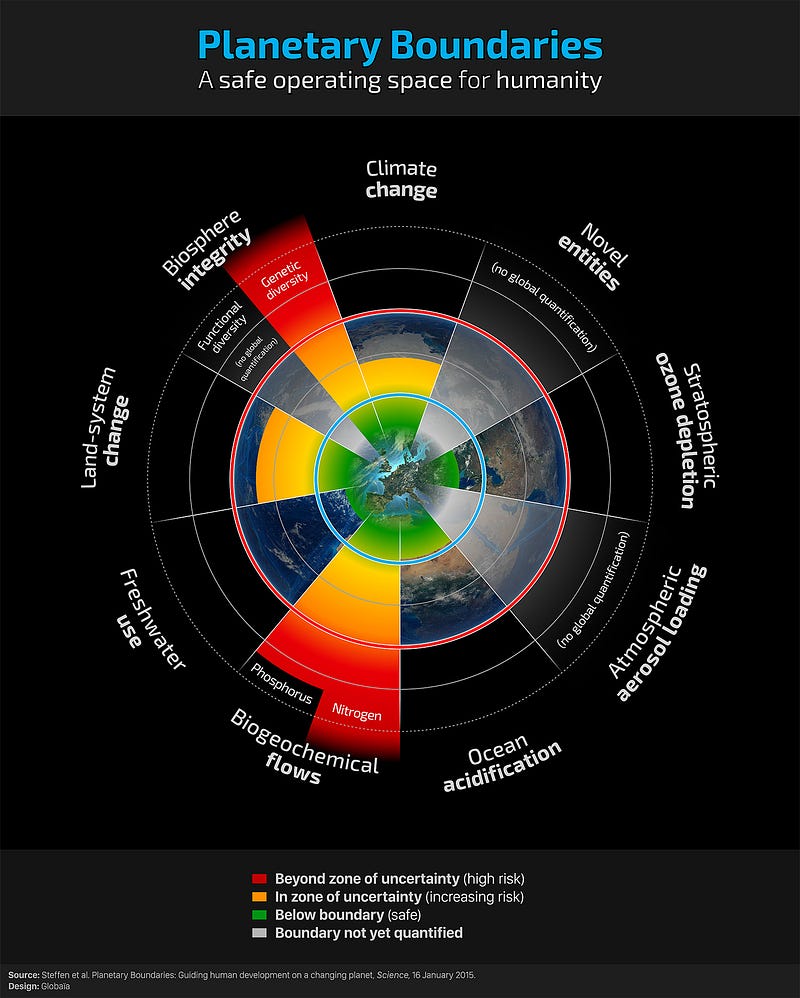
The planetary boundaries concept presents a set of nine planetary boundaries within which humanity can continue to develop and thrive for generations to come.
You can see that Nitrogen, Phosphorous, and loss of biodiversity are already in red and form a problem. Several others are in the orange zone of uncertainty. You can also see here that although climate change has been framed in the public mind to be the biggest problem, it’s not (yet).
Because our planet is systemic, we need to see the problems in relation to each other, we cannot view them separately. Therefore, the solution has to be systemic as well. If we focus on solving just one, e.g. CO2 and fossil fuels, we will definitely create extra problems in one of the other segments.
Doughnut economy
Kate Raworth, an economist, has taken this research and created the concept of a doughnut economy with it. She combines planetary boundaries with the basic needs of humans. Her concept is explained in a one-minute video by Jonny Lawrence.
Brilliant! So what skills do students need to have in the 21st century? They need to be taught how to think systemically. And specifically in economics education, how to balance the shortfalls of societies with the overshoot of our planetary footprint.
Have you ever heard of Earth Overshoot Day? In my country, The Netherlands, this day was already on May 4th this year (2019). It means that on May 4 we already used more resources than our planet can regenerate. It means we are living in debt to nature. We cannot afford our spendings.
Regenerative business models
The work of Johan Rockstrom and Kate Raworth is very important for the general view on macro-economics. We have to redesign the system. But there are many more people who change our economies from the bottom up.
They are e.g. entrepreneurs who build their business cases with regenerative business models. They DO realize their impact. They use waste streams as a resource. They build local short supply chains, so we do not have to ship goods all over the world.
They restore ecosystems and build new value streams with the biodiverse produce. They restore the land, the oceans, the rivers and earn their living doing it. There is even already a living example of a regenerative economy in Europe. I wrote about them in Heroes of El Hierro Part I and Part II.
They use the principles of the Blue Economy as their method. And yes, systems thinking is the key here as well.
A role for everyone
Well, what can YOU do to get here? The good news is: there’s a role for everyone in this new economic thinking. Most important of all is that we care. And that we learn about nature, about our home.
So start to learn about our planet. Take up natural gardening. Connect to nature. Rewild your soul!
Stop buying stuff. You don’t need it. Live abundantly, enjoying the things that are really important in life. Laugh, love, and have fun. Spend your money on personal development, on trees, on organic food, on experiences that deepen our lives.
Make a living doing what you enjoy to be doing and contribute to a new, purposeful economy. We have just one life, why waste it?
And if you want to connect, you can find me on LinkedIn or in our food forest, restoring ecosystems in a small way…
Further reading
About the author
About a steep learning curve


