
We Don’t Want Your Restaurant Here. Go away.
It’s lousy when an entire town disowns you.
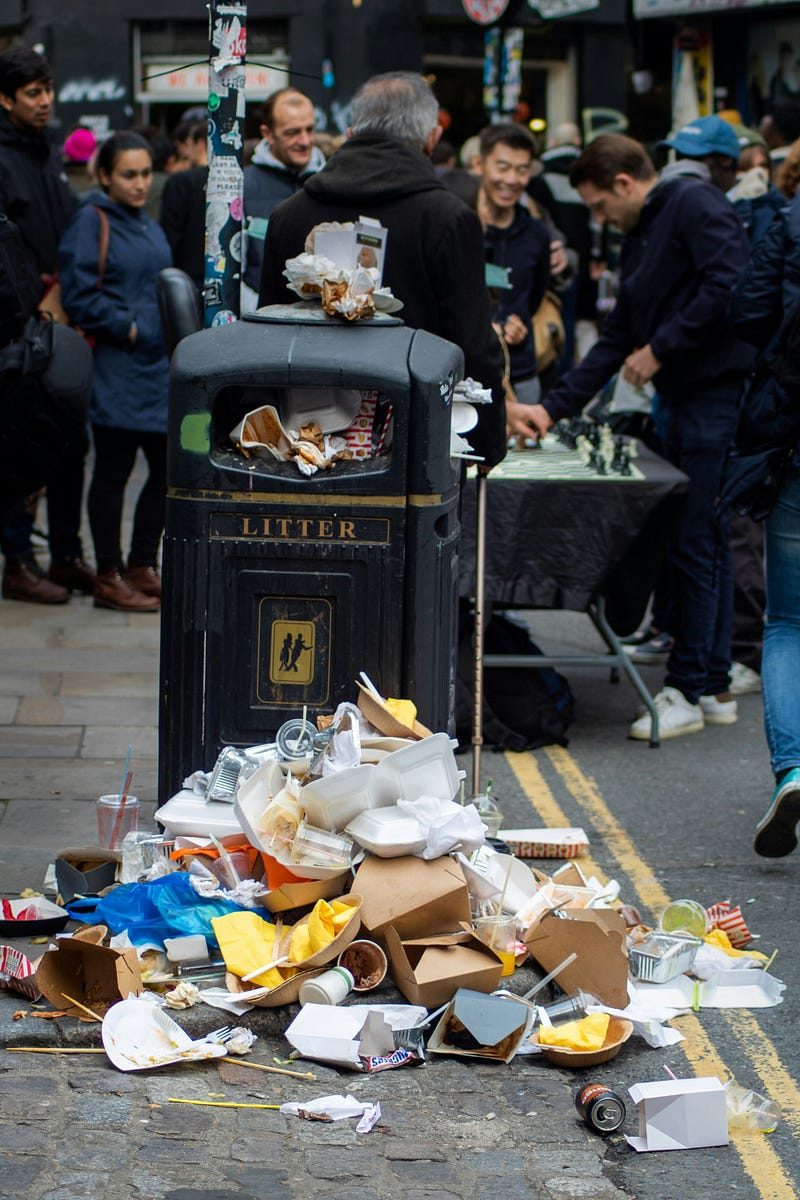
You’re going to litter the streets with takeaway packaging. And bring riff-raff to our town.
Having emigrated from South Africa, we were looking forward to opening our business in England and making it our new home.
I was putting the finishing touches on our restaurant, which was opening in a week. While wiping the glass covering an ancient horse hair and limescale wall that had been uncovered in the renovation, which we preserved, an elderly gentleman stuck his head into the restaurant.
He wore his jacket over his shoulders, unbuttoned, but did not put his arms through the sleeves. It gave him a debonair swagger. He was handsome and I pegged his age somewhere in his mid 80’s.
“Hello, my name is Saville. We really do not want you in this town. You are going to foul up the High Street with litter and bring unwanted people here,” he said.
I said nothing.
An hour later two elderly women barged in demanding to know why we chose “their town”. It was a nice, quiet respectable town and did not need riff-raff and takeaways bringing filthy packaging to their area.
I said nothing.
Half an hour later, the Chairman of the Small Business Association, clearly a wannabe small-time political ‘player’ presented himself to me, and after discouraging me from opening, and describing what sort of shop this town needed, (which mine was not — his words), he offered me an annual membership to the Association.
He sold ornate clocks, high-end ashtrays, “better” umbrellas, and £1000–£10,000 semi-precious stone and gold kaleidoscopes. He struggled to cope with the 7 sales he did a year.
I said nothing besides the usual, hello, hmmm, yes, yes, and goodbye. I declined his offer to join his Boy’s Club or shake his hand. He smelled of little boy’s wee and hair pomade.
I had many naysayers.
It did make me think though. I had never heard of a town refusing potential customers or business. Especially in a town that was dying. All the banks and the Post Office had recently left. A sure sign.
What had I gotten myself into? Nobody would do this in South Africa, I thought. South Africans generally encourage people. This was different. There is nothing quite like the feel of a town telling you,
“You are not welcome here.”
It was orchestrated as well. Fortunately, the other side of a South African character is stubbornness and tenacity. I relied on that part.
Nobody had stopped to ask what we were doing. Or asked to look at a menu. They simply assumed. When I arrived in town, it had nothing decent besides one coffee shop. I took one look at what was on offer, studied the coffee shop, which truly was exceptional — the heart of the community, and knew instantly that this town was a goldmine looking for someone to break it open.
Today it is a food mecca. We did that.
Notwithstanding the negativity, we opened and boomed. We were not a takeaway, besides the odd lunatic who wanted a lobster to take away; and we won awards. The town was noticed because of our little restaurant.
Mr. Saville came in the second week. Popped his head in the door, and said,
“Hello, it’s Saville again, I was wrong about you. My apology.”
He was the only one who apologised.
All the other naysayers booked and dined. They came up to my pass on the way out and expressed what a great meal they had enjoyed. Not a mention or apology by them for the earlier verbal abuse. I was now a culinary hero.
And I probably should have left it at that.
But I didn’t.
“Oh, I remember you, you were the two ladies who told me I was not welcome. So glad you enjoyed my food. You must be pleased we did not take your advice and leave,” I said.
I enjoyed watching them squirm.
That’s the other thing about South Africans. We are generally arseholes. Far too arrogant.
When Saville popped his head in to apologise, he also booked a table for the following week. I really looked after him when he dined with his lady friend. I found out later that he was a total rooster and lady’s man of note. Anybody over 60 in that village was putty in his hands.
The day after he dined, he arrived with a thank you note, a wonderful bunch of flowers, and a box of chocolates. This was a gentleman.
It takes so little effort, and is so easy to apologise. More people should try it.
We remained nodding acquaintances on the street from then on. He dined fairly regularly. I learned he had been a fighter pilot. He was a bachelor. He had been awarded honours by the Queen, a CBE or MBE or something, and he was wealthy.
In that town, everybody was.
And then he got sick. Very sick. I had not seen him around for a while, and then, walking to my car one morning I saw him. He jokingly moaned at me, ‘No self-respecting Englishman drives a German car boyo’.
He had always been immaculately turned out. A good frame, slight but sinewy. Blazer always. His arms out of the sleeves. He swagger-glided like Anthony Hopkins in Silence of the Lamb, … with one hand in the jacket side pocket, but not today. He was shuffling.
His eyes still had a sparkle, and showed his past. But his skin was the wrong colour for healthy, and showed the map of his future. He looked exhausted. Smaller.
I asked him how he was doing. He knew why I was asking. He knew he looked like shit.
“I’m standing aren’t I,” he replied.
“You look thin,” I said.
“I haven’t the strength or the inclination to cook old boy, I’m too tired,” he replied.
“You come past the restaurant just after 6 pm. We open at 6. Before you go for drinks at the pub … and I’ll feed you … every day. Simple home-cooked food,” I offered.
“You’re joking of course,” he replied.
“Nope. And it is not an offer. I insist,” I replied.
He came that night. And almost every night after that. Sheepishly at first. Like a wounded animal peeping out of its lair for food. But it became habitual and it normalised.
On the first night, he insisted on paying. I countered gently for a while, explaining that with his bird-like appetite, I thought I would survive his culinary onslaught.
He looked at me, his eyes watered, as did mine. We both knew he was dying. And although I hardly knew him … I knew he was special. I knew that much. This was a soul worth crossing the street for.
This man was the sort of man, who when dead, made us feel that the world has lost something precious.
If I could do anything with my life, it would be to travel the world and just sit in the presence of these types of men and women, and just listen.
“Please,” he said, “I need to pay. I have money.” As I looked at him, I saw what pride looks like in a man’s eyes. I saw my grandfather and my father. My grandmother and many others who had passed.
Proud people.
“Okay,” I relented, “But … I know the food cost, you don’t. I will present you with a bill, but I set the price. No arguments.”
He nodded. He was happy with this arrangement.
He sat at a small table to one side, and I asked him what he felt like.
“I’d just love a small omelet with a small tomato salad, I don’t eat much, and I haven’t had a decent omelet in ages, they’re all like rubber,” he said.
“Coming up,” I said and went to make the very best omelet I could muster. When I asked him how it was, he said, smiling, “It’s not rubber.”
On some nights he had fish, some nights meat, and many a night soup or an omelet with a slice of our homemade lightly toasted yogurt bread.
On that first night, I presented him with a bill for £3.00. He looked at me when he opened it and smiled. I knew what he was thinking. I could have been one of the very few people in his life who did not try and take advantage of him. And he knew it.
He paid it and left a 30-pence tip. On some nights he might have a glass of wine, a whiskey, or a beer, and on special nights, I would sit with him while he ate, and chat. I loved those nights. He left a tip every night. Always 10%.
Towards the end of his life, he mostly ate soup. He loved a seafood soup I made and it was often that. Or tomato soup. Never vegetable soup. He would eat beef broth, but not willingly. The portions became smaller and smaller.
He began to shrink into his tailored jackets.
He began to look like a boy going to school on his first day.
When he was still feeling better, his lady friends would stop by the restaurant and hoot for him.
He would say,
“Aaah the mating call of the English double-breasted housewife. I shall be forced to migrate South and bury myself in her nest, no doubt. The price one pays for decent company and a glass of lousy plonk.”
He would slowly rise and for a moment, I would see the old Mr. Saville. The debonair woman slayer.
Or he would thank “the boys” in the kitchen for his dinner and say,
Don’t do it, boys. They say paying for it is wrong. Rubbish, … either way, you pay, but one of those options comes with freedom and no strings attached.
It’s not easy to get a hardened kitchen brigade to laugh from the belly. They laughed.
My favourite expression of his was:-
A dinner good enough for the devil himself.
Which if you think about it … is a much better expression than those with ‘divine’ or ‘heaven’ in them. If anybody is going to be decadent and epicurean, it’s the devil himself.
And then one day, Mr. Saville did not arrive for dinner.
I had prepared a small lamb cassoulet for him. No visible vegetables. I waited. By 7 pm the restaurant started to fill up, and service began to pump. I put the lamb aside. Hoping.
That night, after service, which had been a strong night with no fuckups, I felt shit. I sat at his usual table, the restaurant empty, and I ate the lamb. As I forked Mr. Saville’s lamb into my mouth, tears rolled down my cheeks.
I did not know for sure he was dead. But I felt something. An end to a bloody good movie that you did not want to end, type of feeling. I also realised I did not know where he lived. He had eaten with me for around 6 months now, and I knew nothing about this man, except his eating habits, and a few wonderful stories.
I was crying over a man I hardly knew. What a plonker I was.
I made lamb, again, the next night, and again, he did not show. I threw the lamb away this time. I would not let anybody touch it. I felt angry. Deprived of the opportunity to say goodbye.
Word filtered onto the street that Saville had passed. Everybody knew him, and yet none of us did. He had no family. No wife. No children.
He was his everything.
He had died as he ate, and as he lived, mostly alone. No attachments, no debts to pay to people or society. A giver of the things that truly mattered in a life well lived. Probably happy too.
But I wasn’t. I felt empty … deprived of something genuine.
I went to his funeral. A smattering of people turned up. Mostly women. It made me laugh. I saw a picture of him on his coffin. In an RAF uniform as a young man. He was fine.
They buried him behind my restaurant in the church cemetery. He must have been important because few people are still buried there.
I used to go talk to him around 6 pm some nights.
And then months later, just before lunch, a man arrived with a sealed cardboard box. He introduced himself as Mr. Saville’s solicitor. And he told me that just before he died, he had added a note to his will. And this box. With instructions that when the estate was wound up, he was to hand deliver it to me at my restaurant. He even left me a fiver for travel and lunch money, three quid and thirty pence.
“I must give you this message, (The solicitor pulled out a piece of paper on which he had jotted what to say, — typical solicitor). He told me to tell you, that he had told me:
“His food is shit, and don’t eat the soup or an omelet. I started eating it, and look what happened to me. But it’s better than a takeaway.” — Mr. Saville, deceased.
Typically Saville
I undid the plastic seal, and a god-awful pong hit my nostrils. I quickly opened the cardboard box and inside was a filthy dirty used fish and chips takeaway box, inside the box was a small note, and 500 quid in cash.
The note said,
“Take the boys for a “knees up” to remember me by. Thank you for dinner old chap. The tomato soup was salty.”
What a prick.
“Are you crying, Sir,” the solicitor asked.