
Poetry, Photography, Nature
We are Hippopotami
Wildlife Trekker Monthly Challenge: Wild Baby Animals
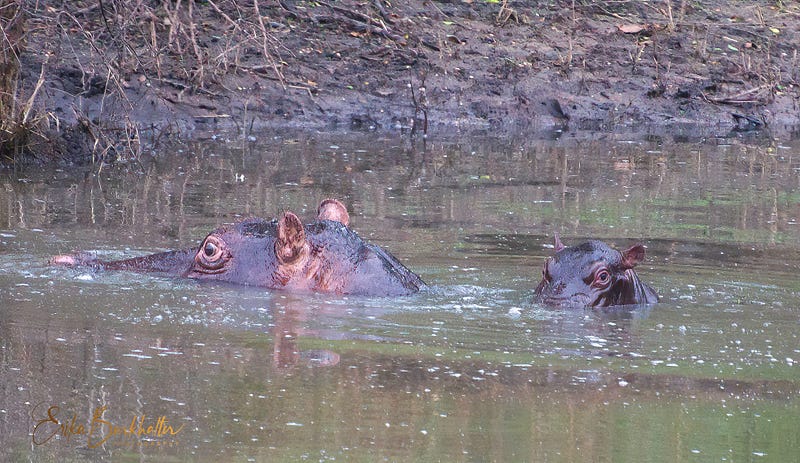
We are hippopotami, my mother and me.
As you can see, I’m still quite tiny — well, as tiny as a hippopotamus can be.
My feet don’t reach the murky muck at the bottom of the pond, just yet.
And so, I get a ride upon my my momma’s back.
I see you watching me from the back seat of that jeep and I really don’t know what to think of humans or cameras or of the whole, big, wild world beyond my little swamp.
So, for now, I’ll take a ride upon my momma’s back and let her decide if you are safe or not.
And, oh — I’m getting sleepy. Perhaps it’s time to take a little hippo nap.
While in a wildlife area near Kruger National Park, in South Africa, several years ago, we came across what looked like a lumpy log floating in a very mucky pond. Our local guide, in a rather hushed, but excited, tone of voice, pointed out that the log was not a log at all, but, rather, was a mother and baby hippopotamus.
When the babies are very small, as this one was, the mothers float them on their own backs in the ponds because the babies’ little legs aren’t long enough yet for them to stand up in the water.
These are adults, lounging in the cooling waters on a hot afternoon.
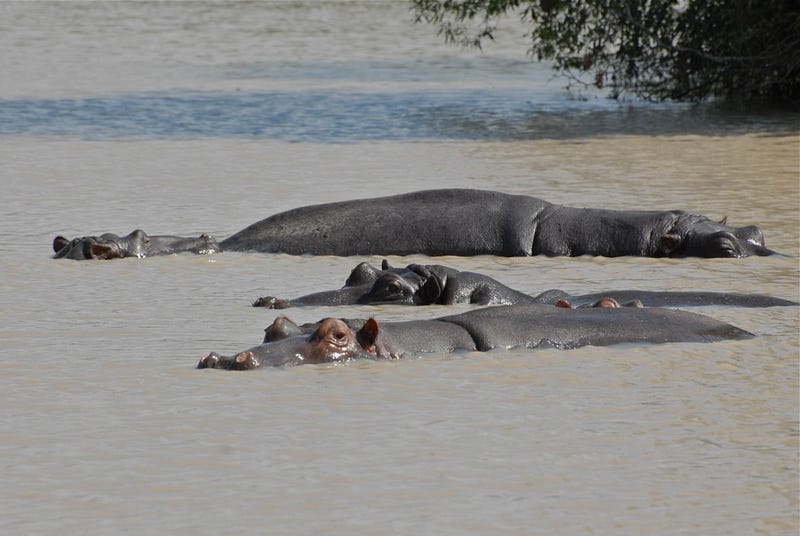
Aside from elephants and rhinos, the hippopotamus is the largest land mammal. Believe it, or not, the closest living relatives of the Hippopotami are cetaceans (whales, dolphins, porpoises, etc.), from which they diverged about 55 million years ago.
They are “even-toed ungulates” or artiodactiles, meaning that they bear their weight evenly on two of their five toes on each foot. Cetaceans have evolved from this same family of mammals.
Despite how cumbersome they look, they can run up to nineteen miles per hour, which makes them among the most dangerous animals in the world. Our guide told us that their eyesight is pretty terrible though, so if you are charged by a hippo, you should run between trees and other large objects to confuse them.
It’s pretty easy to be surprised by a resting hippo, draped in moss and other greenery from ponds and mangrove swamps, because they blend in so well.
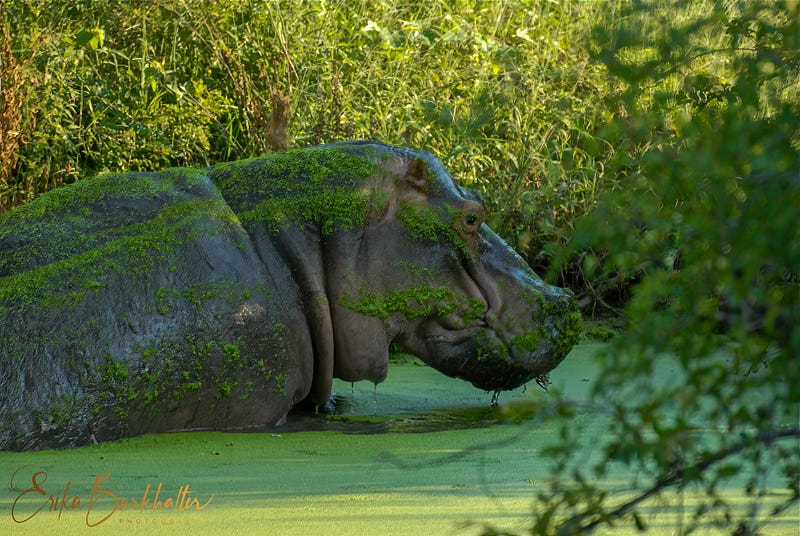
We came home from safari one late afternoon and were told not to go near the pool or the pond because one of the local hippos had decided to take a bath.
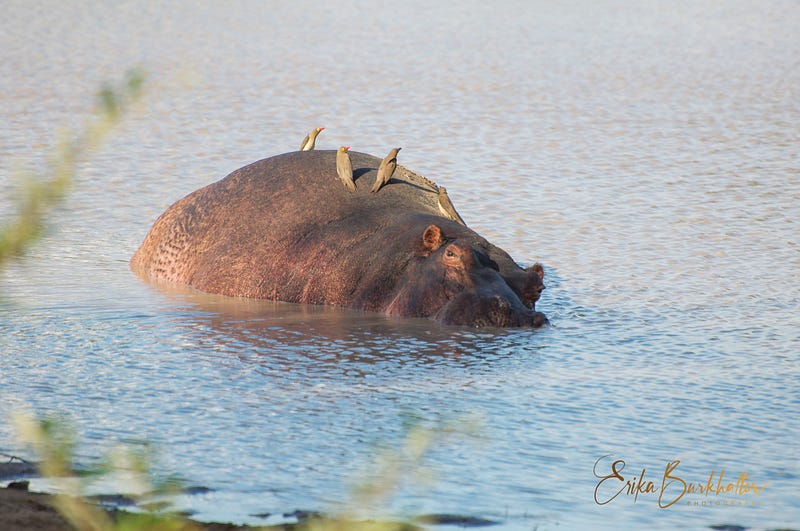
We steered clear and opted for a glass of wine on the viewing deck instead.
We saw so many amazing creatures and such diverse beauty in South Africa, but I have to say that one the images which has most stuck with me is the sight of that little baby hippopotamus perched upon its mother’s back, going for a swim to the deep end of the swamp.
Thank you to Randy Runtsch for creating the “Wild Baby Animals” Wildlife Trekker photo challenge. I’ve gone back and revisited some of my photos from our trip to South Africa and have gotten excited all over again about the animals we saw there.
More baby animals are coming — want to see a baby zebra? Stay tuned.
Several other photographers have been participating in this challenge and it has been so adorable to see the baby animal photos by Annabel Schoen, Anne Bonfert, Sharing Words, Dennett and others. I’d love to see what Scott Younkin and Ian Hanson — two really great photographers — come up with for this challenge.
Erika Burkhalter is a yogi, neurophilosopher, cat-mom, photographer, and lover of travel and nature, spreading her love and amazement for Mother Earth’s glories, one photo, poem or story at a time. (MS Neuropsychology, MA Yoga Studies).
You might also enjoy:
If you enjoyed this piece, you might consider subscribing to my stories. You’ll get an alert whenever a story gets published. While I do normally post my stories with free “friends” links on social media, if you enjoy reading on medium, you can help the many talented writers here by joining. It helps to support the arts and to keep us writing!
And, because I’ve had a few people asking lately, if you’re ever interested in purchasing a photo, just leave me a note.
Photos and story ©Erika Burkhalter. All rights reserved.


