
Water for Elephants; Food for Thought
Lords of the Ring
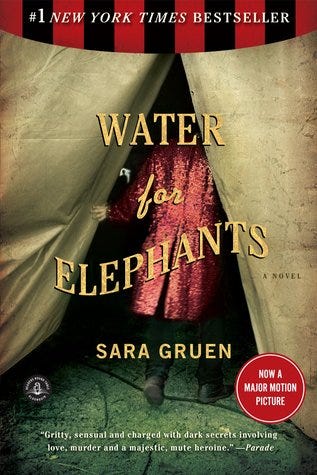
I’ve just finished reading Water for Elephants by Sara Gruen.
I loved it.
But when I went looking for reviews to gain insights on some of the obscure points, I found that the novel was one of those where you love it or hate it.
Like The Bridges of Madison County, which made me go all gooey inside, but had others hurling the book across the reading room.
Like Bridges, Water has an adulterous romance at its heart, and that seems to have caused many to mistake Gruen’s circus tale for a love story. Well, it is, but not quite what some people expect.
The bones of the plot
The male protagonist, Jacob, tells the story, and it’s a familiar one. A family tragedy sees him leave university, and he’s on the bum in Depression America. He hitches a ride on a train which turns out to be part of a travelling circus, and before you know it he’s part of the crew, caught up in all the drama and conflict of the big top.
He falls in love with Marlena, the equestrienne star in her spangled tights, but she’s married to August, the head of the animal department, who has his own animal passions.
So it’s a romance with Jacob and Marlena, yeah?
No. The horse-riding lady is there to spark tension and conflict in the story. The real drama here is between Jacob and August, and the harsh realities of the circus business.
It’s not a love story, unless you cast it as a love story between the author and the topic.
As a period circus drama, it stands well beside other classics of the (limited) genre, such as Gary Jennings’ Spangle.
Now, I can see how one might mistake it for a love story. The two parties meet on almost the first page of the book, they overcome immense difficulties to be together, and in the end, they are together. Kind of.
But no. If it were a love story, then it would be told by the lady. She is married, she has her horses, she has a comfortable life. If she chooses Jacob, she gives it all away. Obviously the tension and conflict in her mind is a great story, and by giving Jacob the central role we lose all this.
Marlena is drawn as a bland and boring character. She doesn’t contribute a real lot to the romance.
Furthermore, if it were a love story, when Jacob gets his chance to leave with Marlena, he would take it. He’s got Camel and Walter — two minor characters — to worry about and he stays to protect them. If his first priority was Marlena, there would be no question about his decision. He’d go off with her.
True love here! Step right up!
Sara Gruen is telling the story of the circus. Backstage, mostly. Very few of the events occur ringside. The cruelty, the violence, the processes of the circus are what the story is about.
And there is where you see the elements of the true love story. Right on the first page, we meet the circus. Backstage. There are difficulties along the way, the characters of the two parties are drawn with considerable care, and they end up together on the final page. For real.

I loved the various framing devices used in the story’s narration. Ostensibly it is told by Jacob, now 90 (or possibly 93) and relegated to a nursing home where he is finding life a bit of a chore.
He may not be able to remember what happened last week, but the events of seventy years ago are crystal clear.
All but helpless with his wheelchair and walker, he echoes the plight of Camel, the first circus worker he meets, who becomes disabled and powerless when stricken with a Prohibition-era ailment.
As readers, we know how Jacob ends up — or we think we do — and we cannot help but contrast his ancient self with the naïve young man who tells the main story.
Jacob is placed within the story in a position where he must deal with performers, workers, and management. This gives him a distinct ability to explore the differences in conditions. The workers are paid a pittance and often sleep in squalid quarters. Two to a bunk in three-high tiers, or under a wagon on a flatbed carriage. They pass around moonshine or worse in their infrequent moments of leisure.
In contrast, the upper classes of the show live in velvet luxury, swilling scotch and champagne, occupying expansive quarters in the “privilege coaches” on the train.
The twin evils of Depression and Prohibition are at large in the land, and we see the effects of both. The circus represents a brief escape from the mundane, where for a quarter the “most spectacular show on earth” is provided, with many more subsidiary delights available for a few coins more.
Behind the scenes, the circus is counting pennies with equal attention, and the book is littered with the picked-over carcasses of other shows until, well, you’ll just have to read the book for yourself.
How to write a good novel
As a writer, I enjoyed the colour and atmosphere. Sara Gruen must have had a splendid time writing some of the scenes. She was guided by histories of the American circus, and she mentions some of the old photographs which provided many of the details.
The sounds, smells, textures, and emotions of the circus life are all described vividly.
The characters — and there are a couple of dozen to keep track of — are all distinct, occupying diverse niches in the travelling show, and it is important to be aware of their various motivations and loyalties.
Perhaps it is a shame that we do not get a better depiction of Jacob’s love interest. She is little more than a flashy starlet, seduced away from a tranquil and turgid life by the chance to perform with a team of liberty horses, and a marriage to a flashy and charming performer.
But Jacob is the star of this show, and it is his love for the animals and people of the circus that powers the narrative. Seventy years on, and the sight of a circus setting up a big top down the street from his nursing home is enough to set his blood racing and his memories flowing.
And his nightmares returning.
There are scenes of cruelty and violence. This is not a book for those who imagine it’s a sweet love story. Bring along your thinking cap, and look under every word for hidden meanings.
Britni
More magic:
What about that Bridges book, eh?


