
Was William F. Buckley, Jr. gay?
The Republican activist was often read as closeted
He was the activist who launched the conservative movement. William F. Buckley, Jr. was a new image for the right-wing—intellectual, and fun? And gay?
There was always talk. He died in 2008, but Republicans haven’t forgotten. The journalist Darren J. Beattie recently tweeted:
“What’s disgraceful is that Willam F. Buckley stayed in the closet his whole life, and managed to pass himself off as an aristocrat to a gullible American audience.”
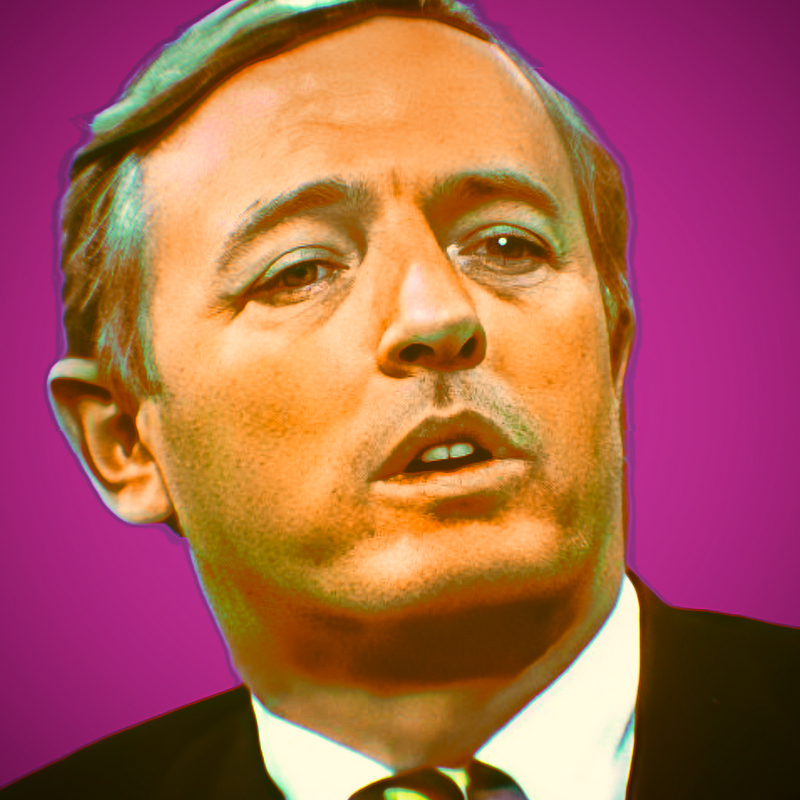
Born in 1925, Buckley was feminine as a boy.
A biographer, John B. Judis, looks at a photo of ‘Bill’ at age three, and finds he could be “a pretty little girl.”
Bill was often off with his sisters, not playing sports, etc. A childhood playmate is quoted recalling him as a “mama’s boy” who was “a little bit effeminate” or “effete.”
He enlisted in the Army during World War II, still ever given to curiously ‘queer’ scenes. As Judis narrates: “Once, when leading a group of men in a training exercise, Bill stopped in order to pick a flower…”
Serving out the War stateside, he then went to Yale University.
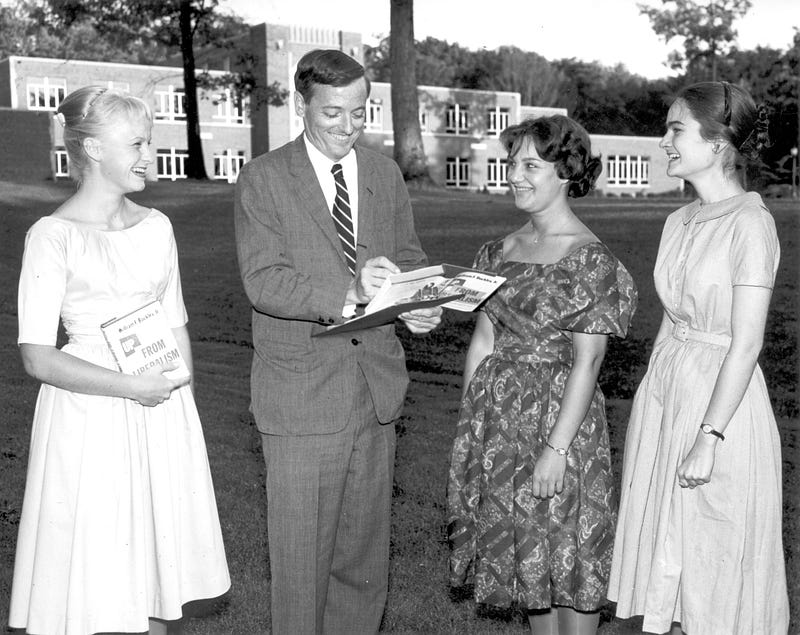
He became a religious activist in 1951.
Buckley’s book God and Man at Yale alerted Protestant America that the Protestant school was becoming ‘un-Christian’. The book was a surprise bestseller.
The religious issues here are complex. As a Catholic, Buckley should’ve read as ‘godless’ to his largely Protestant audience. The Catholic-Protestant divide was so deep, ordinarily, that it really shouldn’t have worked.
But he managed to present himself as a generically ‘Christian’ activist who’d safeguard Protestant concerns. That became his act, transferred into national politics and called “conservatism.” Buckley and other right-wing Catholics offered themselves to Protestant America as guardians of issues relevant to a ‘Christian’ sensibility.
What helped along the way was Buckley slathering on a lot of racism to reassure Protestants they were all on the same team.
In 1950 he married a Canadian lumber heiress turned New York socialite.
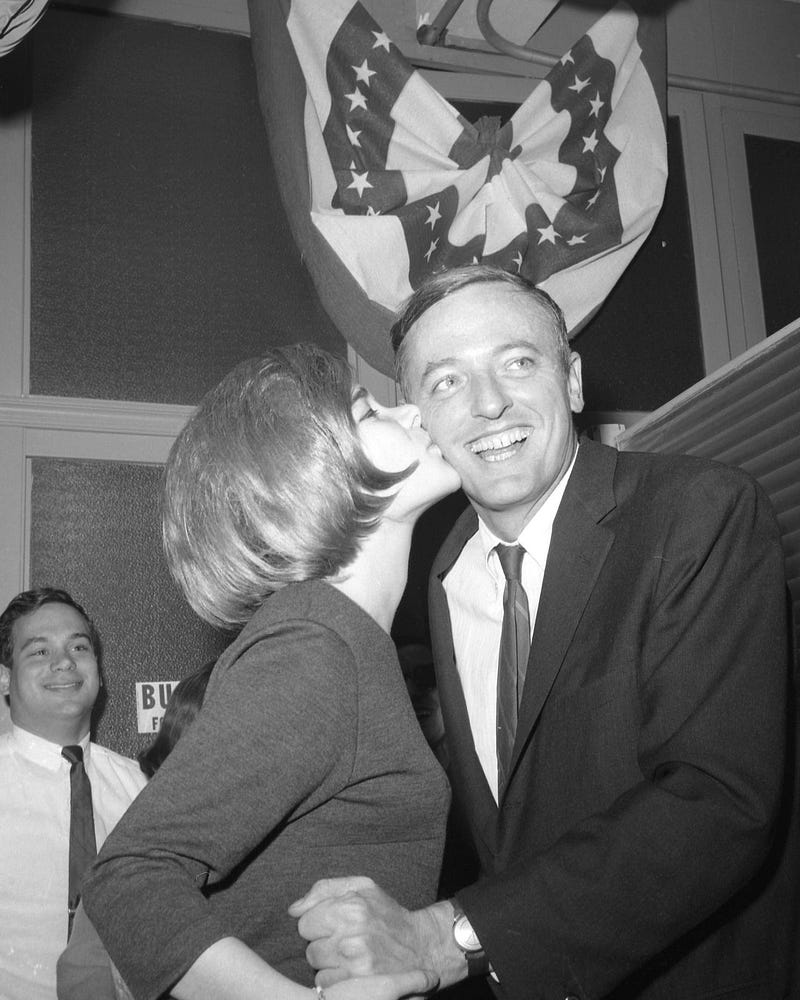
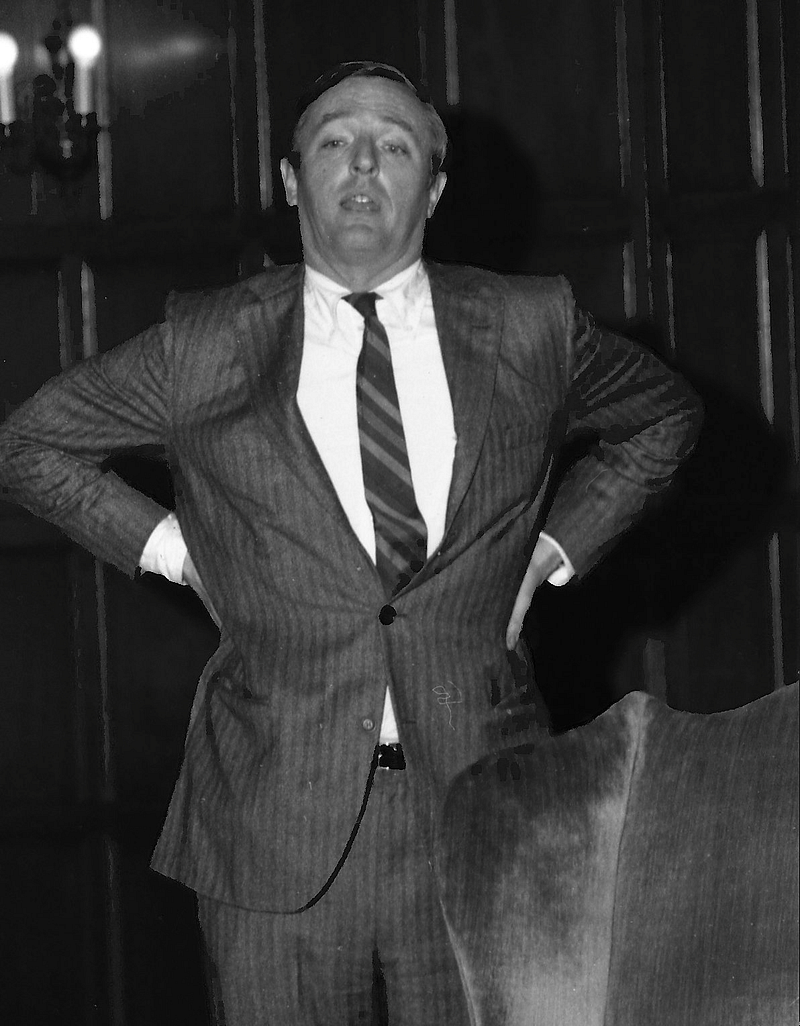
Looking at photos of Buckley and his wife, Pat, I’m often momentarily confused and thinking he’s standing next to a drag queen.
These were two very theatrical people. Unusually for a Catholic couple, they had one child.
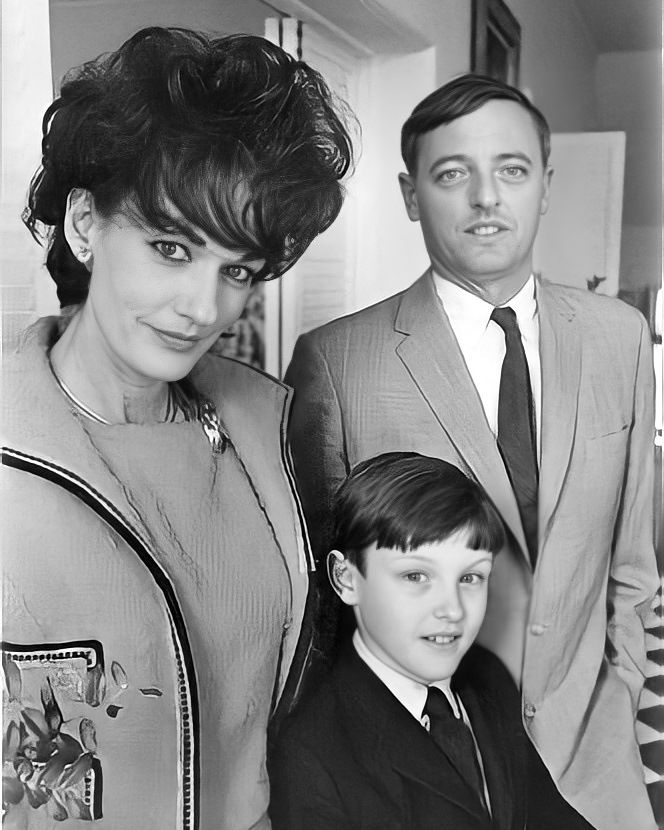
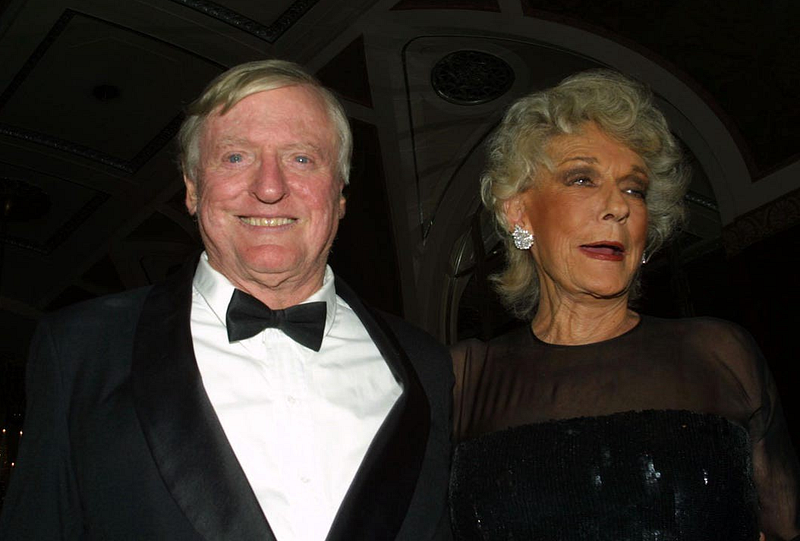
For decades, the Buckleys presided over a conservative club that was bizarrely ‘queer’.
In his 2009 memoir, Losing Mum and Pup, Christopher Buckley writes of his childhood as a kind of gay heaven. The fashion designers Valentino and Bill Blass were around. His mother had Jerome Zipkin, a gay man, escorting her to social events. Then there were all the gay conservatives.
In a footnote to his book, Christopher Buckley adds:
“It’s interesting, in retrospect, how many Republican and conservative operatives/figures were gay — Marvin, Terry Dolan, Arthur Finkelstein, Roy Cohn, Bob Bauman — almost all of them distinguished by an aggressive, one might even say combative, style.”
The Buckley queer lore is legendary.
He was apt to be friends or enemies with a Who’s Who of 20th century queer icons. “Buckley and his wife had once gone to a gay bar with Truman Capote, without any apparent embarrassment,” notes Heather Hendershot in Open to Debate, a 2016 study of Buckley’s media career.
In 1965, Buckley had a famous debate with James Baldwin, the subject of The Fire is Upon Us. A sexual subtext ever lurked. It might’ve even read as “our gays” vs. “your gays.”
Roy Cohn was a friend…if a little too gay.
Whittaker Chambers, who was quietly gay, was an editor at National Review. Buckley was friends with Bob Bauman, a longtime Republican activist and then congressman who was caught, in 1980, soliciting a 16-year-old male prostitute. Buckley was agonized at what to do.
He was longtime friends with the Republican activist Marvin Liebman — or he was until Liebman came out of the closet in 1990. I’m reading Liebman’s 1992 memoir, Coming Out Conservative. He recalls Buckley as emotionally remote. He writes:
“We had a close and almost empathetic relationship, but I can recall only a few times when we ever had a ‘personal’ talk. Bill is shy about revealing any of his innermost thoughts.”
Christopher Hitchens, who knew Buckley, had a similar read of Buckley as very emotionally distant. He recalls:
“He seems to have arranged his life so there was very little privacy, or time for intimacy or informality in it. You had the feeling that he was repressing the demons that would close in on him if he was left alone with his own thoughts…”
Then came a scene that will live in infamy.
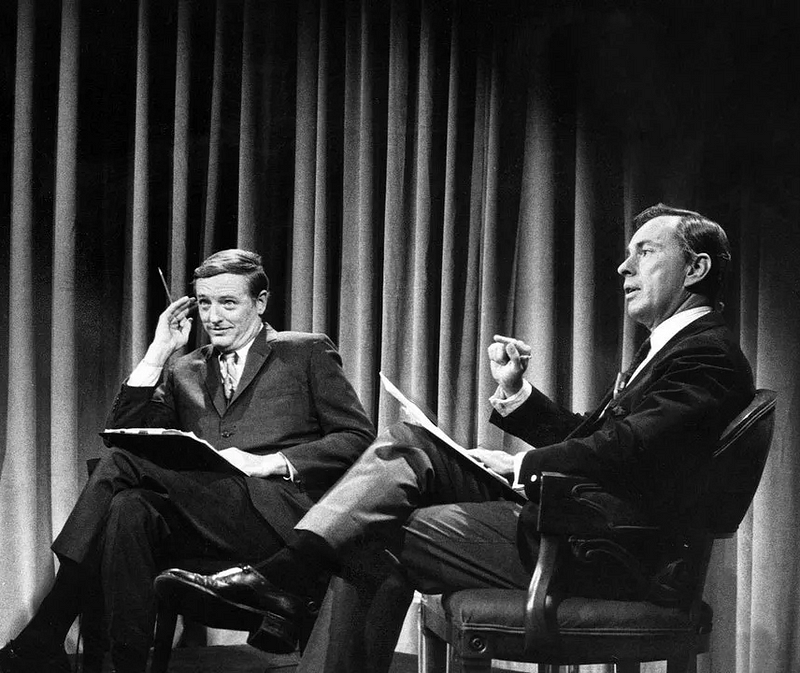
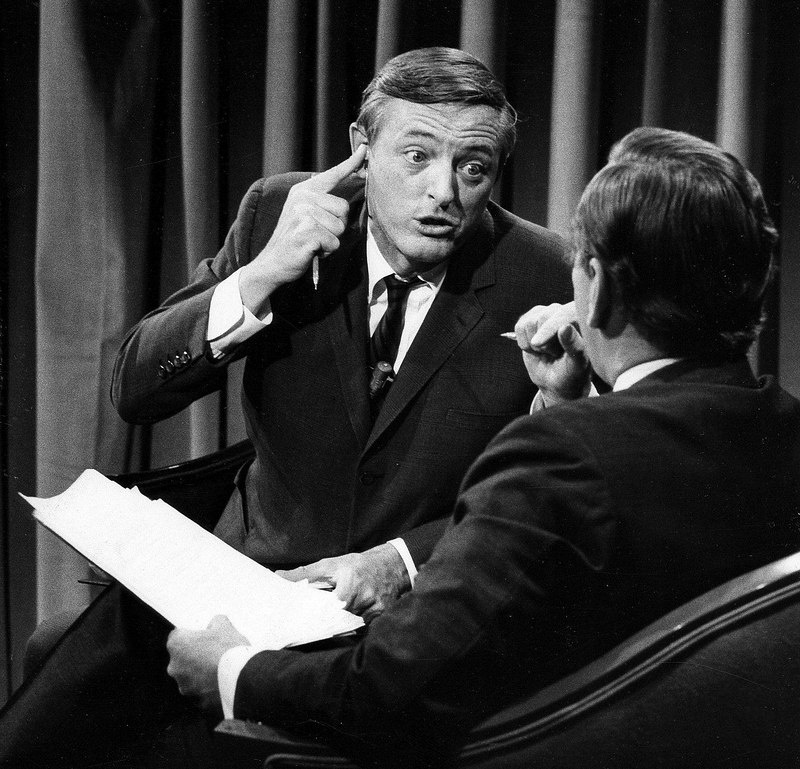
In 1968, Buckley and the novelist and political commentator Gore Vidal were doing some T.V. debates. Buckley was famous from his T.V. show Firing Line, and a run for New York City mayor. Vidal was infamous with his bestselling novel Myra Breckinridge, whose highly-opinionated heroine, he said, was based on William F. Buckley. But Myra was transgender.
During an exchange about the Vietnam War, Buckley exploded:
“Now listen, you queer, stop calling me a crypto-Nazi or I’ll sock you in your goddam face, and you’ll stay plastered!”
“You queer” wasn’t language one heard on T.V.
The 2015 documentary Best of Enemies (or a scholarly paper that same year) brought back the tangled scenes to follow, the wars of words that became career-defining insults. But is the real story yet unacknowledged?
Buckley was also being outed, according to his wife, who fretted that “two hundred million Americans think William F. Buckley is a screaming homosexual…”
This doesn’t owe to anything Vidal had said. The problem seems to have been that Buckley lost all composure. The calmly intellectual mask slipped, and he read as emotionally unhinged.
The scene read as a catfight between two ‘queers’.
There’d always been talk about Buckley?
After the T.V. meltdown, there was more. In an infamous Esquire article that resulted in Buckley suing him, Vidal wrote:
“The writer thinks that Buckley is a faggot. He is not alone. Norman Mailer even shouted the word ‘fag’ at Buckley during a Les Crane taping: It was cut from the show…how innocent television was before Chicago last summer!”
After that, the word seemed to be that Buckley was quietly gay. Who can forget the entry in the 1969 guide The Homosexual Handbook, under the heading “Practical Homosexuals, Past and Present”:
“Mr. Buckley hosts a television program and conducts it with a flourish and a zest, with such brilliant gestures and hand movement, that Gore Vidal is reported to have called him ‘the Marie Antoinette of American politics.’”
In later years there was more gossip about Buckley’s sexuality.
According to Truman Capote, as recalled by Andy Warhol in The Andy Warhol Diaries, Lee Radziwill said she “tried to seduce William F. Buckley, Jr. by asking him for spiritual advice and then when he didn’t respond she accused him of being queer.”
There was a blind item that didn’t seem very blind.
“He spent a lot of time with homosexual prostitutes from a specific procurer. He would often tell his favorites that he would refer to them on his TV show by assigning them an obscure word, Latin or English, and then use the word on his show that week.”
It seemed strange, in the 1980s, that Pat was a noted AIDS fundraiser.
And her husband had an infamous 1986 New York Times op-ed that suggested every person with AIDS should be tattooed on the forearm and buttocks.
In a 2015 essay, Alexander Chee recalls, in the early 1990s, working as a waiter for a New York City catering company. He was gay, and rubbing shoulders with the infamous Buckleys. He writes:
“And so if it seems strange to you that one of America’s most famous homophobes was married to a woman who was a hero to many gay men, if it seems strange to you that the household where she lived with him was sometimes full of gay men serving food and drink to her guests despite his published beliefs, well, it was strange.”
Buckley was devastated when Pat died in 2007.
Bob Colacello reported in Vanity Fair on visitors being shocked.
“I couldn’t believe the state he was in — really like a derelict,” recalls the interior designer Mica Ertegün. “I’m so worried about Bill,” Nancy Reagan told me in a telephone call shortly after Pat’s death. “I don’t know how he can go on without her. She ran his life, really. And he let her. He wanted her to.”
When Buckley followed the next year, Vidal kept up the sex talk.
“Vidal called his deceased nemesis a ‘fag,’ telling an odd story to exemplify the point, and leaving it unclear whether Buckley was reprehensible for hiding, or simply having, queer inclinations.” 🔶


