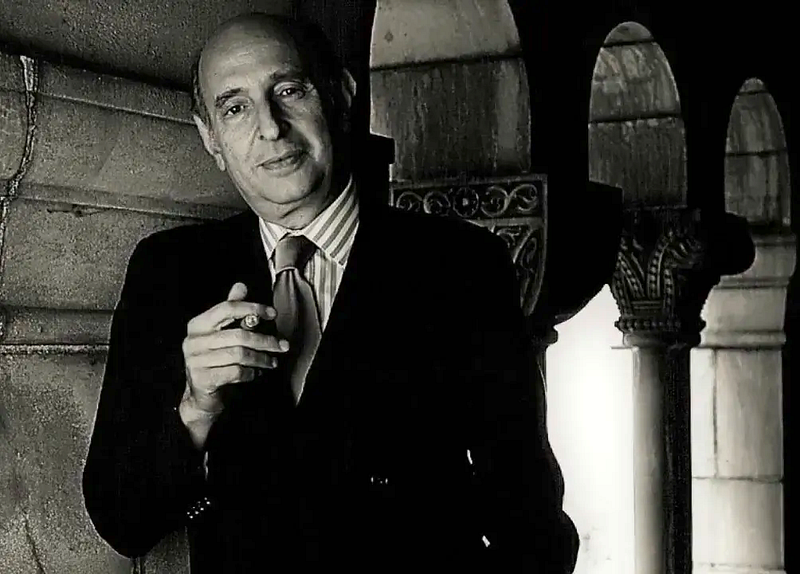
When Allan Bloom hired hustlers
A conservative icon had a secret life
He was the intellectual who published an era-defining book in 1987, and started the conservative war on “political correctness.” He died in 1992, as no one seemed to know much about him.
Allan Bloom, author of The Closing of the American Mind, is still admired in right-wing circles. You might hear grudging admissions he was gay, and died of AIDS. They don’t much care to talk about it.
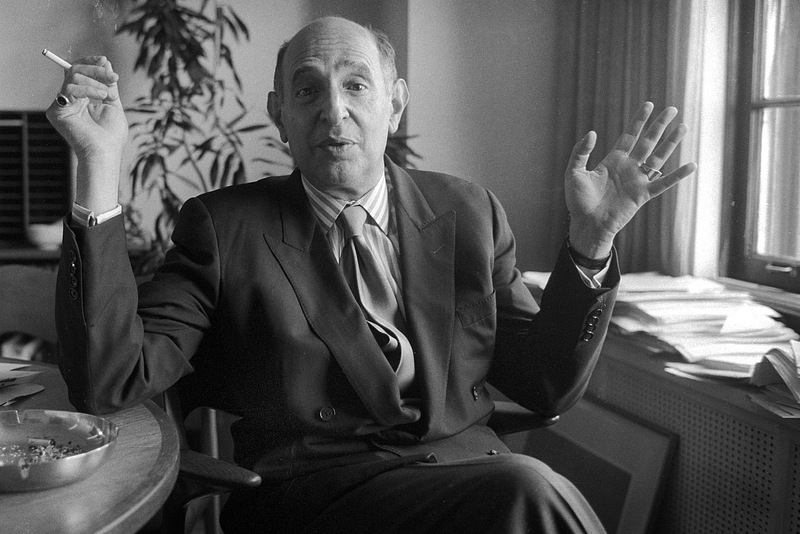
To look back over his life is to see a man who was constantly revealing and concealing himself.
Born in 1930, he was a Jewish boy from Indiana. In a 1987 interview he mentioned he’d been an unhappy child — and was asked to elaborate.
“That’s largely personal,” he says, darting to another subject.
A Jewish unmarried wisecracking political philosopher, Bloom seemed to delight in outraging. In a eulogy, a former student recalls:
“He would walk into class dressed in one of his dazzling Italian suits, carrying his elegant leather briefcase, smoking with gusto, and invariably chatting or joking with a student.… And then he would begin, to speak and to smoke, to laugh and to frown, to pace and to gesticulate, to shock and to charm, somehow all at the same time.”
As right-wing character favors stability, manners, weight and gravity, Bloom was the reverse.
He was recalled as ‘intense’, ‘nervous’, and grandstanding. In 1993, Clifford Orwin writes: “He loved attention, and he insisted on it. He dominated social situations so thoroughly as to drive hostesses to despair…”
He seemed oddly shape-shifting. When he discussed a writer he became that write. As his close friend Werner Dannhauser recalled: “When he spoke of Plato he struck one as somebody trying to become Plato, just as later he turned Shakespearean when writing of Shakespeare.”
And he was keeping secrets.
Werner Dannhauser noted in 2000: “Allan Bloom spent an enormous amount of energy and time keeping his private life private.”
But queerness was a distinct energy around him always. The journalist Jeet Heer recalls as a child going to see Bloom lecture. “I didn’t know the word ‘camp’ at the time,” he recalls, “but it was a very campy performance.”
Heer thinks Bloom’s sexuality was “known to his circle of friends,” as would seem to include many former students. Indeed, Eve Kosofsky Sedgwick all but outs Bloom in her 1990 book Epistemology of the Closet, calling him “unapologetically protective of the sanctity of the closet…”
But for conservatives, there are often public positions and private knowledge.
The conservative hero Harry Jaffa was viciously anti-gay. He celebrated the deaths of AIDS victims! Jaffa was also friends and co-authors with Bloom. He critiqued Bloom for not being sufficiently anti-gay in The Closing of the American Mind.
Jaffa knew Bloom was gay. In retrospect, it was a game.
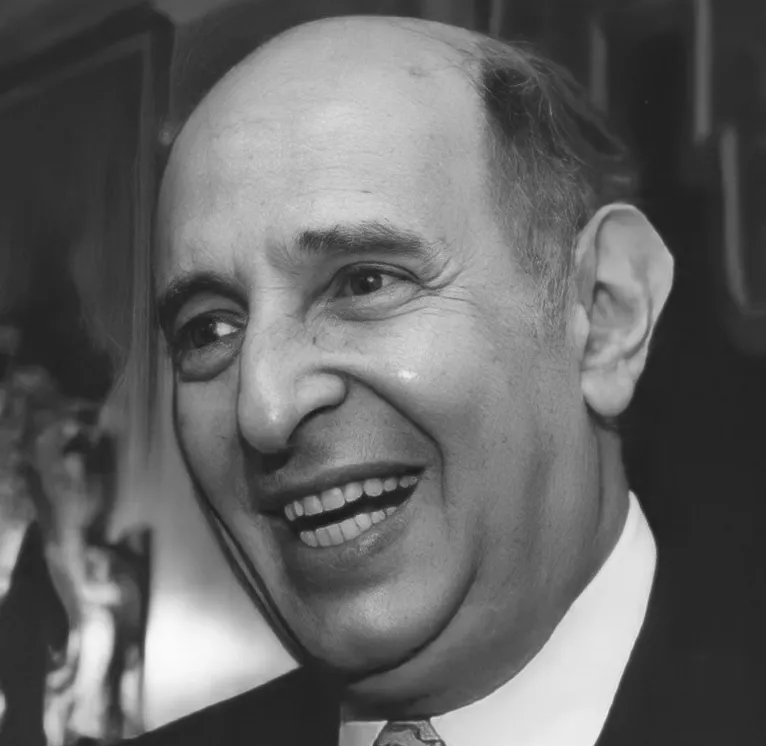
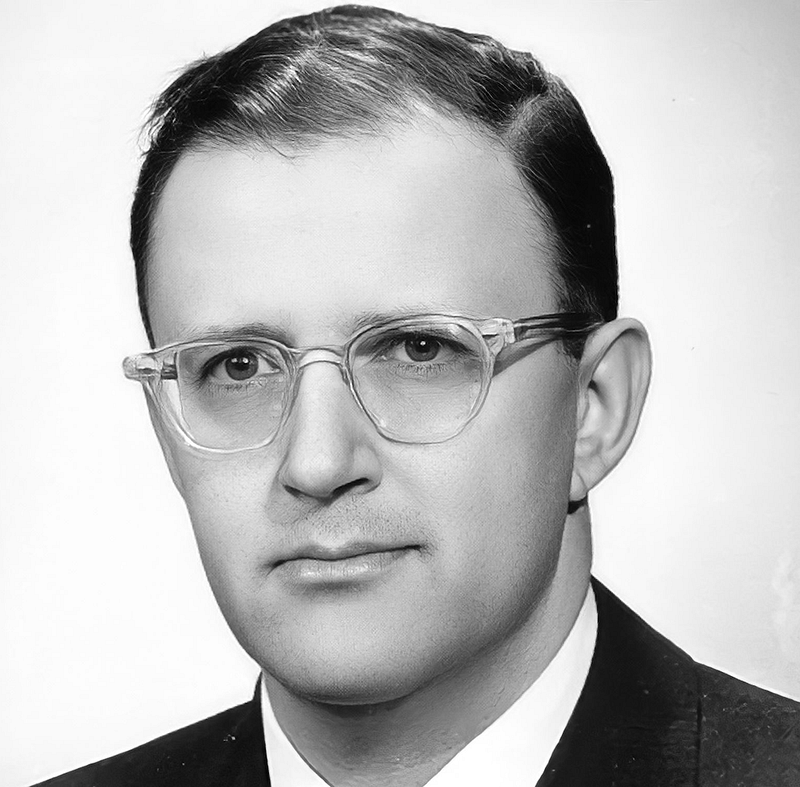
Bloom had a younger partner.
Apparently about 30 years younger, Michael Z. Wu would be described as “a handsome, smooth-skinned, black-haired, Oriental, graceful boyish man.”
Their life together is a story that’s never been told. Bloom’s only public comment on Wu was a line in his acknowledgments to The Closing of the American Mind, saying his former student had “assisted me enormously with his sharp insight and criticism.”
At the core of right-wing culture, we seem to find a gay partnership. But it was all concealed. Bloom died in 1992 at age 62, as his employer, the University of Chicago, said the cause was “a peptic ulcer bleeding complicated by liver failure.”
His obituary lists only his mother, stepfather, and sister.
In 1993, Bloom’s friends published his final book.
For his sequel to The Closing of the American Mind, Bloom took on the subject of human eroticism. Love & Friendship is a nearly spiritual reflection on sex as “the most mysterious, exciting, and deepest animating force in man.”
The book was dedicated to ‘Michael Z. Wu’, without any statement on what they’d been to each other. Love & Friendship was politely received, and went out of print. The right wing has little need to talk about sex.
What matters is rules. Keep following the rules. If things are breaking down, follow the rules even harder. That’s conservatism.
There’d be no effort to write a biography of Bloom.
His fans didn’t seem to want to know much about the man who had fought the “culture wars” for them, and defined the conservative pushback against what they called “political correctness.”
In retrospect, his literary agent, Harriet Wasserman, subtly outs him in her 1997 memoir, Handsome Is…, as she remembers the client who was convinced he was writing a bestseller. He loved money, shopping, and his being single was left unaddressed amid the quirky scenes: “When he greeted me at the door, he was wearing a full-length gray raw-silk kimono, tied with a wide sash in the traditional fashion.”
She knew him to the end, and writes that he died of the effects of smoking and overeating.
Was it clear Allan Bloom was actually right-wing?
To look over his life, there’s regular hints of a man who seems like he was someone else. Bloom would say things, like “I’m in political philosophy because that’s where the big bucks are,” as Dannhauser recalled, or also:
“They used to ask me, if I was so smart, why wasn’t I rich? Now I can say that I am rich.”
In his 1999 memoir, a friend named George Walden, writes: “The Closing of the American Mind had made him a million and he displayed his new extravagances — from Italian coffee machine and hi-fi to pictures and bronzes — with touching pride.”
I muse to myself: Allan Bloom died of AIDS in 1992.
The virus often killed people about a decade after infection. When did he learn he had it? Maybe years before The Closing of the American Mind.
Indeed, his famous book seems to be AIDS literature. One might even suppose that when he’d contracted HIV, realizing he’d be dying, he set out to be as ‘outrageous’ as he could—and make as much money as he could.
His partner would be his sole heir. Bloom wanted to leave Michael a fortune. And as he was going, he’d have money for nice Italian coffee makers, art, fine linens—and hustlers.
Even as he was concealing himself, Bloom was acting to unconceal himself—after he died.
He was close friends with the novelist Saul Bellow, and in his final phase of illness, asked Bellow to write a “memoir” of him.
“There was no way I could refuse to do this,” Bellow writes.
It was a difficult request of a friend—even as Bloom started spilling sex details that Bellow didn’t know, or know how to contextualize or present.
Bloom talked about people around them (“It’s not gossip, it’s social history”), like well-known scholars on the University of Chicago staff, like Edward Shils, who was married with a son and yet Bloom said he was gay.
It was the ‘closet’ of the American mind that Bellow didn’t even know existed.
Then Bloom was talking about his own sex life.
It wasn’t with his life partner, “the handsome Chinese prince,” as Bellow calls him. That relationship had become ‘more father and son’, Bloom clarifies.
He wasn’t done with sex, though. That proved to be a difficult matter. As Bellow writes in his resulting book:
“There were times when I simply didn’t know what to make of his confidences. But then he had chosen me to do his portrait, and when he spoke to me he spoke intimately but also for the record.”
Bellow was in his final years.
His famous novels had been published in the 1950s. He had a last little novella, The Actual, to publish in 1997, then he worked on one he called Ravelstein. Published in 2001, it would be his final book.
It was a story—not identified as fiction or non-fiction—about an outrageous right-wing intellectual named Abe Ravelstein who spent his life being deeply conflicted about his sexuality. Now, ‘Abe’ is telling his friend, named ‘Chick’, about his life as he’s dying of AIDS.
Ravelstein didn’t call himself ‘gay’. Bellow writes: “He was considered, to use a term from the past, an invert. Not a ‘gay.’ He despised campy homosexuality and took a very low view of ‘gay pride.’”
Ravelstein introduced Chick to his sex life. Bellow writes: “Even towards the end Ravelstein was still cruising. It turned out that he went to gay bars.”
Ravelstein’s “type” was another surprise. Chick sees “barely legal African American boys” in Ravelstein’s apartment.
Ravelstein’s final period seemed to be an array of Black people.
Throughout the book, there are many. Black women loved his clothes, he’d note. He wasn’t as fond of the Black woman who was a nurse in the hospital, coming in when he had friends visiting, as she said: “It’s time for your AZT.” The drug for AIDS patients.
“I could have killed the woman,” Ravelstein says, going on a rant about people from the “ghetto.”
And then, Ravelstein is telling Chick about his tricks.
“Harms was a boy he had brought home one night…Eulace was the handsome little boy who had wandered about his apartment in the nude…physically so elegant. ‘No other than sixteen. Very well built’…”
The phrase “very well-built” might reference the boy’s cock size. The conservative hero was a size queen—and hiring the boys, Chick sees, when Ravelstein gives the kid a check for $500. They were hustlers?
It was confusing. Ravelstein was dying of AIDS.
Bellow writes:
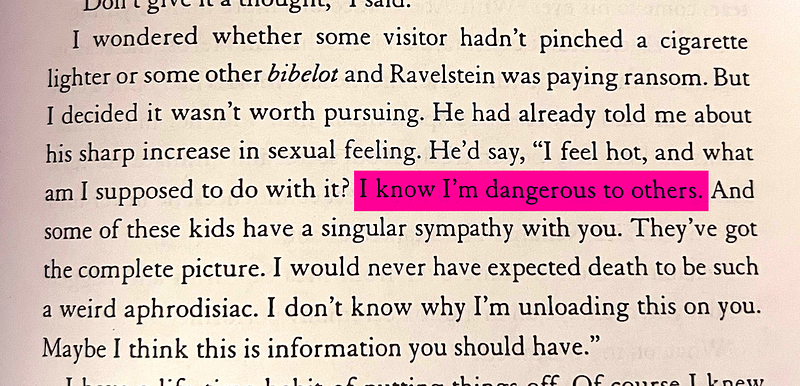
“He had already told me about his sharp increase in sexual feeling. He’d say, ‘I feel hot, and what am I supposed to do with it? I know I’m dangerous to others. And some of these kids have a singular sympathy with you. They’ve got the complete picture. I would never have expected death to be such a weird aphrodisiac. I don’t know why I’m unloading this on you. Maybe I think this is information you should have.’”
On publication, “Ravelstein” was immediately seen as a portrait of Allan Bloom.
Though the reviewers were noticing a strange process. New review copies were being issued with different text. Bellow was revising the book.
A review by D.T. Max published in the New York Times on April 16, 2000 first discussed the problem of the ‘advanced galleys’ that had been more forthright about Ravelstein having AIDS.
But further reviewer copies were being issued, each one with less sexual information. As later revealed in a 2010 publication of Bellow’s letters, he was removing the sexual information at the bidding of Werner Dannhauser, who was also his own dear friend. In a letter of October 6, 1999, Bellow writes to Dannhauser:
“I promised to eliminate what you thought to be objectionable material and I wrote a revised version of Ravelstein. It took quite a lot of doing and the doing went against the grain. When I was done the results were highly unsatisfactory; what was lacking was the elasticity produced by sin.”
Bloom himself, Bellow adds, would have objected to such sensitivities.
He adds: “After all, I was trying to satisfy Allan’s wishes, and I couldn’t have it both ways. I couldn’t be both truthful and camouflaged. So I did as I think he would have wished me to do.”
For his report in the Times, D.T. Max made a few calls to people who’d known Bloom. He located Bloom’s doctor, who was cagey about the cause of death, saying it was “pretty much irrelevant.”
Max interviewed Michael Wu, who would only say that Raveinstein is “fiction, not a biography.”
A debate was on over whether ‘Ravelstein’ was Bloom.
Bloom’s fans insisted it was fiction—and meant nothing. Was that so clear? George Walden noted: “I am surprised people are treating this book as a novel when it is so clearly a memoir.”
Werner Dannhauser was clearly irate at Bellow for the disclosures he had made. On a panel on C-SPAN, Dannhauser said:
“He did not want certain things exposed to publicity, and so Bellow knows that. He knows it because there’s evidence in the book that it was that way. Why would Ravelstein be so obsessed when someone comes into the hospital room in front of someone else and says, ‘It’s time for your AZT pill’? That, by the way, was a real incident.”
More left-wing writers tried to assess the strange situation of a gay right-wing hero.
Andrew Sullivan wrote: “Perhaps Bloom’s finest achievement was to write about human love from the perspective of homosexual love and have no one notice the seam.”
But the subplot was not seen that Bloom had wanted even his conservative fans to know this most personal side of himself. Bellow reflects on that angle in a letter of February 7, 2000 to Martin Amis:
“I tell people that Ravelstein asked me to write a memoir and that it would have been false and wicked to omit the sickness that killed him from the account I gave of his life. With an omniscient wisdom like his it would have been impossible not to predict what would come of this.”
Bloom had known it would be a scandal.
He’d have known, as well, that it would come at some cost to Bellow, and might pit his friends against each other. He had given no guidance or direction for that process. It would just occur.
For his part, Bellow, clearly personally affected, continued to try to downplay any insult against the conservative hero. He made some public comments saying he wasn’t sure about the AIDS part.
He told the New York Times the book was a “testimony to my feeling for Bloom.” The friends criticizing him, he says, feel “a special pious duty to protect Bloom,” as “for them it’s not just a friend, it’s a movement.”
Days later, he told The Guardian: “I’m sorry for exposing him. I don’t like the feeling it brought with it, and the recklessness on my part because I didn’t mean any harm to Allan.”
As talk of “Ravelstein” was winding down, the part about the hustlers came out.
Christopher Hitchens had published a long review of Ravelstein in The London Review of Books on April 27, 2000, but then had a second piece, titled “Bloom’s Way,” in The Nation on May 15, 2000. (Both are reprinted in his collection Unacknowledged Legislation.)
There wouldn’t be too many venues for talking about that kind of material. Nor would there be any in the future, except some online blog posts.
There’s been no scholarly effort to assemble the original text of Ravelstein. I purchased a reviewer copy, noting the passage I’d quoted was different from the published text.
There was a hit to his popularity, but Bloom’s ideas continued to be discussed.
Generally, his homosexuality and AIDS were kept quiet. Ravelstein was dismissed as a fiction. The right nearly tried to re-closet Bloom, or at least be silent about his personal life.
Scholarly sources might have some mention of the more difficult issues that were involved. In a 2016 book, Saul Bellow: A Literary Companion, Mark Connelly read the scene with Black boys as an “obvious reference to both prostitution and pedophilia…”
What was the dynamic between the professor and his hustlers?
It would seem a provocative question but has been discussed very little. In a conference paper in 2004, later published, the scholar Christopher Koy, an American teaching in the Czech Republic, discussed images of Black people in Bellow’s work. He sees the “barely legal African American boys” that Bloom had hired as a fetish situation.
He reads the scene: “the black child played the role of the slave, and Allan Bloom the role of the master…”
After the paper was read at a conference, Koy tells me, someone in the audience came up to him saying: “Do we really need to listen to issues concerning homosexuals in this conference, for God’s sake?”
I’m left trying to imagine the scene.
A young Black hustler from Chicago comes in to see the famous intellectual. What had Ravelstein said?
“And some of these kids have a singular sympathy with you. They’ve got the complete picture.”
Whatever the hustlers saw—was the reality. In contrast, he was seen among his colleagues and friends as the theater.
In telling Saul Bellow about the hustlers, Bloom wanted his conservative fans to see him as the hustlers did, but they turned him down. 🔶