
Was Hitler a Christian?
Scholars find the German dictator was more religious than his religion wants to admit
If you call yourself “Christian” and speak of Jesus as your “Lord and Savior,” you’re usually taken to be a Christian. The exception is Adolph Hitler.
The German dictator would seem to have been Christian, or at least hitting all the marks that Christians of the time would hit—including being murderously anti-Semitic.
But Christianity seems not to want to claim him.
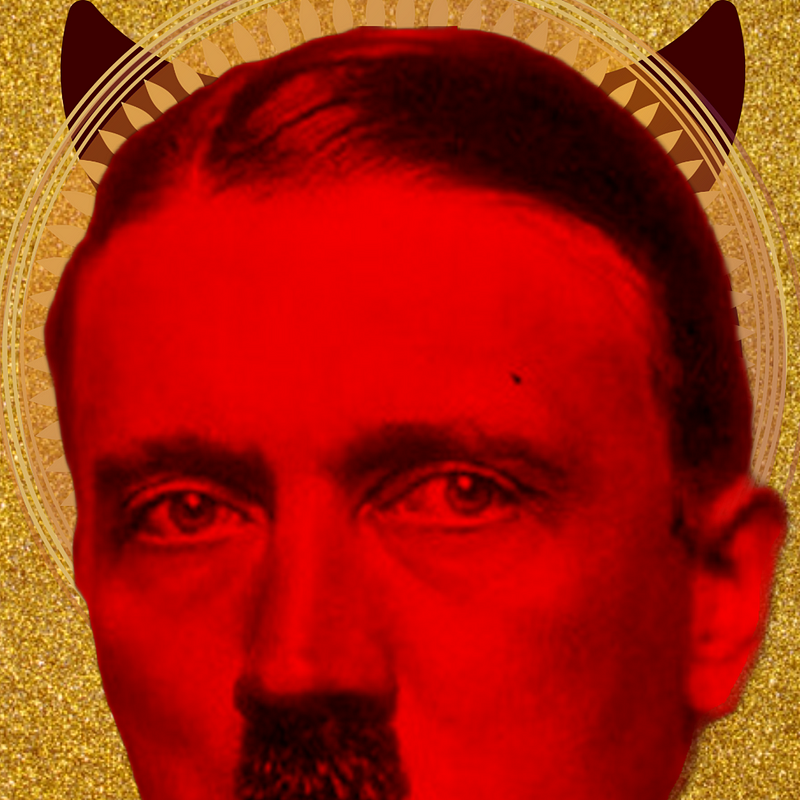
Hitler was born in 1889 and baptized Catholic.
His mother was devout, and his father less so. At age five, Adolph was confirmed in the family’s local parish in Linz, Austria.
After that, sources for his life get tricky. But to look over the sources is to see a much stronger case than Christianity would like to admit. Hitler was a working artist until age 30, and often did works on Christian subjects.
As I browse through the book Adolf Hitler, the Unknown Artist, he regularly features Christian churches in a way that suggests he viewed them as important, and centers of human life.
Perhaps his most involved painting, in 1913, was of Jesus and Mary.
Hitler did like that blond, blue-eyed “Aryan Jesus.” If that might strike some as historically implausible, there is a long history of Christians seeing Jesus this way, as in paintings by Raphael or Rubens.

I am unaware of any analysis of the painting.
I muse over various points. Was his Mary modeled on his own mother, Klara Hitler?


A shrine or home altar that Hitler painted in 1915 finds him depicting Jesus visiting a wounded soldier.
Was this a self-portrait? Hitler was wounded around the time.
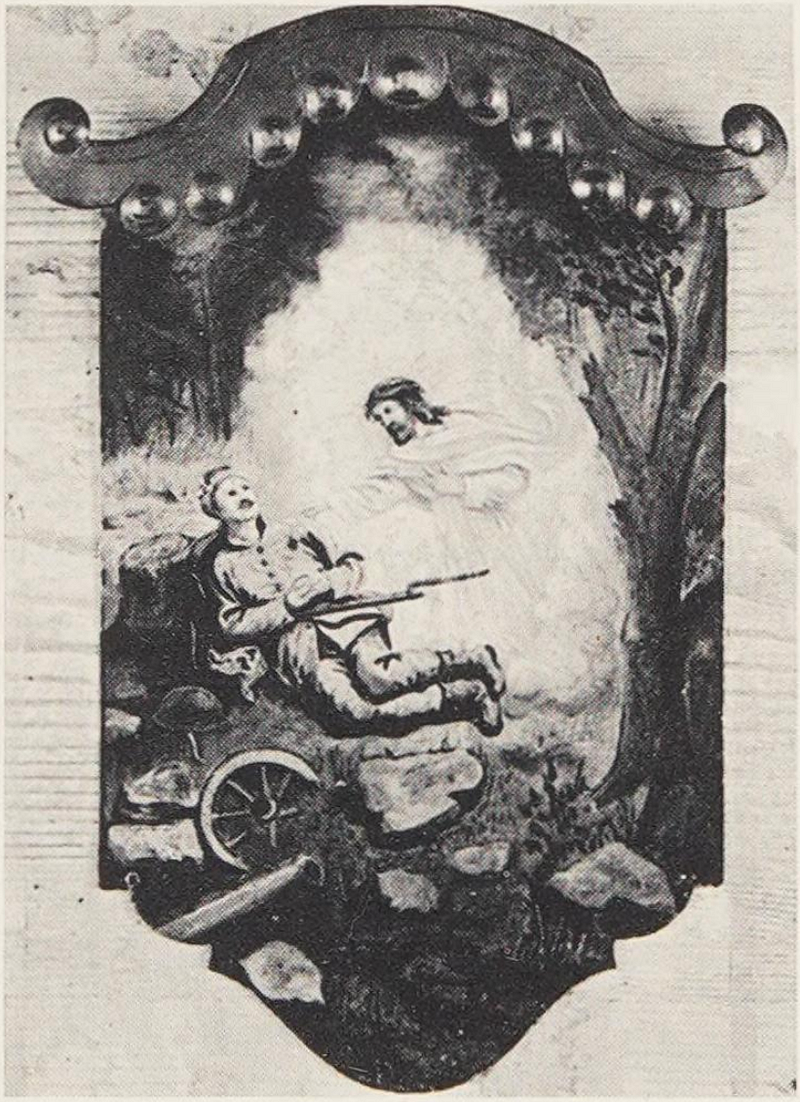
Hitler later wrote that at the end of World War I, he’d fallen on his knees to thank Heaven.
The clue begin to pile up that he was a believer in the Christian God and had typically Christian structures of thought.
And yet, if you read about Hitler you’re often told he was an “atheist” or a “pagan.” That’s the view advanced in a 2016 book, Hitler’s Religion: The Twisted Beliefs that Drove the Third Reich, by a historian named Richard Weikart. He concludes that Hitler was a ‘pantheist’.
Weikart writes: “I have never found any evidence that Hitler believed in the deity of Jesus.”
The problem is that a lot of people saying Hitler wasn’t Christian…are Christian.
Richard Weikart was a devout Evangelical Christian whose career was largely devoted to advocating for the faith.
The truth might be that Hitler’s religion was a difficult matter for Christianity, and the references were read in a contrived way. The resulting story becomes less coherent. At the time, Germany was a very “Christian nation”—but went along with a ‘pantheist’ leader?
That was the Christian-approved history.
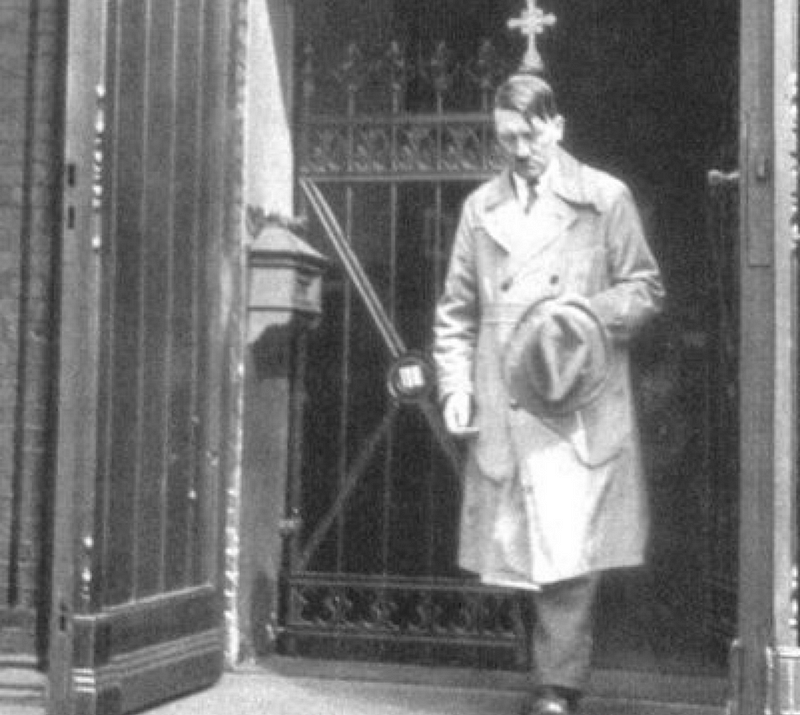
It’s amusing, in a way, watching Christians manage the distressing subject of Hitler’s religion.
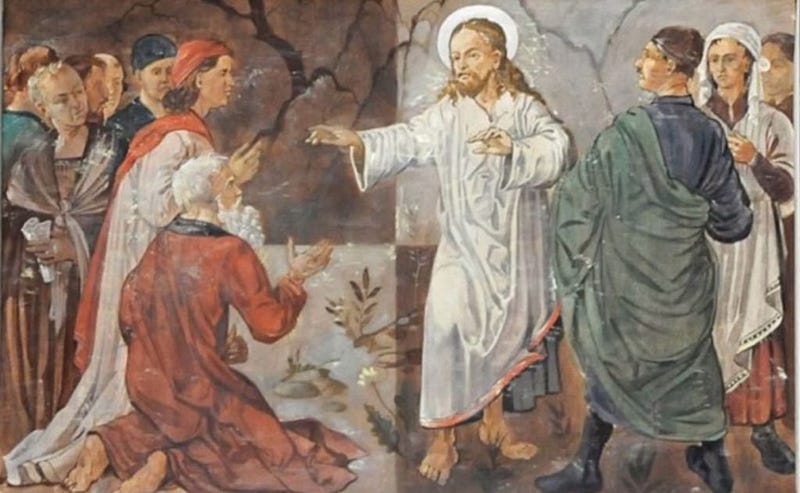
It’s a comedy that plays out, year after year. In 2014, a church in Hof, Germany cleaned a painting to find it revealed Hitler standing beside Jesus.
The church argued the image was a “subversive” critique of Nazism.
Otherwise, your lying eyes might tell you that Hitler was portrayed in a Christian chuch as a disciple of the blond Jesus.
Lately, scholars are laying out more references.
A 2021 paper by Mikael Nilsson, “Christ on the Crooked Cross: The Divinity of Jesus in Hitler’s Weltanschauung,” documents the many times that Hitler refers to Jesus as his “Lord and Savior.”
Hitler’s 1925 autobiography, Mein Kampf, argues for “true Christianity”—which he sees as largely concerned with hating Jewish people.
Jesus, as he writes:
“…even gripped the whip, when it was necessary, in order to drive out these enemies of humanity, who also back then viewed religion as only a business-like means to its own existence, out of the Lord’s temple. For that reason, Christ was then later nailed to the cross.”
Hitler rooted Nazism in a reading of the Bible.
He thought that the ‘Israelites’ or ‘Children of Israel’, as the Bible calls them, were not Jews, but Aryans. He saw Jesus as a blond, white Aryan who taught that Jews had taken over the sacred space of the Temple.
But I have to repeat that this was not a non-Christian view. In Christian depictions of Jesus he is rarely ‘Jewish-looking’. If such depictions of Jesus were made, Christians wouldn’t like it.
Hitler saw the non-Jewishness of Jesus as confirmed by early Christian art. In 1938, he was in Rome and saw a statue of Jesus from the 2nd century. He noted the deity’s appearance did not seem ‘Jewish’ to him.
Hitler’s Christianity saw anti-Semitism as the basic work of the religion.
He did not make up the idea. He’d seen a series of newspaper articles by a former theology student that argued this case, as the ‘Aryan Bible’ concept had floated around in German Christianity of the day.
Hitler framed his politics as, like Jesus, kicking the Jews out of the Temple. For Hitler, the ‘Temple’ was Germany.
If this seems an unusual view, Christians in many places have identified their countries as the earth’s most sacred land. Italy has done it for over a millennia, and the United States was devoted to the idea since its founding.
Hitler started out his political career as something of a “preacher.”
This point is not made by Mikael Nilsson, but is my reading of the evidence he presents. Ih early political speeches, Hitler seems to have been doing the basic activity of sermonizing. His speeches had an electric quality.
As a politician, Hitler offered himself as a Christian who was doing the work that Jesus began. As he put it in 1922: “My Christian feeling shows me my Lord and Savior as a fighter.”
He idealized the Bible’s messiah as a figure very like himself:
“…the man who once alone, only surrounded by a few followers, saw these Jews for what they really were and who called to arms against them, and who, God’s truth, was the greatest not as victim but was the greatest as warrior!”
Nazism was “Christian action.”
Hitler took to advancing National Socialism as “nothing else than a practical following of Christ’s teaching.” His rhetoric in assailing Jews was adapted directly from the words of Jesus.
He called Jews a “spawn of vipers,” quoting Matthew 23:33.
He cited Matthew 27:25, where in the aftermath of the crucifixion of Jesus, the (Jewish) crowd says: “His blood is on us and on our children!”
As Nilsson puts it, such Bible commentary “may directly have influenced Hitler’s decision to launch the Holocaust.”
Hitler liked to quote 1 Thessalonians 2:15 as establishing that Jews “killed both the Lord Jesus and the prophets…”
He ended speeches by saying: “May God watch over us! Amen!”
The oath given to Nazi soldiers became: “I swear by God this sacred oath…
Hitler himself said: “We tolerate no one in our ranks who attacks the ideas of Christianity. Our movement is Christian.”
If hatred of Jews doesn’t seem too “Christian,” there’s a problem.
The theme is deeply rooted in Christianity. Some readers have found it in the gospels, and explicit insults against Jews by early church figures like John Chrysostom remain startling in their vehemence.
The Nazi party, of course, made great use of the anti-Semitic writings of Protestant founder Martin Luther, especially the infamous tract Of the Jews and Their Lies.
It seems to me that World War II was a Christian ‘holy war’, even if later Christians wish to deny it this status. As Nilsson concludes:
“Hitler did not consider his mission to be simply a secular one; on the contrary, the mission to save the German nation and the German people was always also seen as a divine task with religious meaning.”
Hitler seems to have long remained a Catholic.
There were a few claims to that effect by people close to Hitler. His lawyer, Lorenz Roder, wrote in a newspaper of the time that Hitler “is still to this day a convinced Catholic.”
In 1941, Adolf told General Gerhard Engel: “I am now as before a Catholic and will always remain so.”
But Hitler seemed to view existing Christianities as mostly diseased. In 1937, Joseph Goebbels recorded a conversation with Hitler saying: “we must declare ourselves to be the only true Christians.”
He was proposing something along the lines of a new Reformation, that broke from Catholicism into a new Christianity that saw itself as the authentic one.
For Hitler this seems to have been a theocratic religion, centered on eugenics, viewing women as breeders, seeing male assertion as a spiritual good, with a core of anti-Semitism.
In America, isn’t this called ‘Evangelicalism’?
There’s curious affinities between German Nazism and American Evangelicalism—the religion that does love its blond German leaders. Even in 1972, Billy Graham was on board with state action against Jews.
Then James Dobson, the Evangelical eugenist, was chummy with Nazi sympathizers. A case for a basic similarity between Nazism and Evangelicalism could be made, and that by extension Nazism was a movement within Christianity. 🔶


