
Wain
Wagons… ho!!! Let’s explore some words
Today’s New York Times Spelling Bee letters:
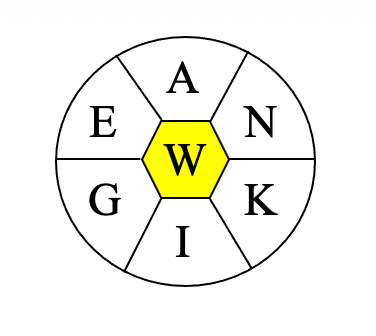
A, E, G, I, K, N, and center W (all words must include W).
Merriam-Webster says…
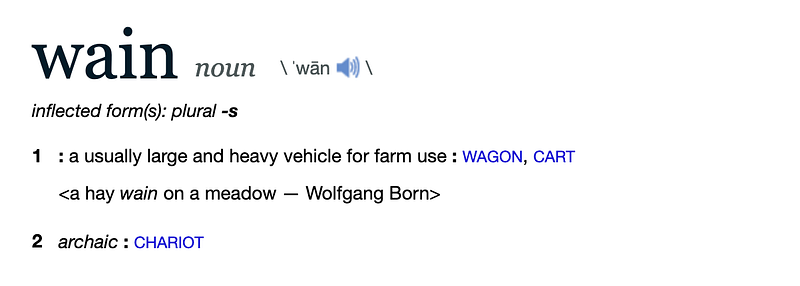
Silly little dictionary! Don’t you know wain can’t possibly be a word if the New York Times says it ain’t?
For further fascinating facts, check out the Spelling Bee Master.
What’s your favorite dord* from today’s puzzle?
My Two Cents
Yesterday’s Spelling Bee went schizophrenic on the New York Times, resulting in two games being put out into the inter webs. I only realize that early today, so the column I wrote yesterday was based on the first iteration, which can’t be accessed. I’m mulling whether or not to go back and edit the piece to include the second game. For now, I’ve placed a note explaining the discrepancy between the word I chose (furfur) and the letters that appear in the link to the Spelling Bee Master.
Remember that famous Oscar-winning movie about the 1924 Paris Olympic Games, called Blazing Wains? No? Well, that’s because the producer didn’t want to give his movie a title mildly porno-sounding, so he called it Chariots of Fire.
The film not only won four Academy Awards (including Best Picture), but also turned running barefoot in slow motion into a fad and made Vangelis and his electronic music a household name. Which caught the eye of Ridley Scott, who promptly hired him to score the soundtrack for Blade Runner.
And… we’ve veered completely off track here. But that’s okay; any excuse to mention Blade Runner works for me.
For farmworkers only
Okay, we covered the “chariot” definition of the entry, which is archaic. The dictionary tells us that wain refers to “large and heavy vehicles for farm use”. So if it’s small and light and used in the city, it certainly isn’t a wain. Got that? Don’t you dare start calling your Vespa scooter a wain!
This also reminds me of that old elephant joke: Why are elephants large, grey, and wrinkled? Because if they were tiny, white, and smooth… they’d be an aspirin.
Wow, we just can’t stay on track today.
Merriam-Webster also kindly and convolutedly explains that wain comes from “Middle English, from Old English wægn, wæn; akin to Middle Dutch wagen wagon, cart, Old High German wagan, Old Norse vagn wagon, cart, Old English wegan to move, carry, weg way.”
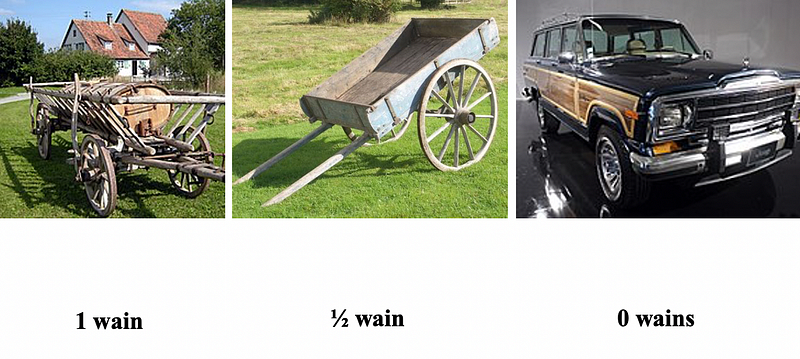
I spoke to some transportation experts, and they told me wains are what wagons used to be called before Jeep came up with the Wagoneer, which sounded too lame as the Waineer. And these experts pleaded with me not to use the word cart when talking about a wain because, as we all know, carts have only two wheels and wains have four. Except for haywains that are used as carts. Those have two. In case you’re as confused as I was, these might help:
The most famous wain of them all was the Conestoga, a freight wagon widely used in the 18th and 19th centuries to haul goods (and haul ass) across the Great Wagon Road. Like so:
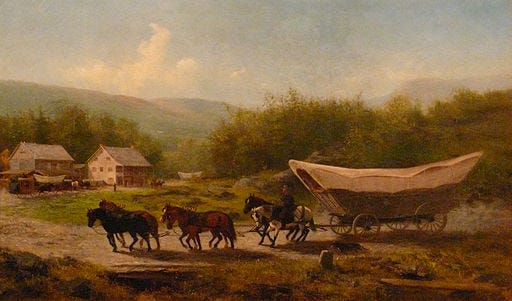
You’ll notice that the above 1823 model had an upgraded engine with 6 horsepower. Much faster than the older and slower 1822 Conestoga, which had only 4. Plus the 1823 was available for $8.54 a month for 36 months and no money due at signing.
Unfortunately, if your income came from Medium back then, you still couldn’t afford to buy one.
Now, someone had to build and repair these beauts. And that someone was called Wagoneer. Just kidding. The person in charge of wain maintenance was the wainwright.
Which brings us to…
The biblical judge who fought a wagon repairman
Wainwright is a last name many joyous Cardinals and angry Mets fans know well. As in: Adam Wainwright. He pitched the curve ball heard ‘round the world in the 2006 National League Championship Series. I won’t go into details about this because… well, I’m one of those angry Mets fans.
Any lawyer reading this will surely be familiar with Wainwright as half the name of a landmark Supreme Court Case decided in 1963. In Gideon v. Wainwright the court unanimously held that, under the Sixth Amendment of the United States Constitution, states are required to provide an attorney for those defendants who cannot afford one.
Previously, this had been imposed only in federal cases. Then in 1961 Clarence Earl Gideon was arrested for a burglary in Florida. After being denied counsel and forced to act as his own attorney in court, Gideon lost the case and was sentenced to five years in state prison.
After his appeal to the state supreme court was denied, Gideon took the Secretary of the Florida Department of Corrections, H. G. Cochran, to the Supreme Court. Cochran pulled a Murtaugh and retired. Seeing his chance to make history and appear in this distinguished column, Louie Wainwright went to bat for Cochran… and then pulled a Beltrán and struck out looking.
Gideon was defended by Abe Fortas, an attorney who two years after the case became a Supreme Court justice. Quite possibly because one of his winning points during oral arguments was called “probably the best single legal argument” by one of the justices deciding the case.
The decision freed some 2,000 people. But not Gideon. He was forced to get a new trial, which he won, now that he had a lawyer. Gideon went back to his working life, married, got cancer, and died. Just like most men of his era. His headstone was inscribed with a quote he had written in one of his letters to Abe Fortas:
“Each era finds an improvement in law for the benefit of mankind.”
So that’s the story of the biblical judge (Gideon) who defeated the wagon repairman (Wainwright).
In any case, next time you travel the Great Wagon Road from Pennsylvania to North Carolina, drive down in a classic Wagoneer. You won’t be able to go in a wain, because the editors of the Spelling Bee puzzle decided that wain is a dord.*
Please check out my previous entry on another dord*:
*What the heck is a dord, anyway? Here you go: