
Voting Rights Bill Targets Supreme Court
Recent rulings provide cover for vote suppression, nullification
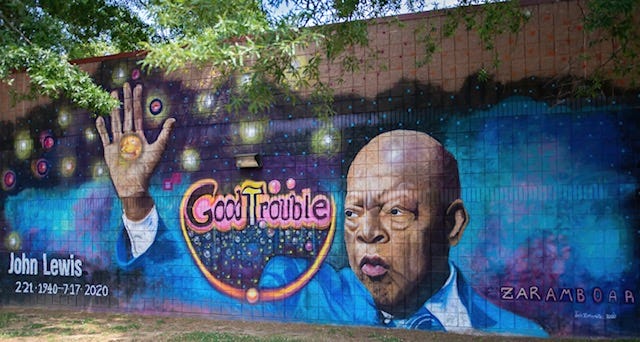
You have to give the House Democrats some credit. The John R. Lewis Voting Rights Advancement Act they just passed takes square aim at a big threat to democracy: the U.S. Supreme Court.
The legislation uses congressional power under the Constitution to tell the conservative court how its rules must change to ensure access to the ballot and fairness in counting votes.
It’s unlikely that the bill, passed without GOP votes, would get the 60 votes to overcome a Senate filibuster. But there is small hope that a rule change could be made to allow just 51 votes on issues dealing with democracy.
Citizens will push for that and more in March on for Voting Rights protests Aug. 28 in Washington, D.C., and other cities. The date is the 58th anniversary of Dr. Martin Luther King Jr.’s 1963 March on Washington.
“Old battles have become new again,” said Alabama Rep. Terri Sewell, who introduced the bill named after the late civil rights leader and congressman. “Modern-day barriers to voting are no less pernicious than those literacy tests and those poll taxes. And what we must do, as we did back in the ’60s, is when we see states running amok, we need federal oversight.”
Senate Republicans have already blocked the For the People Act, which addresses campaign financing, redistricting and the new restrictive voting laws passed by GOP-controlled legislatures.
President Joe Biden says the country needs both voting-rights bills. Civil rights activists insist Biden needs to accept the need for changes to the filibuster and then pressure moderate Senate Democrats to do it.
Two major Supreme Court decisions gutted the 1965 Voting Rights Act, which has been extended three times under Republican presidents with bipartisan support. The new legislation seeks to restore and even strengthen enforcement of the law.
In 2013, the high court ruled that states with a history of voting discrimination no longer needed federal approval of voting changes, as required by the landmark law. Since a lot of minorities now vote, there is no racism, Chief Justice John Roberts opined.
A ruling earlier this year said it was OK if voting changes disproportionately impact minorities. It’s justified as long as legislatures say they are seeking election integrity, Justice Samuel Alito argued in the majority opinion.
Add to that, a 2006 ruling that courts have limited power to prevent changes in voting rules close to elections, even if those efforts disenfranchise voters. And there is the overarching conservative theory of the Independent Legislature Doctrine that insists states have the right to overturn the will of the voters.
The detailed John Lewis Act would restore the Justice Department’s power to pre-clear voting decisions in states with a history of discrimination and would create a new process to block certain voting restrictions in all states.
It also would prevent the court from changing the rules governing who may cast a ballot while an election is underway — and then retroactively disenfranchising voters who did not comply with the new rules.
The court would also be limited in using its “shadow docket,” when emergency decisions are made without public hearings and with unsigned rulings.
Court decisions have had a negative impact on voting patterns in the eight states that had been under federal review, according to a study by the Brennan Center for Justice.
In 2012, before the 2013 Shelby v. Holder ruling, seven out of the eight states with a history of discrimination had Black voter turnout higher than that of white voters. In 2020, the reverse is true — in only one of the states was Black turnout higher than white turnout, the study said.
South Carolina’s change in turnout was especially dramatic: Black turnout exceeded white turnout in 2012, yet white turnout was more than 15 percentage points higher than Black turnout in 2020.
Whether or not any voting rights legislation becomes law this year, the gauntlet has been thrown and the high court — once seen as a beacon for equality — has been exposed as the unfair umpire it has become.
That’s what John Lewis would describe as “getting into good trouble.”