
Shrinking White Population Only Intensifies Political Conflict
Growing diversity doesn’t erase violence, curbs on voting rights

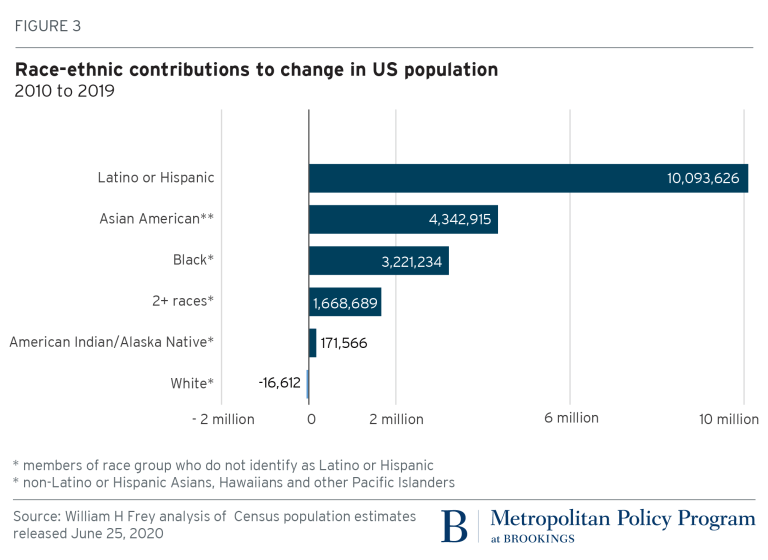
America’s white population shrank for the first time in history, while the numbers of people of color increased faster than expected, according to the 2020 U.S. Census.
People who identify as “white alone” still make up the largest racial group at 57.8 percent, but that represents an 8.6 percent drop from 2010. Fewer than half of residents under age 18 are white, while three-quarters of those over 65 are white. Multiracial people had the biggest increase, from 2.9 percent of the population in 2010 to 10.2 percent now.
Earlier estimates had projected the first decrease among whites would occur in 2024, according to William H. Frey, the senior fellow at the Brookings Institute’s Metropolitical Policy Program. “The mostly white baby-boomer culture that defined the last half of the 20th century is giving way to a more multihued, multicultural nation,” he said.
Yet, we are unlikely to see a trend toward unity any time soon.
For example, a lot of people live in states controlled by Republicans, giving the predominately white party more say in presidential elections, more power in drawing congressional and legislative districts, and the clout to influence local decisions.
That imbalance has underscored conflicts in this country for a while. White citizens want to hold onto power; others want their fair share. White supremacists and calculating politicians will continue to stir discord. The Jan. 6 insurrection, which tried to keep Donald Trump as president, is the clearest example.
But there is no doubt that the reality of shrinking white citizenship will add immediate fuel to three controversies:
Threats of violence
Department of Homeland Security recently cautioned that more violence is likely, especially since one conspiracy theory insists Trump would somehow be reinstated this month.
Outrage over The Big Lie that the election was fraudulent has merged with Canon, a belief in a Satanic cult of elites controlling the world. Even mainstream conservative media personalities insist Democrats are bringing in people from other countries to replace white Americans.
According to Census data, however, the shrinking white population is due largely to lower birthrates, rather than to immigration.
Voting rights
GOP-controlled legislatures have spent this year passing laws that make it harder for people of color and young people to vote. Some new laws allow legislatures the right to ignore legally cast votes. States say they are concerned about election security, although Trump administration officials ruled the election was fair.
A group of 52 Texas House Democrats left the state for weeks to deny a quorum to vote on those laws and to lobby Congress to stop state efforts. Texas recently issued warrants for their return to work; the state Supreme Court supported that action. Meanwhile, the Texas Senate passed the voting restrictions early Thursday morning after a 15-hour Democratic filibuster.
In Washington, civil rights groups have been regularly protesting and engaging in civil disobedience. Senate Democrats have promised to move a voting rights bill next month, although it’s unclear how they will overcome a GOP filibuster.
The current Justice Department is suing Georgia over its voting laws. It is doubtful that the U.S. Supreme Court would support it. The court has already neutered the 1965 landmark Voting Rights Act, prioritizing states’ rights and declaring that voting discrimination no longer exists.
Redistricting
Most of the nation’s population growth is concentrated in urban areas where most Democratic voters live. But many of those cities are in GOP-controlled states. For instance, Texas will get two additional congressional seats; Florida, Montana and North Carolina would each be getting one extra seat.
Republicans will control redistricting in 20 states with 187 congressional districts, according to the Cook Political Report. Democrats will draw the map in eight states with 75 districts. Six states with 46 districts have split control. Independent commissions will draw maps in 10 states with 121 districts; six states have only one congressional seat.
Democrats have already filed lawsuits asking state courts to rule if there are stalemates in Pennsylvania, Louisiana, and Minnesota. The chances of the Supreme Court weighing in are unlikely after the 2019 Rucho v. Common Cause ruling blocking federal judges from intervening in partisan map-drawing.
So, as encouraging as the population data may be to those who value diversity, GOP political strategist Karl Rove was right when he said, “He who can control redistricting, can control Congress.”
Related article:


