
Volata
This sport beloved by fascists is not music to my ears
Today’s New York Times Spelling Bee letters:
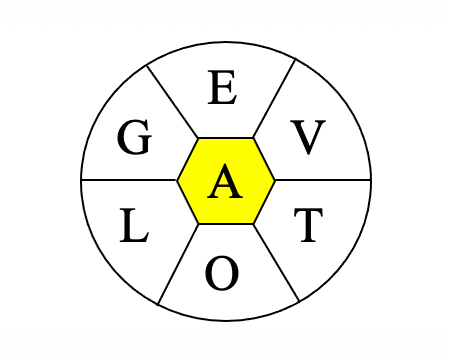
E, G, L, O, T, V, and center A (all words must include A)
Merriam-Webster says…
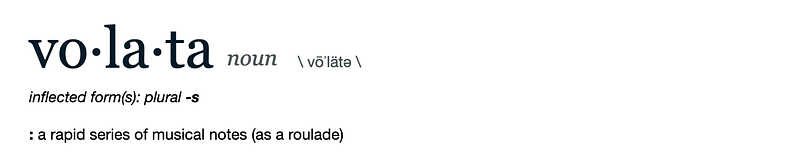
Silly little dictionary! Don’t you know that volata can’t possibly be a word if the New York Times says it ain’t?
For further fascinating facts, check out the Spelling Bee Master.
What’s your favorite dord* from today’s puzzle?
My Two Cents
I couldn’t find much regarding the dictionary’s definition of volata. Merriam-Webster explains that the word is borrowed from the Italian, itself from the Latin volare meaning to “fly”.
Interestingly, the Italian term for a “fly ball” in baseball is also volata. That same word also refers to the muzzle of a gun, a sprint in a bicycle race, the arrangement and loading of the explosive material needed to break down a rock face during tunnel work, and a variation of soccer promoted by the Italian fascists before World War II.
Hurry up and sing!
In his early 19th-century book A Dictionary Music: Theoretical and Practical, Thomas Busby defines volata as “the appellation sometimes applied by Italians to a division, or rapid flight of notes. See Roulade”. And he defines roulade (or roulemen) as “a term applied to all kinds of rapid movements, or passages; but particularly to a rapid flight of notes extemporaneously introduced as an embellishment. See Volata”.
So just like the dictionary, we seem to ping-pong between the two terms. What’s clear is that a volata implies both speed and floridity. So does a roulade, except when it refers to the filled and rolled meat and pastry dish.

The above is a salmon and dill mini-roule, according to Brzezinski. Below is, I believe an example of a musical roulade, first with piano only, showing the sheet music…
And then the singer:
Both roulades and volatas are used in opera to showcase the singer’s abilities and talent. If any music experts knows if the above is also considered a volata, please let me know in the comments section.
Sports and politics
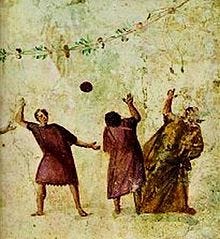
Volata the sport was promoted in the early 1920s in Italy when the fascists came to power. It was a combination of football (soccer) and rugby with eight-player teams developed by the national secretary of the Fascist Party, Augusto Turati. He based some of the rules on the medieval calcio Fiorentino and the Roman harpastum.
Although Italian fascists loved football for its contribution to physical fitness, this sport was considered a dirty foreign “English game” — because the English Football Association had been the one responsible for establishing the rules used by most countries and the country had been the first to hold organized matches). And as anyone familiar with fascists and extreme right-wing schools of thought, anything not “made in my country” is not worth a damn.
Volata became very popular for about a dozen years starting in 1921. More than 100 volata clubs were formed around the country, and there was even a league. So why did Italy abandon this sport all of a sudden in 1933? Well, because Italy got to host the 1934 World Cup, which it also happened to win. Conveniently, the fascists did a 180 on their attitude towards the sport.
Here is a highlight reel of a 1929 game played in Rome:
Speaking Italian football and its history… I was happy to discover this game I knew nothing about until several hours ago.
Calcio Storico (historical football). Also known as Calcio Fiorentino, since it seems to have originated in Florence and is currently still played there. Now… what the heck is calcio? The word has a few meanings in Italian, including “calcium” and “butt” (of a gun). But it also means “kick” (noun), and has become the way Italians refer to their beloved sport of football. And, as usual, when I say football, I mean “soccer” for my American readers.
As Javier and Briana write in the web site A Dash of Life, there are rumors that an early version of the Calcio Storico was played in 1490 when Florence’s Arno river froze solid that winter. They explain that:
“The official Calcio Storico website states that the game which is celebrated today, took place on February 17, 1530. The city was under siege by the imperial troops of Carlo V. .Legend has it that the game was played within view of the siege lines as a form of defiance. It was held in Piazza Santo Croce where the game is still played today.”
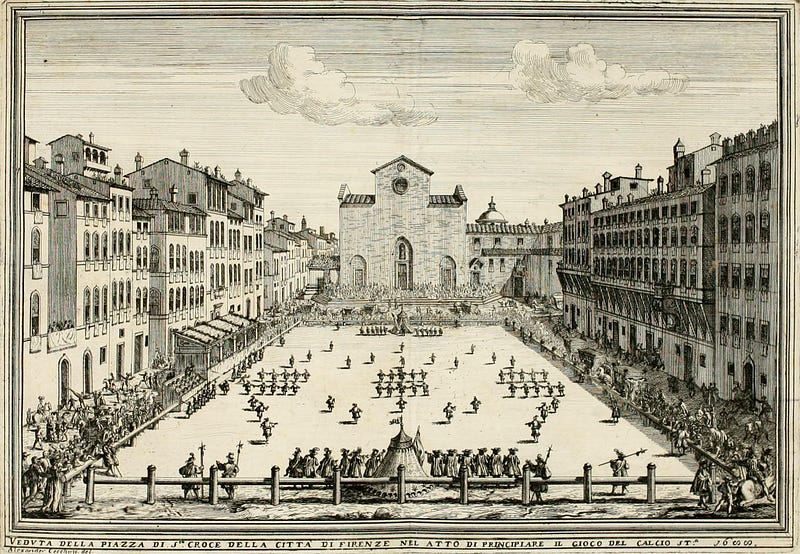
The photo at the top of today’s column shows a depiction of a game being played in that piazza.
Supposedly it was this game that eventually was copied by the English when they saw it being played in France. Florentine noblewoman Caterina de Medici had moved to Paris after marrying King Henry II, and she helped popularize Calcio Fiorentino there.
I’m sure if you ask an Englishman how football came about, you’ll get a completely different story, however.
Calcio Fiorentino declined in the 1700s but was revived again in 1930. The fascist factor mentioned probably had a major role in that, too. Unlike volata, however, Calcio Storico survived and is still played today every year with two semifinals right around the beginning of summer, and a final that takes place on San Giovanni (St. John the Baptist) Day, which falls on June 24th.
Supposedly King Henry III of France said the sport was “too small to be a real war and too cruel to be a game”. Today most Americans would probably describe the game as “mixed martial arts meets soccer”.
Here is Ninh Ly explaining the game of Calcio Storico. Warning: there are images of sweaty, muscular men beating the crap out of each other. Just in case you enjoy that kind of thing. And I promise I am not one to judge.
So, despite being a word used in opera and a sport used by fascists — or perhaps because of those two things — the editors of the Spelling Bee decided that volata was a dord.*
You can check out my previous entry on another dord* here:
*What the heck is a dord, you ask? Here’s the answer: