
Deodand
In olden times, objects could be sued
Today’s New York Times Spelling Bee letters:
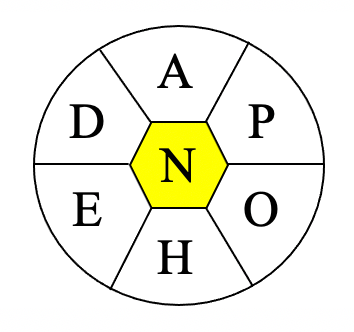
A, D, E, H, O, P, and center N (all words must include N)
Merriam-Webster says…
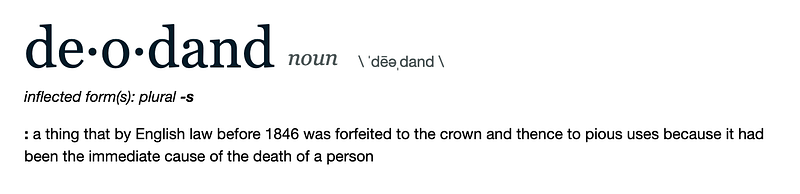
Silly little dictionary! Don’t you know that deodand can’t possibly be a word if the New York Times says it ain’t?
For further fascinating facts, check out the Spelling Bee Master.
What’s your favorite dord* from today’s puzzle?
My Two Cents
If you think modern U.S. society is litigious, you should read about Ye Olde Englishe common law. It was soooooo litigious… (Cue readers yelling “How litigious was it?!?”) Well, it was so litigious, if you fell off a ladder and died, your family could take the ladder to court.
Not to climb to the roof of the court building (cue facepalm), but to request a jury award damages.
God-given hair
The above phrase, my dear reader, is the literal translation of Diosdado Cabello’s name. If you didn’t know who this sadistic criminal mastermind of the Venezuelan dictatorial narco-state is… well, now you do. But that’s neither here nor there.
Deodand comes from the Anglo-French deodande, itself originated from Medieval Latin deodandum, via the Latin expression Deo dandum, meaning “that must be given to God”.
In the middle Middle Ages (around the 11th century), English common law determined that chattel (any personal property except smartphones, because they had none back then) would be designated a deodand when it was determined that said chattel had caused the death of a human being. Then the harmful object would be sent over to the King or Queen, most likely through their designated “deodand handler” — a term I just made up. The royals were supposed to sell the chattel and use the money for a pious deed, like giving alms to the poor.
This was the theory, which sounded somewhat noble, albeit silly. Or somewhat silly, albeit noble. Take your pick.
In practice it didn’t always work that way. To start with, usually a local jury was convened to attribute responsibility. And humans being humans, they weren’t always consistent. For example, someone got fatally scalded by McDonald’s coffee. I’m kidding. The scalding occurred with boiling water from a pot — or perhaps a vat, because you probably need a lot of boiling water to fatally scald someone.
Now, when the jurors got together, they would argue about whether the pot or the water was to blame. It made more practical sense to declare the pot guilty, since it was an object easily donated or sold. The water had already been spilled, after all, and you shouldn’t cry over spilled water. Unless you’re the one who gets scalded, of course.
Before the deodand system, harmful animals and objects were called banes. (Now that Batman villain’s name finally makes sense!) Anyway, the banes were handed over directly to the victim or their family. This was called noxal surrender, the word noxal coming from the Latin noxa, meaning “damage”.
Later, to simplify things, the jury would simply assess a monetary value to the deodand and have the owner pay up. Or the township, if the owner wasn’t available or couldn’t pay. Which got complicated when chattel grew in complexity and price. And that directly and eventually brought this quaint legal custom to an end.
As Michael Quinion explains in World Wide Words:
“The law of deodand survived into the nineteenth century. What ended it was the industrial revolution. Expensive pieces of machinery involved in accidental deaths were judged as deodands with consequent substantial fines. The rise of the railways meant that coroner’s juries in the 1830s and 1840s awarded large deodands against companies whose trains were involved in fatal accidents. As a result, the government of the day passed a law in 1846 abolishing the concept.”
Other deodands
Unsurprisingly, a couple of writers found new and novel uses for the word deodand.
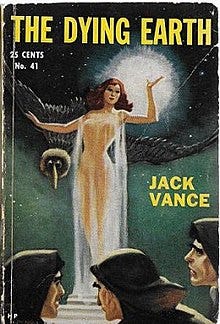
Hugo- and Nebula-winner Jack Vance, who wrote in the science fiction, fantasy, and mystery genres, published a collection of fantasy stories called The Dying Earth in 1950. All six stories are set in future Earth when our Sun is about to die and wizards use magic spells that need to be rememorized every time they are used. The planet is populated by strange plants and animals, the deodands among the latter.
According to Wikipedia:
“Deodands are humanoids which look like handsome, muscular human men, but with “dead black lusterless skin and long slit eyes.” They are strong, murderous, and carnivorous creatures, but can be killed with offensive spells, which they fear. In Cugel’s Saga, the wizard Follinense believes they are a mixture of basilisk, wolverine, and man. Deodands are notably eloquent.”
I assume the connection with the old English law has to do with “murderous”, although it would have been really interesting if he had called them Banes.
Canadian science fiction and techno-thriller author Karl Schroeder created a “pathologically shy Ukrainian arms inspector and anti-James Bond” named Gennady Malianov, about whom he’s written several stories over the last two decades.
In one of them called “Deodand”, the word is used to name an artificial intelligence that represents some system of nature and attempts to optimize the interests of said system.
You can listen to Schroeder talk about the story and the significance of using the word deodand here. Around the 12-minute mark, if you want to skip the first part (although it’s interesting).
So there you have it. Despite being a law used well into the 19th century, and also a word used in the fiction prose of two award-winning writers, the editors of the Spelling Bee decided that deodand was a dord.*
You can check out my previous entry on another dord* here:
*What the heck is a dord, you ask? Here’s the answer: