avatarFaisal Khan

Free AI web copilot to create summaries, insights and extended knowledge, download it at here

2145

Abstract

tor took place mostly after June, the broader picture is different. While it is true that the growth really took off since June, it had been on the run since the beginning of the year. It’s just that the increase in value has been so massive since June that it pales the growth of prior five months (Figure 1). After a brief lull in October, things have picked up again.</p><h1 id="f591">Weekly Revenue comparison of DeFi Platforms</h1><figure id="b3d2"><img src="https://cdn-images-1.readmedium.com/v2/resize:fit:800/1*-iwwmDzV-FNXwSrE0rMRYg.png"><figcaption>Figure 2 — <a href="https://blog.chainalysis.com/reports/defi-growth-regulations-compliance">Chainalysis Insights</a></figcaption></figure><p id="c4ab">Decentralized exchanges (DEXs) are the most popular type of decentralized Applications (dApps) and the chart above breaks down the performance of these DEXs in DeFi growth over this year. As evident, Uniswap (version 1 & 2), Kyber, Curve Finance, and 1inch Exchange responsible for the majority of the growth (Figure 2).</p><h1 id="65c6">Value & No. of Transfers received by DeFi Platforms</h1><figure id="14df"><img src="https://cdn-images-1.readmedium.com/v2/resize:fit:800/1*A5gF4C6h0DehdeZ-zsqkKg.png"><figcaption>Figure 3 — <a href="https://blog.chainalysis.com/reports/defi-growth-regulations-compliance">Chainalysis Insights</a></figcaption></figure><p id="1608">The chart above (Figure 3) highlights the total value received in 2020 by DeFi platforms by total value transferred and the number of transfers. As one can see, the majority of the participants are retail traders, evident from the higher number of transfers — the highest number of transfers taking place in the 100-1k bracket. Nevertheless, institutional investors seem to be driving this market segment with the highest value transferred for the 10k-100k bracket, closely followed by 100k — 1M. Notice how the number of transfers shrinks in size for big-money investors.</p><h1 id="66d9">Value sent from Illicit sources to DeFi Platforms</h1><figure id="41a0"><img src="https://cdn-images-1.readmedium.com/v2/resize:fit:800/1*j9MxhZfaFevJ0ywMEp2p5

Options

A.png"><figcaption>Figure 4 — <a href="https://blog.chainalysis.com/reports/defi-growth-regulations-compliance">Chainalysis Insights</a></figcaption></figure><p id="795a">While the previous three statistics highlight the enormous growth of DeFi, this last one is equally disturbing and probably not surprising. Although the value of stolen funds and scam money has peaked in October, the percentage of illicit transactions is only 0.05%. The significant percentage drop from the 1.00% peak in May owes to the fact that the overall market has grown so much since that point. In perspective, 0.05% is a pretty small number if you compare it to the total cryptocurrency transaction volume that was received or sent by an address associated with illicit activity <a href="https://go.chainalysis.com/2020-Crypto-Crime-Report.html">stands at 1.1%</a>.</p><p id="7a09">Unlike centralized financial institutions in the legacy financial system, DeFi platforms on the other hand, at least in theory, are governed by self-executing code, where they don’t generally take control users’ funds at any point. They are routed between individual wallets based on the platform’s underlying protocol.</p><p id="448b">Although DeFi platforms don’t function like conventional money service businesses, and might not come under current regulatory & compliance requirements — outstanding questions like auditing of platform code, the responsibility of financial crime & other vulnerabilities remain.</p><p id="133d">For now, there isn’t much clarity on this front and the sector continues to grow and expand. I will leave you with a promising upcoming DeFi Platform dubbed <b>Spherium</b> — an <a href="https://spherium.finance/">all-in-one DeFi platform</a> that offers a universally usable wallet, token swap platform, money markets, and inter-Blockchain liquidity transfer. The future of finance is here.</p><figure id="df02"><img src="https://cdn-images-1.readmedium.com/v2/resize:fit:800/1*KWNetPcjA8bVEn51BK3vWg.jpeg"><figcaption></figcaption></figure><h2 id="c1ae">Stay informed with the content that matters — Join my mailing list</h2></article></body>

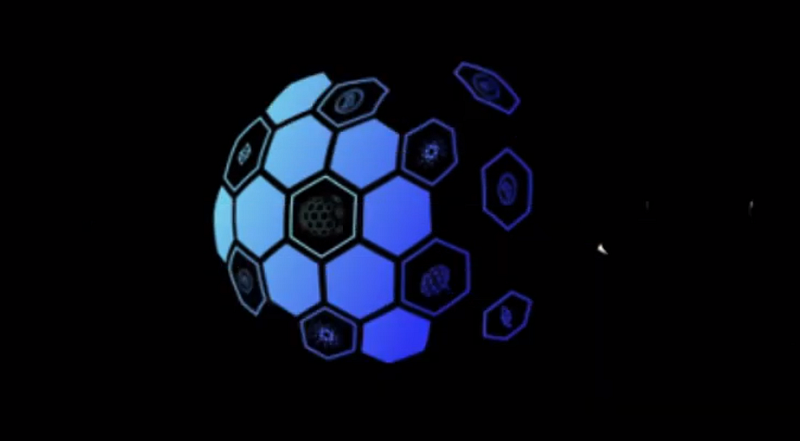
Image Credit: Spherium.finance

DECENTRALIZED FINANCE

Visualizing the explosive growth of DeFi in 2020

4 Charts showing how the future of finance is shaping up — regulatory requirements remain a concern

The biggest story in the blockchain space this year has been the phenomenal growth of Decentralized Finance (DeFi). You can gauge the exponential growth from the fact that the total USD value locked in DeFi which stood at $690.9 million on Jan. 1, 2020 has now ballooned to a staggering to $11.73 billion at the time of writing — the month of September alone saw the value tripled on a month-over-month basis.

For those of you who are new to this, DeFi refers to the use of Blockchains, Cryptocurrencies, and smart contracts to provide financial accessibility & inclusiveness to those who have been kept out of the current system by geographic, economic & financial barriers. DeFi platforms fall into the category of decentralized applications (dApps) built on top of smart contract-enriched blockchains — primarily the Ethereum network.

Blockchain analytics company, Chainalysis, has looked at the astronomical growth of this segment in 2020. Here are a few charts to visualize how the DeFi market has evolved this year.

Weekly DeFi Value Comparisons
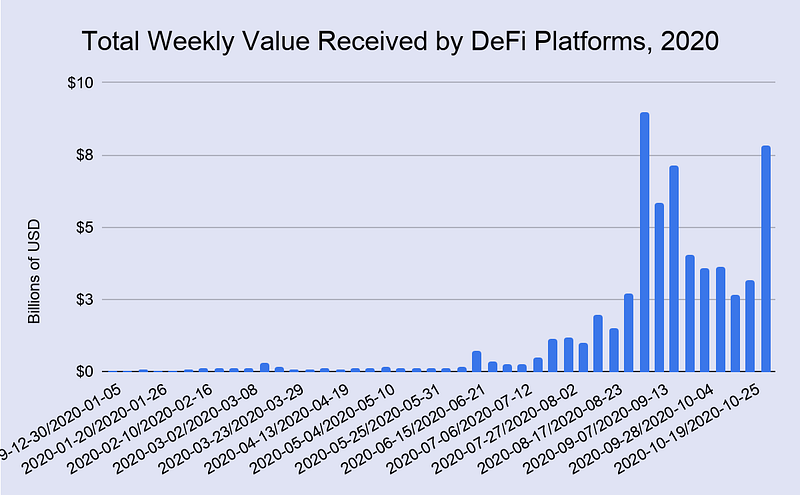
Figure 1 — Chainalysis Insights

Although in the chart above, it looks as if the growth in the DeFi sector took place mostly after June, the broader picture is different. While it is true that the growth really took off since June, it had been on the run since the beginning of the year. It’s just that the increase in value has been so massive since June that it pales the growth of prior five months (Figure 1). After a brief lull in October, things have picked up again.

Weekly Revenue comparison of DeFi Platforms
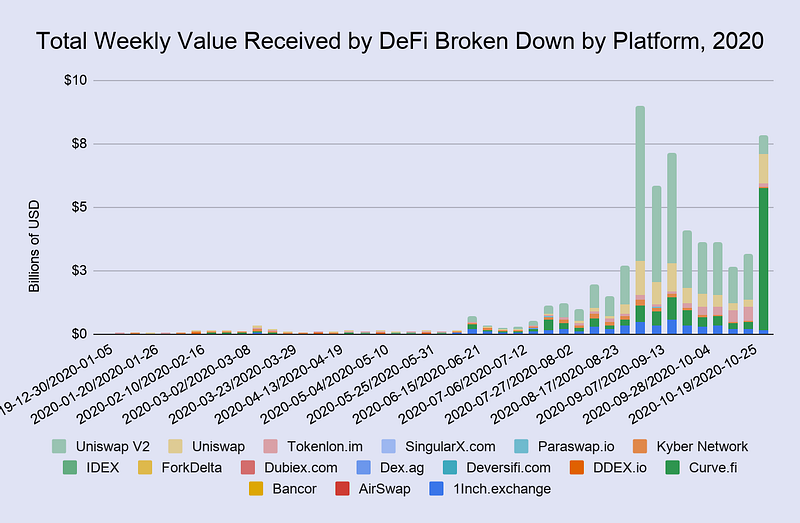
Figure 2 — Chainalysis Insights

Decentralized exchanges (DEXs) are the most popular type of decentralized Applications (dApps) and the chart above breaks down the performance of these DEXs in DeFi growth over this year. As evident, Uniswap (version 1 & 2), Kyber, Curve Finance, and 1inch Exchange responsible for the majority of the growth (Figure 2).

Value & No. of Transfers received by DeFi Platforms
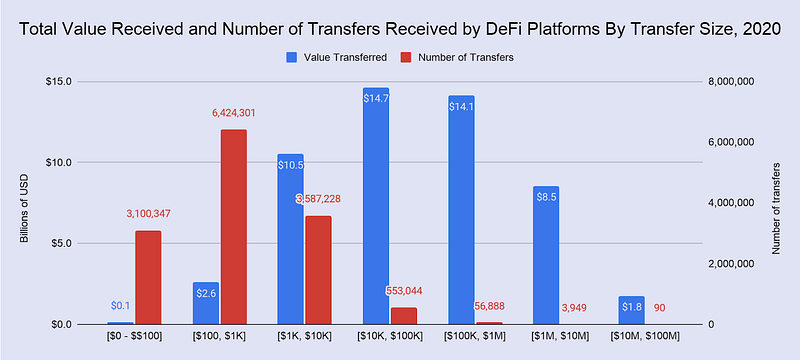
Figure 3 — Chainalysis Insights

The chart above (Figure 3) highlights the total value received in 2020 by DeFi platforms by total value transferred and the number of transfers. As one can see, the majority of the participants are retail traders, evident from the higher number of transfers — the highest number of transfers taking place in the $100-$1k bracket. Nevertheless, institutional investors seem to be driving this market segment with the highest value transferred for the $10k-$100k bracket, closely followed by $100k — $1M. Notice how the number of transfers shrinks in size for big-money investors.

Value sent from Illicit sources to DeFi Platforms
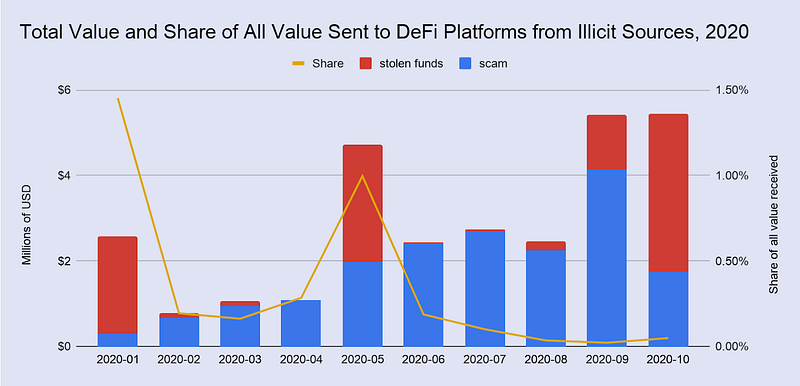
Figure 4 — Chainalysis Insights

While the previous three statistics highlight the enormous growth of DeFi, this last one is equally disturbing and probably not surprising. Although the value of stolen funds and scam money has peaked in October, the percentage of illicit transactions is only 0.05%. The significant percentage drop from the 1.00% peak in May owes to the fact that the overall market has grown so much since that point. In perspective, 0.05% is a pretty small number if you compare it to the total cryptocurrency transaction volume that was received or sent by an address associated with illicit activity stands at 1.1%.

Unlike centralized financial institutions in the legacy financial system, DeFi platforms on the other hand, at least in theory, are governed by self-executing code, where they don’t generally take control users’ funds at any point. They are routed between individual wallets based on the platform’s underlying protocol.

Although DeFi platforms don’t function like conventional money service businesses, and might not come under current regulatory & compliance requirements — outstanding questions like auditing of platform code, the responsibility of financial crime & other vulnerabilities remain.

For now, there isn’t much clarity on this front and the sector continues to grow and expand. I will leave you with a promising upcoming DeFi Platform dubbed Spherium — an all-in-one DeFi platform that offers a universally usable wallet, token swap platform, money markets, and inter-Blockchain liquidity transfer. The future of finance is here.

Stay informed with the content that matters — Join my mailing list

Bitcoin
Finance
Economics
Investing
Technology
Recommended from ReadMedium