
Virtual Items and the Creator Economy
Gaming is currently a $180B global industry that derives 75% of its revenue from virtual items — nearly a four-fold increase in marketshare for this business model over the last decade. By 2025, games and AR/VR experiences in virtual worlds — what I call the metaverse — will be a $390B industry and get nearly all of its revenue from virtual items.
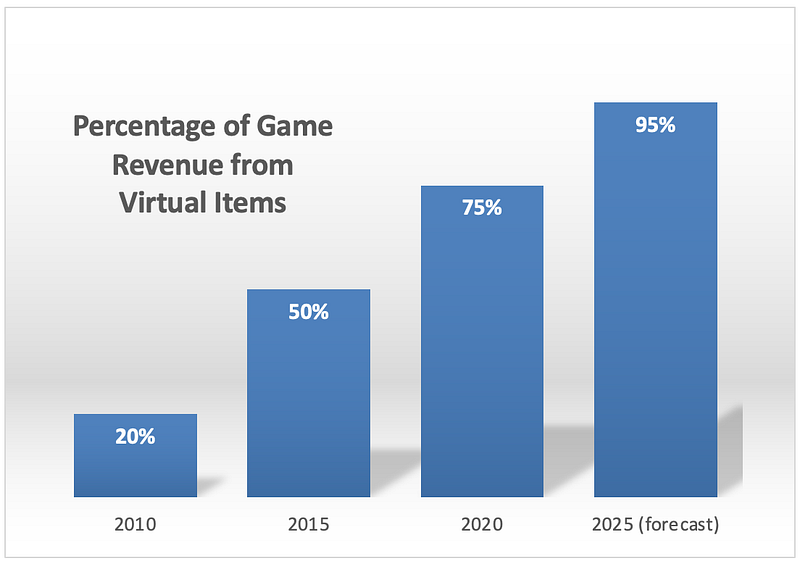
Why?
- Games are hobbies, and virtual items appeal to the hobbyist mentality — owning, investing, customizing and personalizing your experience.
- Virtual items are a democratized and lower-friction business model: people can try a game before deciding whether to put money into it.
- Virtual items are a more scalable business model: purchases increase in proportion to the attention a player directs to a game.
- Virtual items are a more sustainable business model: ongoing item sales fund the creation of new content, new experiences and new events that players crave.
The Future of Virtual Economies
Virtual inventories are growing larger, have more variety, get updated more frequently and are governed by increasingly complex metadata and rules. This requires gamemakers to design more sophisticated systems for managing, pricing, organizing, selling and deploying all these items.
Furthermore, the creator-economy around games and virtual worlds will expand to include far more participants. Right now, it is mostly about the content that gamemakers define for their players. But in some metaverses, notably Roblox, there’s a thriving market for builders to share assets with each other; and in Unity, the Asset Store makes it possible for creators to share content that can be used in other independent games.
Eve Online has a real virtual economy where players trade what they’ve built with each other. Take that to the next level: more games will be designed with the idea of a player economy, and it won’t simply be markets of crated items from preconstructed templates; players will have the opportunity to put their creative stamp on the economy of a game. One can already see this emerging in a metaverse like Rec Room, where your “maker pen” unleashes the creative aspects of the experience within the same interactive space you play within.

When Shopify disrupted ecommerce by making it accessible to any small business, they radically expanded the online opportunity for businesses. Similarly, games will undergo a transformation over the coming years in which far more independent gamemakers and content creators will get to participate in the $390B+ revenue generated yearly in virtual worlds.
If you enjoyed this article, here are a couple others you may find interesting:
- In the Metaverse Value-Chain I go over the seven layers of value-creation in the metaverse, from the experiences all the way down to infrastructure.
- In Market Map of the Metaverse I highlight many of the companies who are building the metaverse — as well as a more detailed analysis of Roblox, Unity and Epic Games.
- In Game Economics, Part 3: Free-to-Play a do a thorough overview of what drives most in-app purchase revenue today.
- In Evolution of the Creator Economy, I give some more context around how creator-led economies build over time and the opportunities for democratization and disruption within them.


