
Villanella
A musical interlude on a busy Monday

Today’s New York Times Spelling Bee letters:
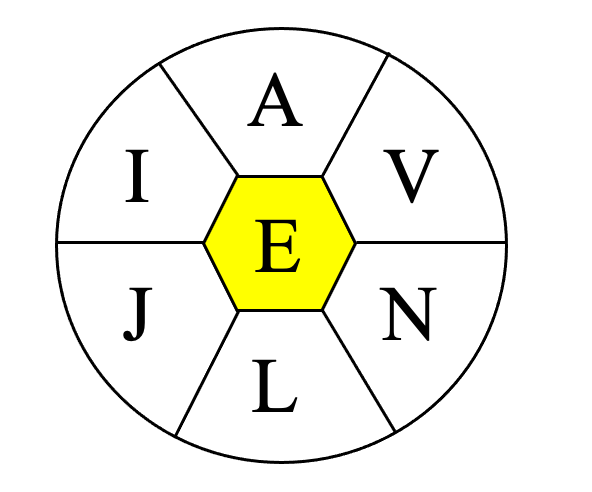
A, I, J, L, N, V, and center E (all words must include D)
Merriam-Webster says…
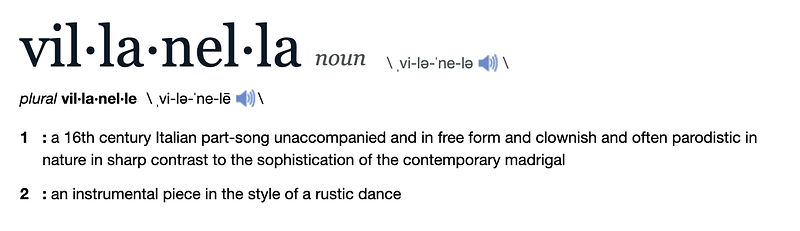
Silly little dictionary! Don’t you know that villanella can’t possibly be a word if The New York Times says it ain’t?
For a complete list of rejected words, check out the Spelling Bee Master.
What’s your favorite dord* from today’s puzzle?
My Two Cents
Today has been a very busy day with little time for creative writing. And still, I wanted to provide some content for those three or four readers that habitually spend more than half a minute scrolling down this column. They have helped me earn those 13 cents on a regular basis, so I’d like to not disappoint them today.
And also earn another 13 cents.
Villanella is an odd word for the Spelling Bee to have rejected. After all, they accepted villanelle, which is the irregular plural. However, when I looked up villanelle I discovered it had a different (albeit related) meaning:
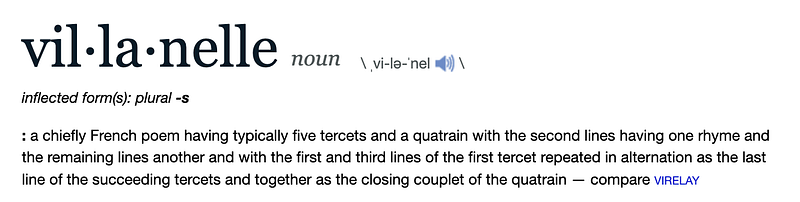
Conclusion: The New York Times has no issue with obscure French poetic formats that rhyme, but doesn’t particularly care for obscure Italian musical formats that rhyme.
Here we go, my dear readers. I promise this article will be short and musical.
Short
The villanella was born in Naples, today the third-largest Italian city (after Rome and Milan), located on its west coast towards the southern part of the boot, where one might image the ankle would be.
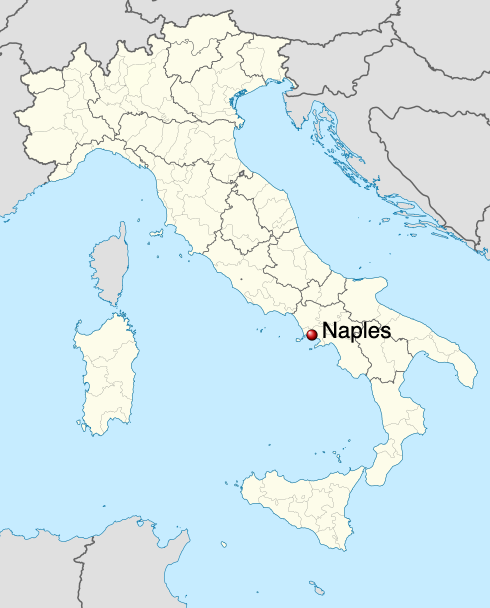
Naples is known as the birthplace of modern pizza, and I recommend saying this with authority whenever you’re in the presence of two or more Neapolitans.
Back in the 16th century, Naples was part of the Spanish Empire. Spain beat France in a battle named for river north of the city, and ruled over Naples for a two centuries and change. It was during this time that the villanella was developed, and was therefore called villanella alla napoletana. In the beginning, the rhyme scheme of the verses was abR abR abR ccR.
The online Britannica has this more technical explanation:
villanella, plural villanelle, 16th-century Italian rustic part-song, usually for three unaccompanied voices, having no set form other than the presence of a refrain. The villanella was most often written in chordal style with clear, simple rhythm. Traditional rules of composition were sometimes broken; for instance, the normally forbidden movement of voices in parallel fifths was common in the villanella. The villanella was not a folk form but a reaction against the more refined madrigal, often parodying well-known madrigal texts and music.
The madrigal was a type of vocal chamber music that originated in northern Italy during the 14th century, and was taken quite seriously by the time the villanella was developed. The villanella, on the other hand, had lighter, more rustic subject matter. It was often satirical, and made fun of the madrigal itself. (As an aside, villanella comes from the Italian villano, meaning “rustic laborer” or “peasant”, from Medieval Latin villanus.)
Today the term villanella is also used to refer to the music in the style of the old-style vocal songs.
Musical
I managed to find a few . We’ll start off with one called “Villanelle all Napoletana”, which should give you an idea of what this tune may have sounded like 400 years ago.
Next is a “suite in the style of a 16th-century villanella”––which may be the musical equivalent of “kosher style”.
Here is a short sample of villanella music played by Christopher Wilson. I’m not sure if that is, in fact, a lute. My musical ear is terrible hen it comes to distinguishing lutes from guitars and banjos.
And finally, here is a tune that seems to be about the villanella… although I’m not sure if it is, in fact, one.
Now you know. Next time you hear a 16th-century Italian rustic part-song for three unaccompanied voices, you can show off your knowledge by telling everyone that they’re listening to a villanella. No one will pay much attention to you, though. Not because they don’t care for 16th-century Italian rustic part-songs for three unaccompanied voices… but because the editors of the Spelling Bee decided that villanella is a dord*.
You can check out my previous entry on another dord* here:
*What the heck is a dord, you ask? Here’s the answer: