
Giardia
The tiny parasite with huge eyes

Today’s New York Times Spelling Bee letters:
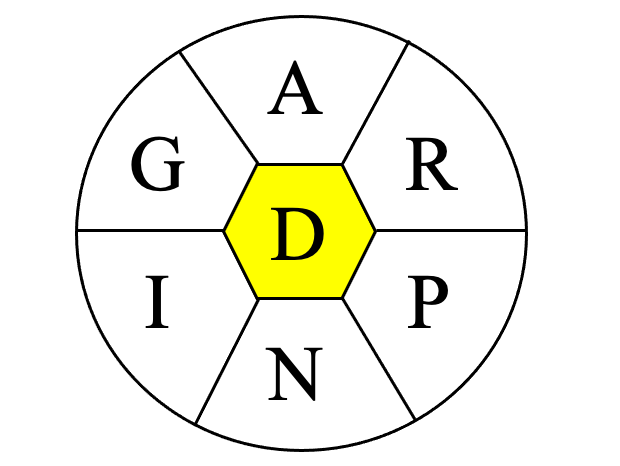
A, G, I, N, P, R, and center D (all words must include D)
Merriam-Webster says…
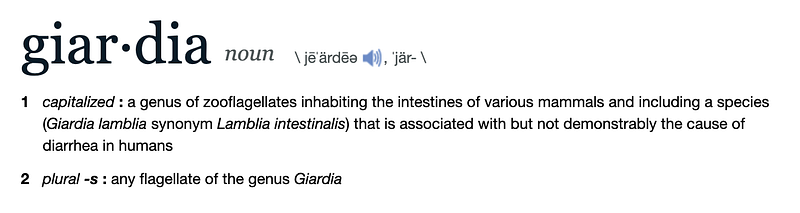
Silly little dictionary! Don’t you know that giardia can’t possibly be a word if The New York Times says it ain’t?
For a complete list of rejected words, check out the Spelling Bee Master.
What’s your favorite dord* from today’s puzzle?
My Two Cents
I know that discussing a diarrhea-inducing parasite may not be the best way to attract readers on a Sunday afternoon ––or any afternoon, for that matter–– so just take this as a public service announcement. And, although I do have a medical background and know what I’m talking about here, if you are ever feeling ill for any reason, go talk to a doctor. And by doctor I mean your physician, not Dr. Google. A friend of mine has a mug he likes to quote:

Did you know that the term parasite originally referred to the assistants of priests in Ancient Greece? They parasites would help the priests with ritual sacrifices, after which they would eat together. The Greek para- means “beside” or “next to”, while sitos means “grain” or “bread”. Later the term began to be used for one certain people in Ancient Greece who would dine or even live with the rich, earning that benefit by flattery, entertainment, and even humiliation.
Only much much later did parasite come to mean “an organism living in or on another living organism, obtaining from it part or all of its organic nutriment.”
The agent
The Giardia genus was named for Alfred Mathieu Giard, a 19th-century French biologist who was one of the first to describe this parasite. The species lamblia, which is the one that infects humans, was named for Czech physician Vilem Dusan Lambl. The first definition provided by the dictionary is capitalized, which a Spelling Bee no-no, but the second meaning isn’t. Which means giardia should be accepted as a valid word.
The oldest articles in The New York Times about this parasite date to 1970. A piece that came out in December of that year describes how “Physicians attached to the State Department and others at the Center for Disease Control in Atlanta are investigating a series of outbreaks of parasitic disease that has affected Americans traveling to the Soviet Union.” The article then goes on to describe the infection thusly:
The illness that afflicted the tourists to Leningrad is not “traveler’s diarrhea,” which is an entity of unknown cause that usually strikes people for a day or so just after their arrival in a foreign country. A pear-shaped parasite, called giardia lamblia, is what made these tourists ill. The parasite has two nuclei that “give the organism the appearance of a face with two large eyes,” when doctors peer at it under a microscope, Dr. Ivan L. Bennett Jr. of the New York University Medical School has said.
A face with two large eyes?
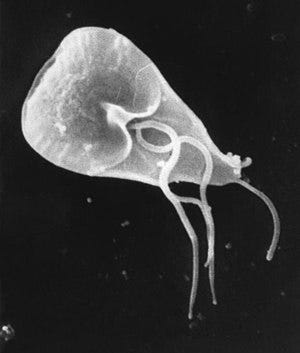
The above image came from an electron microscope. Which might make people take the giardia more seriously than the typical illustrations used years ago:
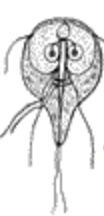
That little fellow reminds me of those sea monkeys advertised in comic books in the 1960s and 70s.

Please don’t print this form and mail it along with $1.25. I think that offer is no longer good. Also, don’t take the giardia lightly, either. It’s able to survive outdoors for long periods of time thanks to a tough outer shell it develops during part of its life cycle. As the online Britannica explains:
G. lamblia has two life stages: a motile, replicative trophozoite stage, in which the parasite survives in the small intestines of the host, and a nonreplicative cyst stage, in which the parasite survives in the environment. Upon ingestion by a host species, trophozoites adhere to the epithelium of the small intestine, where they then divide by binary fission. Fission may result in the production of additional trophozoites or in the generation of cysts. Cysts pass through the intestines, ultimately being shed in host feces. Once in the environment, under moist conditions, dormant G. lamblia cysts can survive for weeks or even months.
The above explanation might be helped with a visual, courtesy of the CDC:
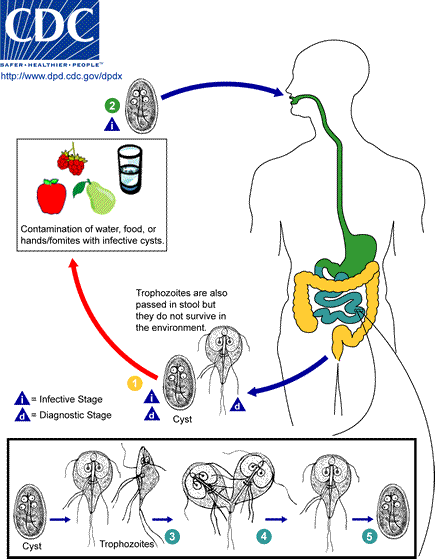
Yep, water is one of the main media through which giardia hops from host to host. It can be found in lakes and small streams, but also in public water supplies, and even in swimming pools. It can be prevalent in areas with poor sanitation. Giardia can also spread via food and person-to-person contact, including anal and anal-oral sex.
The disease
A giardia infection, or giardiasis, is an intestinal infection with symptoms that include severe stomach cramps, nausea, bloating, and diarrhea. The diarrhea can become very intense and watery, requiring hospitalization to avoid the risk of getting dehydrated. Some people, however, show very mild symptoms or none whatsoever.
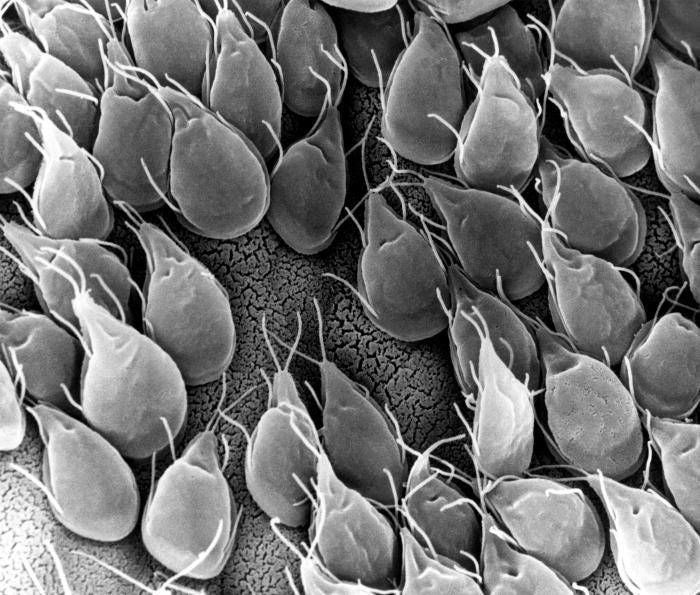
The disease can go away on its own after a few weeks––your antibodies and T cells help with that–– but can leave you with digestive problems for a long time. Some people develop lactose intolerance as a result of getting infected by giardia. (The photo at the top of today’s article shows the small intestine of a gerbil infested with giardia.)
Diagnosis is made by taking into consideration a patient’s symptoms and examining stool samples. Sometimes several samples need to be looked at. Patients with severe symptoms may receive anti-parasitic medication such as metronidazole or tinidazole. Pregnant women with giardiasis should not self- medicate to avoid exposing the fetus to these drugs, and should consult with their doctor to see what the best treatment options might be.
The best measures against giardiasis are preventive ones:
- Purify water if you’re outdoors. Don’t drink water from shallow wells, lakes, rivers, ponds, etc., without first filtering it or boiling it for at least 10 minutes at 158 degrees Fahrenheit (70 Celsius).
- Wash your hands and all produce. The easiest and best way to prevent giardiasis as well as many other infections. Needless to say, you should wash your hands thoroughly after going to the bathroom, changing diapers, or preparing food. Alcohol-based sanitizers can kill giardia, too, but they don’t work on the cyst form.
- Keep your mouth closed. That’s good advice in many cases, like family Thanksgiving dinners or when in the army. But in this case, we mean you should avoid swallowing water in pools, lakes, or streams.
- Use bottled water, especially in places where the water supply may be unsafe. In those cases, you shouldn’t use the local ice, either. It’s alos recommended that you brush your teeth with bottled water.
- Practice safe sex, especially anal and oral-anal sex.
Remember, don’t get fooled by this cute face…

Now you know. Next time your friend complains about a case of severe diarrhea, you can tell them they should check to see if it’s due to giardia. Don’t be surprised if they give you a weird look, though. Not because you’re not a doctor… but because the editors of the Spelling Bee decided that giardia is a dord*.
You can check out my previous entry on another dord* here:
*What the heck is a dord, you ask? Here’s the answer: