
Amole
You might get in a lather over this word
Today’s New York Times Spelling Bee letters:
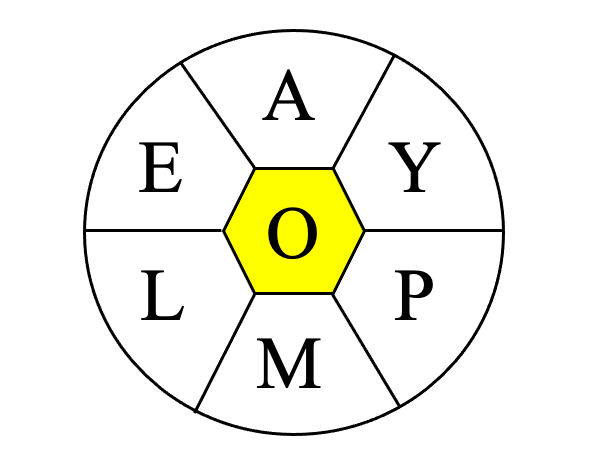
A, E, L, M, P, Y, and center O (all words must include O)
Merriam-Webster says…
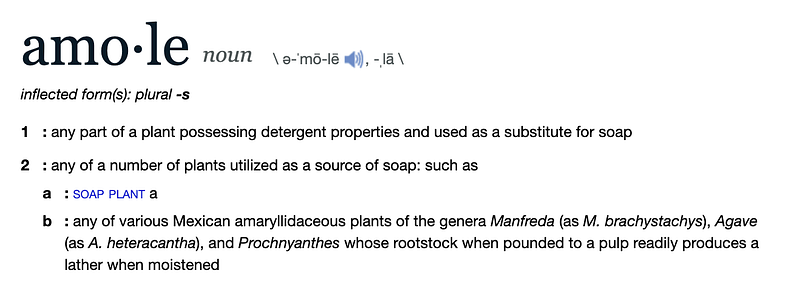
Silly little dictionary! Don’t you know that amole can’t possibly be a word if The New York Times says it ain’t?
For a complete list of rejected words, check out the Spelling Bee Master.
What’s your favorite dord* from today’s puzzle?
My Two Cents
I wasn’t feeling very inspired today by the Spelling Bee Game ––it took me forever to reach Genius level–– or the list of reject words to choose from. Or perhaps it’s just me. I’ve been posting daily for almost two-thirds of the year now, and sometimes I feel the embers of a mild burnout in my brain. Still, I’m trying to soldier on, so bear with me if this article is worse than my usual not-so-good stuff.
Earlier I was perusing the rejected words without much enthusiasm. When I checked to see if amole might be worth writing about, I realized I might have accidentally run into a historic baseball first that I hadn’t heard about before. That immediately made it interesting for me. So, amole it was.
As an aside… how in heck was the adjective moppy not accepted by the Spelling Bee?!? Really? I can’t imagine anyone who plays the game thinks it’s obscure, and I’m willing to bet most of us tried inputing the word today. Is moppy some type of slur or offensive word I’m not aware of? What do you think, my handful of readers?
lowercase a
Our friends at Merriam-Webster tell us that amole was borrowed from American Spanish, itself borrowed and altered from the Nahuatl ahmolli, meaning “soap plant, soap”.
Nahuatl is the ancient language (or group of languages) of the people who lived in Central Mexico during the years of the Aztec Empire. The dictionary lists three genera of plants found in Mexico –-Manfreda, Agave, and Prochnyanthes–– but these are now all grouped in the single genus Agave. Yes, that same plant from which tequila and mezcal are made.
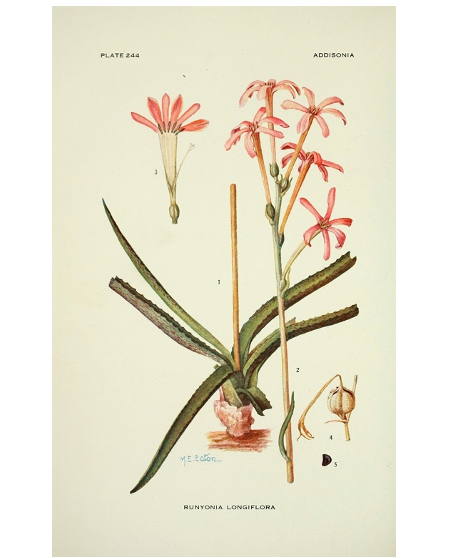
It turns out the sap of some agave species can be used as soap. One such species is Agave longiflora (also known as Manfreda longiflora), native to the southern part of Texas in the United States and the northeastern part of the state of Tamaulipas in Mexico.
In other parts of the North American, especially the Western states of the U.S. and Canada, the soap plants known as amole are in the genus Hooveria…
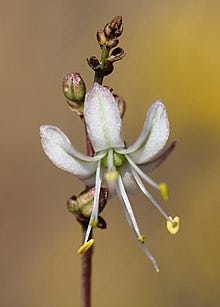
…and Chlorogalum.
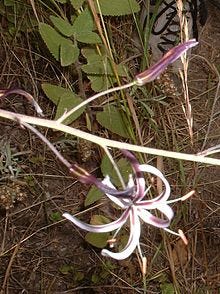
Both belong to the same same family of the agave, which happens to be that of the asparagus. The above species, Chlorogalum pomeridianum, was widely used by Native Americans as a soap-like substance… and also for fishing! According to Paul Campbell’s 1999 book, Survival skills of native California, some indigenous people pulverized the roots of the amole, mix the powder with soil and water to create a foam lather, and then pour that in a stream where they had seen fish. This would kill or incapacitate the fish, which would then rise to the surface of the water and be “harvested” by the tribespeople.
No word on whether or not this allowed the Native Americans to skip the step of having to clean the fish.
Uppercase A
▹ Amole with a capital A is the first name of Amole Gupte, an Indian actor, screenwriter, and director. He also chaired the Indian Children’s Film Society between 2012 and 2015. Along with his wife, Bollywood editor Deepa Bhatia, he developed the idea for the critically-acclaimed movie Taare Zameen Par (known as Little Stars on Earth in English), which he then wrote the screenplay for. The movie was a box-office hit, raised awareness about dyslexia in India, and was that country’s official entry for the 2009 Academy Awards Best Foreign Film category. However, it did not advance to the final five shortlist.
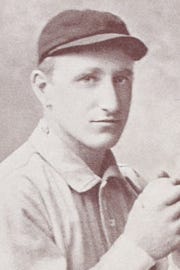
▹ Amole with a capital A is also the surname of a short-lived 19th-century Major League baseball player named Morris George. Better known as “Doc”, he had the following very anemic stats the only two seasons he pitched in the National League, which back then was the only league in MLB.

And here is a picture of Doc Amole, judging you for judging him based on those paltry numbers.
One of the harder things for pitchers in the Major Leagues to achieve is throwing a no-hitter, a game in which they allow no hits by the opposing team. Players have other means of getting on base and advancing (for example, a walk, an error, or a sacrifice fly), so although a no-hitter usually ends with no runs for the losing team, it’s not always the case. In fact, there have been two games in which the team throwing the no-hitter ended up losing!
Well, if you think I wrote the above paragraph to segue into Doc Amole’s no-hitter… psych! I’m now going to write about the time he threw a ball with an explosive to hall-of-fame shortstop Honus Wagner. Wagner connected, setting of sparks and the wrath and confusion of the crowd. To be fair, the game was played at night on July 4th… so it kinda makes sense that Amole did that. This happened during his first year (1896) as a professional pitcher, and the next year he joined the Baltimore Orioles (not the same franchise we know today) in the National League. After the season he was traded to the Washington Senators (again, not the same franchise that played in the 20th century), but by 1898 he was back in the minors.
Now I’ll mention Amole’s no-hitter. He tossed it for the Buffalo Bisons, and American League team, on Opening Day of the 1900 season. It was the first no-hitter thrown in that league, but because at the time the American League was not part of Major League Baseball, it’s not considered an official MLB no-hitter. That honor belongs to Nixey Callahan of the Chicago White Sox, who achieved it on September 20, 1902.
The first (and so far only) major league no-hitter on Opening Day happened on April 16, 1940. Despite walking a bunch of players, future hall-of-fame pitcher Bob Feller allowed no hits and no runs as his Cleveland Indians beat the Chicago White Sox 1–0.
Back to Doc Amole… he retired in 1904 and died eight years later at the very young age of 33. Amole was found dead on the floor of his room at a boarding house in Wilmington, Delaware. No word on whether or not Honus Wagner was in Delaware that day.
Now you know. Next time you’re out camping and find some soap plant, you can show off your knowledge by telling your fellow campers that you can all wash your hands using the sap from that amole. Don’t be surprised if they ignore you, however. Not because they all brought their own soap… but because the editors of the Spelling Bee decided that amole is a dord*.
You can check out my previous entry on another dord* here:
*What the heck is a dord, you ask? Here’s the answer: