
Vasco da Gama’s expeditions to India — how did they change the world?
Vasco da Gama accomplished what other great voyagers failed to do — he found a sea route to India. It was this discovery that proved to be one of the most important and forever changed the perception of the world. Who was the famous Portuguese traveler? What was the significance of Vasco da Gama’s expedition? These and other questions are answered below.
The world around us has aroused our curiosity since ancient times. Driven by the desire to know the unknown, already the ancestors of our species left Africa and conquered almost all the continents. With the development of civilization, the desire to conquer the world became stronger and stronger.
The greatest geographical discoveries date back to the late 15th and early 16th centuries. Ferdinand Magellan, Christopher Columbus — even children know these names. Among the most outstanding explorers, Vasco da Gama — the man who opened a new period in the history of the world — must not be missing either.
Who was Vasco da Gama?
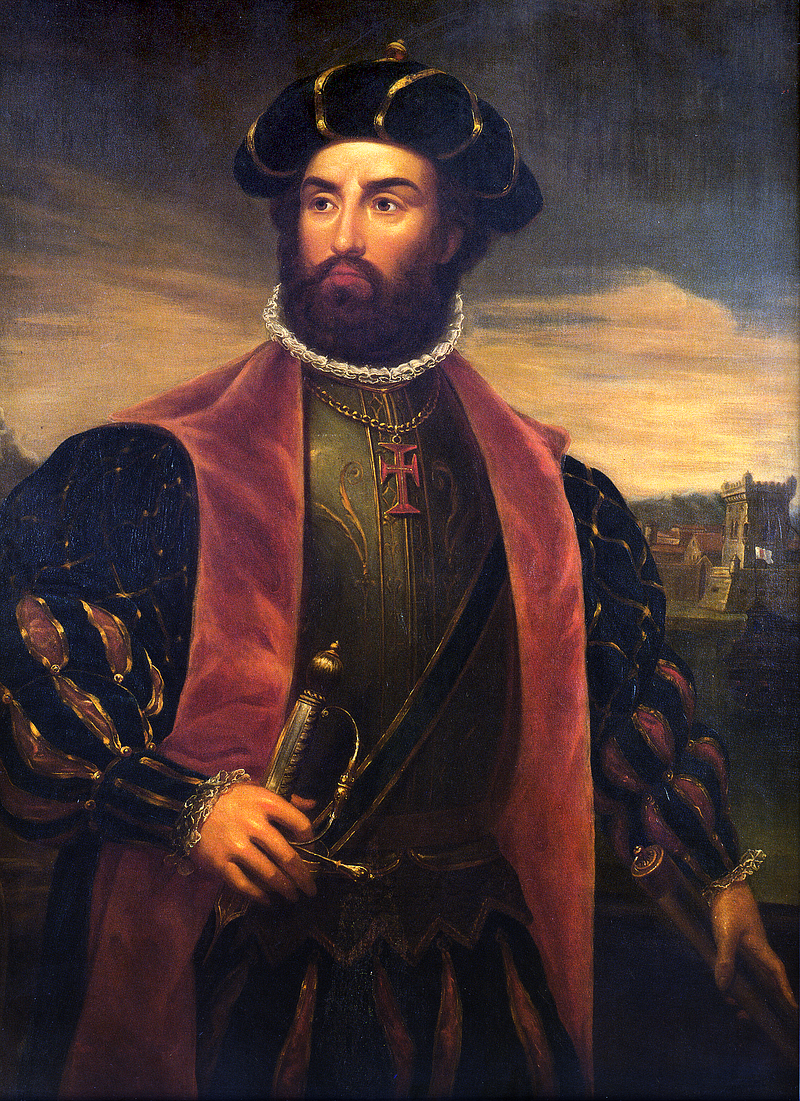
Vasco da Gama was born in 1460 or 1469 in the Portuguese town of Sines. The son of a knight of the Order of St. James, he spent his entire youth in Lisbon, where, following his father’s example, he joined a knightly order. In his youth, he probably also studied mathematics and navigation (in Evora). It was then that he was to meet Juan Ponce de Leon, the future explorer of Florida.
In 1492, King John II the Perfect commissioned the young sailor on his first mission. Vasco da Gama was sent to Setubal and the Algarve, where he was to carry out a seizure of French ships in revenge for the robberies committed against the Portuguese fleet. The success of the expedition allowed him to gain the favor of the ruler. He was soon to be given a much more ambitious task.
What was the purpose of Vasco da Gama’s expedition?
After the death of Henry the Sailor, Portuguese shipping fell into a slump. It was not until John II the Perfect, who came to the throne in 1481, that he decided to restore these traditions. The new ruler wanted to become independent from the influence of the feudal nobility, but to achieve this he had to fill the royal treasury. John II began to develop trade in West Africa, but soon set himself a new goal.
He wanted to take back the Republic of Venice’s monopoly position in the spice trade with Asia. To achieve this, he set his fleet commanders a daunting task: to find a sea route to Asia by circumnavigating Africa.
The royal envoys managed to become quite familiar with the southern areas of Africa, which had previously been almost virgin territory. It soon became clear that the coast of the Black Continent extended far to the southeast.
Initially, the expedition was to be led by Estêvão da Gama — the father of the future great explorer. His untimely death meant that the king had to modify his plan somewhat. He entrusted the mission to reach India to his son Estêvão, who was already highly trusted at court.
Why did the Portuguese ruler care about the sea route, when land routes to India were already known at the time? After the fall of the Byzantine Empire, the Muslims conquered Constantinople. They gained control of the Black Sea straits, Asia Minor and the Middle East. Transporting precious spices by land was too risky an undertaking.
What was Vasco da Gama’s first expedition to India like?
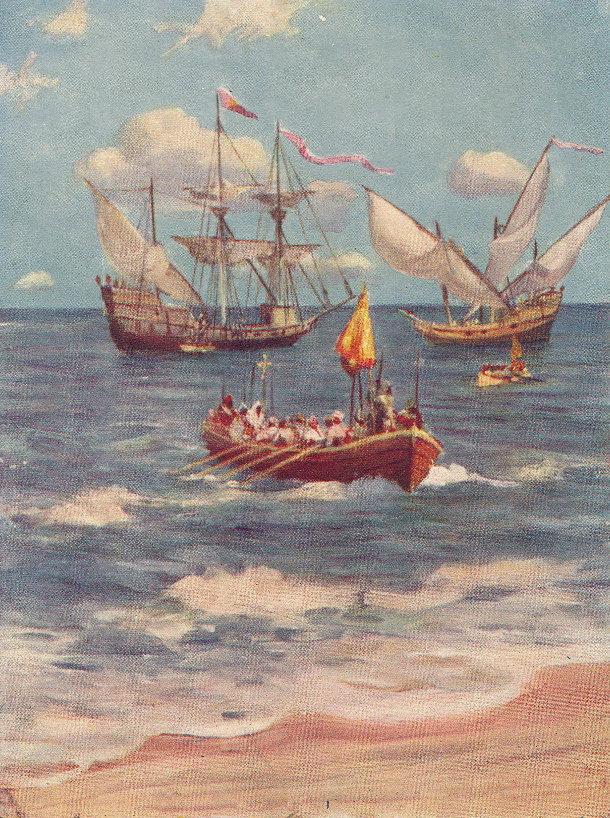
Vasco da Gama was given a crew of 160 men at his disposal. On July 8, 1497, the flotilla set out from the port of Lisbon. It consisted of four ships. The flagship was the “St. Gabriel,” armed with 20 guns.
The most experienced Portuguese sailors — Pedro Escobar, Pedro de Alenquer, Afonso Gonçalves Baldaia and João de Coimbra — were responsible for navigation. The rest of the crew was much less competent. Not many sailors participated in the expedition. Most of da Gama’s men were convicts, for whom the voyage was intended as a form of penance for their crimes.
The impulsive nature of the crew meant that there were mutinies, the main reason for which was…. unfavorable weather. However, Vasco da Gama proved that he was a born leader, effectively stifling all manifestations of insubordination.
After passing the Canary Islands and Sierra Leone, the flotilla set sail for the open sea. The four ships traversed the waters of the Atlantic Ocean for three months. After another two, the expedition reached the Cape of Good Hope. The real voyage to the unknown began on December 16, 1497, when the expedition passed the Great Fish River. Vasco da Gama sailed onward through waters that no European sailor before him had explored.
Three months later, the expedition docked in Mozambique. The expedition’s leader feared that the local Muslim population would not welcome the Christians with open arms. To buy into the Sultan’s favor, he pretended to be a Muslim. This clever maneuver was of little use. The Portuguese sailor had no worthy gift for the ruler. As a result, he had to flee. The flotilla’s retreat was covered by fire from the ship’s guns. Traveling further north, somewhere around Kenya, da Gama’s fleet launched an attack on several merchant ships belonging to the Arabs.
On April 14, 1498, the expedition reached Mombasa. From there it proceeded to the port of Malindi, which proved to be a much friendlier place for the newcomers. There da Gama obtained information about Indian merchants staying nearby. The sailor looked among the locals for a guide who would show him the way to India. Some sources say that this was the Arab navigator Ibn Majida. However, historians have no doubt that when da Gama’s expedition docked at the port, he was in a completely different place.
In what year did Vasco da Gama reach India? The expedition ended on May 20, 1498, when the flotilla docked at Kalikatu. The mission was only half-successful. In exchange for spices, the local Samudiri ruler expected gold. The royal envoy was able to offer him a much more modest gift. As a result, he filled only one ship.
History of subsequent expeditions to India
The second Portuguese expedition to India, led by Pedro Álvares Cabral, was a complete failure. Not only did the Portuguese sailor fail to establish trade relations, but in addition he came into conflict with Muslims. There was then a riot in which about 70 members of the expedition were killed. In retaliation, Carbal fired Kalikat from the ship’s guns.
The failure of the expedition meant that the mission to obtain the precious spices was again entrusted to da Gama. When the expedition, consisting of 15 ships, reached Calicut, da Gama demanded that the local ruler banish all Arabs. His order was not fulfilled. At that point, the Portuguese ordered the shelling to begin. The siege of the city lasted 2 days, as a result of which trade along the Malabar Coast froze. A naval skirmish ensued, which da Gama easily won. After a few weeks, the expedition left Calikat, having previously filled the ships with spices.
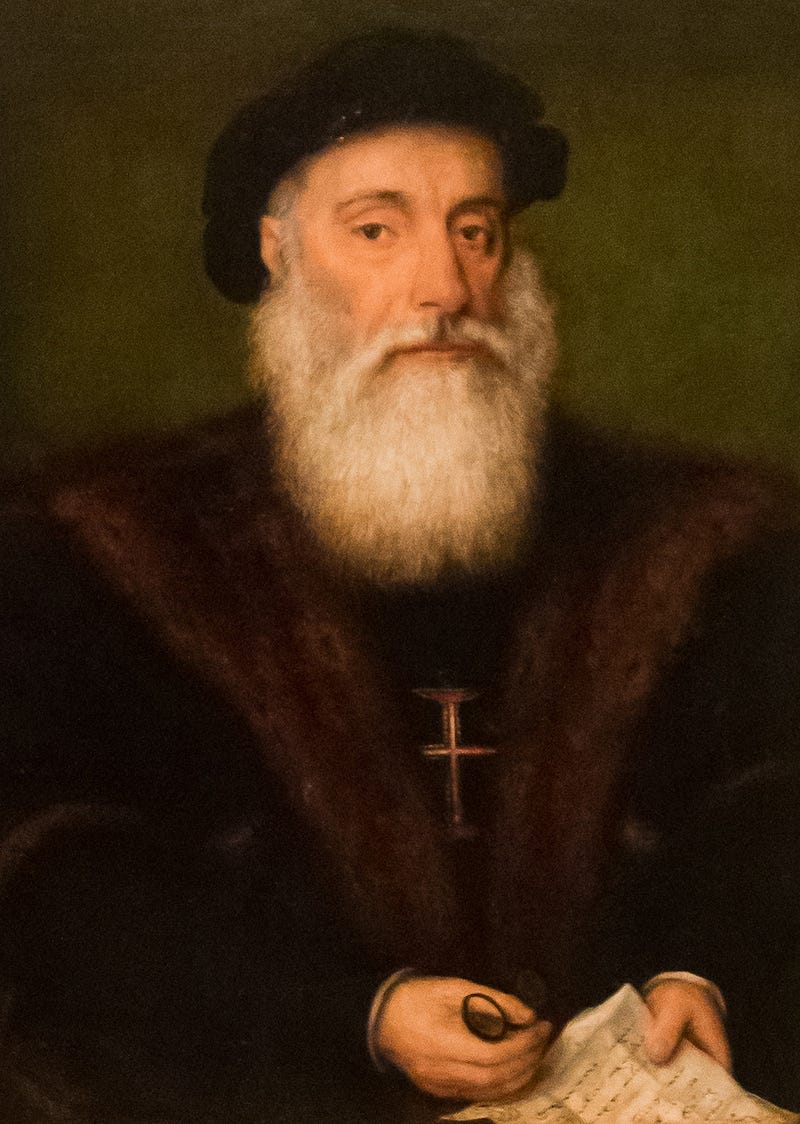
When da Gama returned to Portugal, King Manuel I decided to remove him from contact with India. When John III Aviz took power in the country (in 1521), Vasco da Gama again gained the favor of the king. In 1524, he sailed to India for the third time.
After arriving in Calicut, he exchanged royal officials for his men in all Portuguese colonies. His order, however, did not last very long. The Portuguese contracted malaria and died three months after his arrival (December 24, to be exact). In 1539 his body was transported to Portugal.
While da Gama’s first expedition could be called a diplomatic mission, the other two no longer left any illusions about the actual intentions of the Portuguese. Even the second expedition was partly of a warlike nature. The third should be considered a purely military mission.
The effects of Vasco da Gama’s expeditions
What were the consequences of the discovery of the sea route leading to India? In the economic context, da Gama’s expeditions made Portugal a leader in trade with Southeast Asia. The Portuguese monopolized trade with India for several decades.
Another aspect is geographical. The road laid out by da Gama was the main trade route until the opening of the Suez Canal. The expedition also overturned the Ptolemaic perception of the Indian Ocean. Vasco da Gama proved that it was open and connected to the Atlantic.
Vasco da Gama’s expeditions should also be considered from a political angle. It was the Portuguese sailor who took the first step to colonize India.
Cool that you made it to the end of this article. I will be very pleased if you appreciate the effort of creating it and leave some claps here, or maybe even start following me. It would be nice if you also left a tip! Thank you!


