
How does a dog see? The world from a dog’s perspective is quite different from ours
Dogs do not perceive the world only in shades of gray at all, as was thought until recently. They also see colors, although only two. How does a dog see?

Dogs have a huge range of visual field, although the acuity of this vision is relatively poor. And although they are very sensitive to movement and can track objects moving very fast, the facial expressions of even the most beloved human do not arouse their interest. It is worth finding out how a dog sees in order to better understand it. Especially since dogs see a little differently than, for example, cats.
We are so close to our four-legged pets that we sometimes see dogs as an extension of us. Such a slightly different version of humans. This is understandable, since dogs have accompanied humans for up to 40,000 years. The very relationship with them is the best evidence of the possibility of interspecies understanding.
When we look at the expression of the four-legged dog’s muzzle, we think that he also reads emotions from our face. When he accompanies us as we relax with our favorite movie, we think the dog is watching with us. When he finally comes running towards us in the twilight, distinguishing his human from the others in the blink of an eye, we recognize that he simply saw us. But the matter is not so simple.
How a dog sees
First of all, dogs see the world from a completely different perspective than we do. We humans, thanks to our upright posture, see much more objects in the farther and closer distance. But even the largest breeds of dogs do not match the height of humans and have their heads at a maximum height of 80–100 cm. Most, however, are much shorter and view their surroundings from a fairly mundane level.
If you want to check what’s around your dog, sit next to your dog so that your eyes are at a similar height to your dog’s. You will notice all the dog toys hidden under the couch. For that, even the most beautiful chandelier will not impress you.
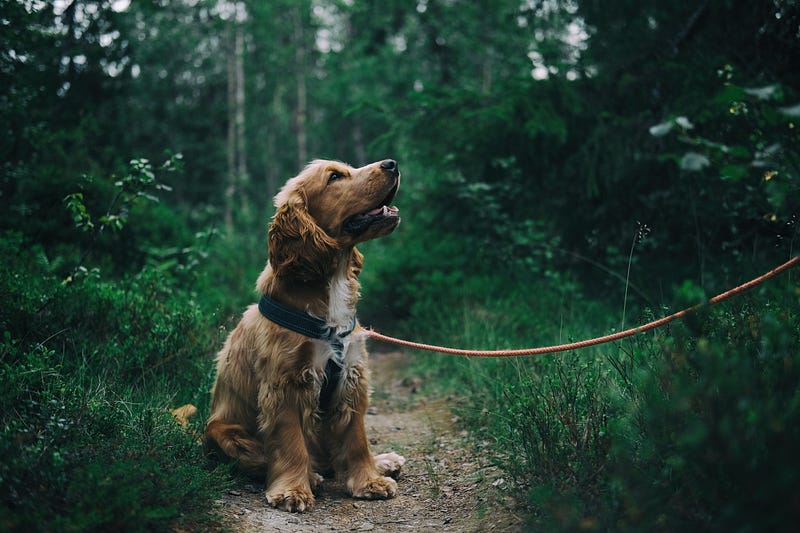
Dog’s field of vision
However, even if you go down to the level of a dog’s vision, your vision will be severely limited. A human’s field of vision is 180 degrees. But due to the arrangement of dogs’ eyes, their field of vision covers up to 240 degrees! This is one reason why our guardian pets do not need to look around at all to observe a very wide slice of space.
Those who are fortunate enough to own more than one four-legged dog may have noticed that when guarding, dogs lie down in characteristic configurations with their backs turned to each other. As a result, they are able to constantly observe their entire surroundings without moving. It is precisely the wide field of canine vision that is one of the reasons why our pets often do not turn their heads when we speak to them. They can see us even without that.

How a dog sees a human
But how does a dog see a person? It always sees movement more than a stationary figure. Dogs are extremely sensitive to movement. Hunting dogs are able to unerringly track the movement path of a shot animal — that’s why they find their prey so quickly. Therefore, if we want to start an interaction with a dog, we have to move. In contrast, if we do not want to confront the dog, it is better to stand still.
We recognize people primarily by their faces. We recognize the emotional states of our fellows by their eyes, their grimaces, the curving of their mouths. For this, a dog sees all this by reading our body movements. After all, dogs are descended from wolves. In turn, these have developed a whole complex system of movements, even a dance, to inform the other members of the pack about emotions. The characteristic “walking sideways” is an expression of anxiety, uncertainty related to the dynamics of the situation. Curling the tail represents fear. On the other hand, lying on its back and showing its belly — complete confidence.
Since dogs show emotions this way, they also read them this way. Yes, it may seem to us that they comfort us because they see tears. However, they do this rather because when we cry, we often assume a hunched, fearful position. And the dog reads this very well. Warbling by our side, it says: don’t be afraid, I will defend you. Of course, to all this should be added the excellent sense of smell of dogs. It is he who is able to perfectly distinguish the chemical signals sent by animals.
What about the face? A study conducted in 2020 by a team of Hungarian researchers found that dogs are completely uninterested in our faces. They are more interested in other dogs’ mouths than in people’s faces. In general, a whole lot of things interest them more than human faces.
There is one exception to this rule. A smile. For humans, showing teeth in a smile is a sign of friendship. For a dog, especially one that does not know us and is in a stressful situation, it is an expression of aggression.

Can a dog see well at night?
You’ve probably wondered more than once how it is that a dog runs without hesitation after dark over an area dotted with numerous obstacles? What for us would end in at least a sprained ankle, for dogs comes easily and naturally. This is due to the structure of the dog’s eye.
Dogs have a sizable lens and a significant corneal surface area. This allows the dog’s eye to focus a lot of light. In addition, there are a lot of photoreceptors in the dog’s eyes, which are responsible for low-light vision. Behind the retina of the eyes of our merry pets is the so-called reflective membrane. Thanks to it, dogs catch many more photons than humans.
Dogs can see at night much better than we can. However, they tend to see shapes and contours rather than details. Because although they are great observers, their visual acuity leaves much to be desired.
Can a dog see colors?
If so, do dogs see colors, or do they not need it for anything? For many years it was considered that dogs see the world like in the old cinema, black and white. And indeed, modern research has shown that dogs’ eyes have relatively few receptors responsible for seeing colors. However, they do distinguish between the colors yellow and blue. For that, bright in our perception red, appears to them as black. So if you want to get your dog a toy, choose one in a blue or yellow shade.
And do dogs watch movies? More than once you’ve probably seen dogs turn their heads, purr or growl while looking at the screen. Unfortunately, they didn’t react this way to the movie itself, because they simply can’t see it. Rather, they perceive the flicker itself, and it is this, combined with the sounds coming from the receiver, that can trigger such a reaction from the dog.
Therefore, the next time your dog lies down at your feet joyfully enjoying an evening of movies, think that he is doing it because he loves you very much. And not because he can’t wait for the next episode of his favorite show.
Cool that you made it to the end of this article. I will be very pleased if you appreciate the effort of creating it and leave some claps here, or maybe even start following me. It would be nice if you also left a tip! Thank you!


