
How do cats see? Their world is blue, yellow and gray, at dawn and dusk, they have very sensitive eyesight
Many animal lovers wonder how cats see. Do they see colors and recognize human faces? Scientific research gives us the answer.
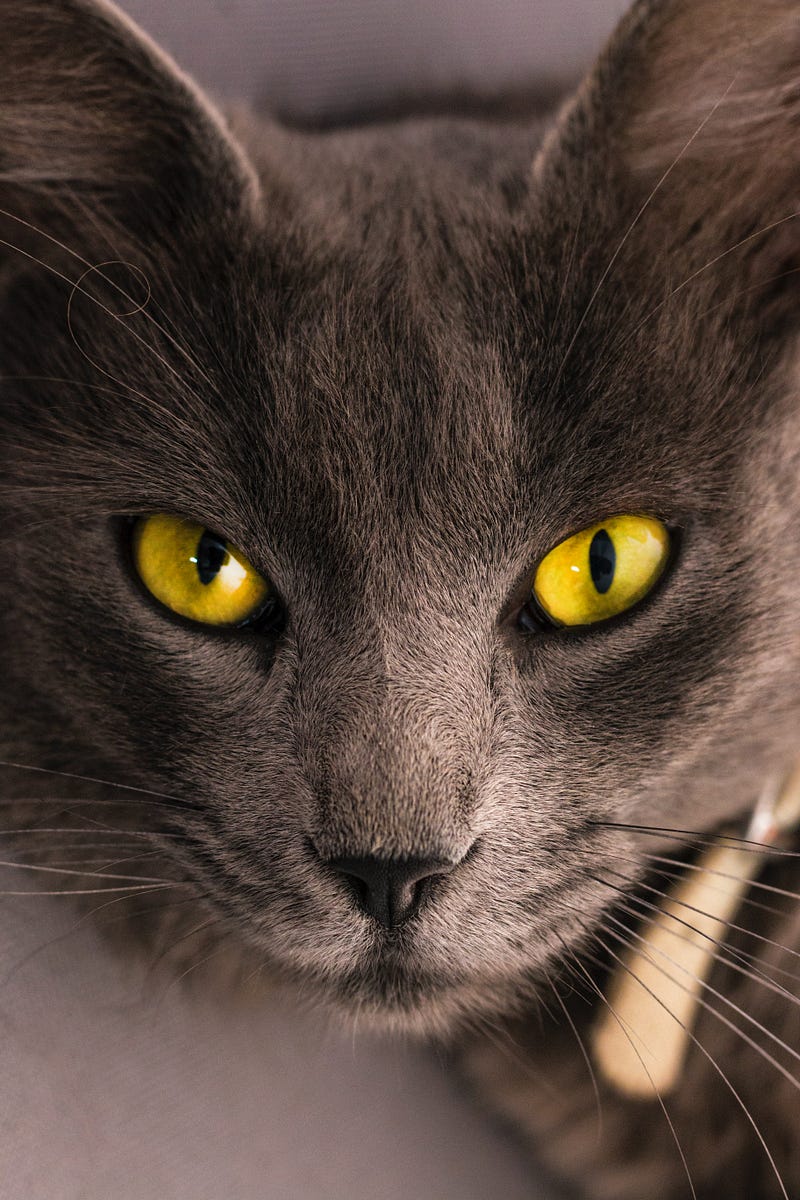
One may wonder who is man’s best friend — a dog or a cat? This does not change the fact that dogs, cats and many other mammals we know well cannot distinguish between red and green. That’s why, for example, a bull does not react to the red color of a sheet, but to its movement. And how do cats see?
What colors do cats see in
Cats do not see the world the way we do. First of all, they look from a different point of view. Their heads are generally quite close to the ground. This means that they see objects higher up less well. So, for example, our faces.
Cats can’t see the color red. They also do poorly with green. So their world is mostly blue, gray and yellow. Interestingly, research suggests that cats — unlike humans — can perceive part of the ultraviolet spectrum.
All vertebrates — from fish to humans — see thanks to the cones and rods that make up the retina. These cells contain various proteins called opsins. Each type of opsin, or visual pigment, corresponds to a different range of light wavelengths that most strongly excite it.
The cones are useful during the day. Stamens, on the other hand, in the diffuse, low light that prevails at night or on the border between night and day. On the retina of most mammals, rods dominate. The cones in nocturnal species make up only up to 3 percent of the eye’s photoreceptors, while in diurnal species they make up between 5 and 30 percent. But the toke gecko (Gekko gecko), for example, a typical “nocturnal brand,” has only rods. In contrast, the diurnal anolis green lizard (Anolis carolinensis) — only cones.
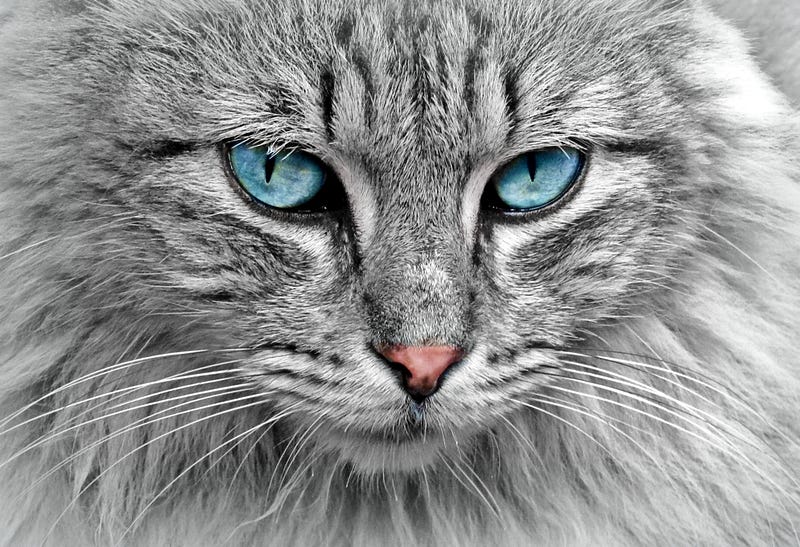
Are cats daltonic?
Only cones give the ability to see colors. But only if at least two different types of these cells are present on the retina. Most mammals have two types — red and blue. This results in bichromatic vision.
Cats are therefore similar to people affected by daltonism. Daltonists usually lack one type of visual pigment. Cats see similarly to people affected by protanopia. A person with even only one type of cones will still see, but only black and white. So we know that cats don’t see colors very well. For that, they see several times better than humans at night. Why?
How a cat sees at night
Rods, being too sensitive, do not function in bright light. Instead, they allow them to see in low light. Since they are only found in one kind, we can no longer distinguish colors after dusk. It is worth remembering, however, that in the really dark night even the rods do not work. That’s why cats are not nocturnal animals, because they can’t really see at night.
Cats are animals that function best in low, diffuse light. So, the kind that occurs in the wild at dawn and dusk. This is when the rods are most useful. A cat can see in light six times weaker than we can.
What helps a cat see in low light
Cats also have a higher critical blink frequency than we do. This means that cells in the retinas of their eyes take more “pictures” per second than ours. This makes a cat’s eyes more sensitive to movement. Cats have another adaptation for low-light vision. This is a reflective membrane located behind the retina. Reflecting light gives it an extra chance to catch photons. Other felids, lower primates, ostriches, owls, and spiders of the pogonia family also have such a membrane.
Because of this membrane, cats’ eyes look as if they glow in the dark. Among other things, this is the origin of beliefs in the magical or impure powers of these animals.
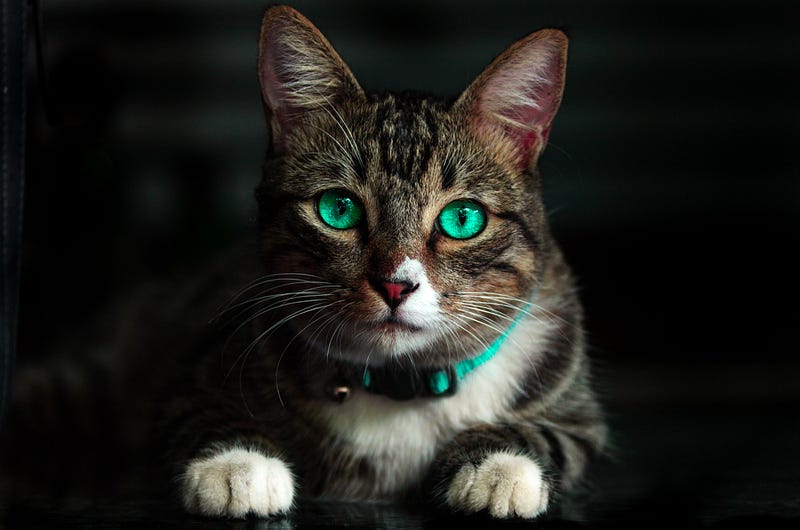
How cats see people
It is colloquially accepted to think that cats see us as big mutant creatures. According to scientists, this is an exaggeration. This view is not supported by studies. Instead, they show, for example, that cats understand when you call them by name. So why do they often not respond? Because they prefer to ignore humans.
On the other hand, it is possible that tame, domestic cats treat us as their parents. Most of them are attached to their owners. In a new environment, it is the close human who is a source of security for them.
Cats can recognize other cats by their canine appearance. However, this does not work well with humans. Cats either don’t perceive differences in our faces, or they simply don’t care what we look like. Their guardian’s voice and scent may be more important to them.
For cats, slow squinting is of great importance. Scientists say this is an effective way to communicate with a cat. In cats, it is an expression of joy and contentment. This is the way cats are supposed to smile.
A cat’s field of vision
Cats are able to clearly see objects six meters away at most. This is due to their evolution. As predators, they focus on prey that is relatively close. Thus, it can be said that cats are short-sighted. They can hardly see objects up to 35 meters clearly.
The cat’s field of vision is 200 degrees. This is more than in humans. Our field of vision covers 180 degrees. However, compared to us, cats have a narrower binocular field of vision. the edges of the image seen by the cat are blurred.
The cat’s eyes face forward. This is a typical feature of predators. This allows cats to better perceive depth. Among other things, this is how they judge the distance to their prey.
A little-known curiosity about cats is that they cannot see their nose. Thus, the cat is not able to see what is located directly in front of it.
Cool that you made it to the end of this article. I will be very pleased if you appreciate the effort of creating it and leave some claps here, or maybe even start following me. It would be nice if you also left a tip! Thank you!


