avatarAvi Kotzer

Free AI web copilot to create summaries, insights and extended knowledge, download it at here

2726

Abstract

n the stomach and the latter reaching all the way to the solar plexus.</p><p id="0713">At that point he said (in Spanish, but I’ll translate): “So we have the right vagus and the left vagus”, and extended his arms forward and to the sides in a dramatic flourish. The lights happened to turn on at that moment.</p><p id="bbee">Here I pause to explain something about the name of this nerve in Spanish. And in English, for that matter. The term <i>vagus</i> was borrowed from New Latin <i>vagus nervus</i>, literally, “wandering nerve”. That’s because this long cord snakes through the neck, chest and abdomen, connecting to a bunch of things inside you as it meanders along.</p><p id="5c7c">In English the word <i>vagus</i> may remind you of the term <i>vague</i>, and you’d be correct in assuming they are related. In Spanish the nerve is called <i>vago</i>.</p><p id="c882">Aside from also meaning “vague”, <i>vago</i> is a word used to refer to people who wander about, or spend their time idling. It translates as… <b>bum</b>.</p><p id="a3bf">When the anatomy professor spread out his arms and said “vago derecho y vago izquierdo” one could have interpreted it as “the bum on the right and the bum on the left”.</p><p id="3f2b">Cue the lights turning on. And the eyes of about a hundred students settling on Isaac and me, peacefully asleep in class.</p><p id="a042">Two bums. One on the right, one on the left.</p><p id="0761">I think to this day that anatomy professor has no idea why the entire auditorium burst out laughing hysterically.</p><p id="9c43">Anyway, that’s what comes to mind when I hear <i>vagal</i> or <i>vagus</i> or <i>vago</i>.</p><p id="7c41">Oh, and also…</p><h2 id="50df">We’ve got some nerve!</h2><p id="3e40">The <i>vagus</i>, also known by its thuggish moniker <b>pneumogastric nerve</b>, is the longest nerve of the autonomic nervous system in the human body. The autonomic (independent) nervous system regulates key body functions that you normally don’t think about, like your heart rate, your breathing, and your digestion. This way you can spend time meditating about more important issues. For example why the second season of <i>True Detective</i> was such a letdown, or how come no one seems to be able to sack a 74-year-old Tom Brady. (I’m talking about the future here, when he wins his 130th Superbowl ring.)</p><p id="104d">Back to the <i>vagus</i> nerve. It’s in charge of the muscle movement of all organs from the neck down to the part of the colon (except the adrenal glands). This means that it helps your heart beat, your digestive system process food, your sweating when you’re anxious… well, you get the idea.</p><p id="ad0b">Scientists have studied this impressive, multi-tale

Options

nted nerve forever, and have found other interesting uses for it.</p><p id="c497">For example, a<i> vagotomy</i> (slicing the vagus nerve) used to be performed on people to treat their ulcers. Now it’s practically obsolete, as medical treatments have surpassed it in ease and effectiveness. However, <i>vagotomy</i> still seems to be an option for weight loss and would work as alternative to gastric bypass surgery, a much more radical and complicated procedure.</p><p id="e6f6">For the past 25 years, stimulation of the <i>vagus</i> nerve in the chest has been used as therapy for seizures in epilepsy patients. It’s also being looked into for treating drug-resistant cases of clinical depression.</p><p id="17d7">To top it off, the vagus nerve is also involved in the “diving reflex”, a set of reactions your body has to being immersed in chilly water without breathing.</p><p id="18be">Which brings us to this cool scene from the early days of the TV show E.R. (around the 0:58 mark, if you want to skip ahead):</p> <figure id="2790"> <div> <div> <img class="ratio" src="http://placehold.it/16x9"> <iframe class="" src="https://cdn.embedly.com/widgets/media.html?src=https%3A%2F%2Fwww.youtube.com%2Fembed%2FOZ2F1AltV-M%3Ffeature%3Doembed&amp;display_name=YouTube&amp;url=https%3A%2F%2Fwww.youtube.com%2Fwatch%3Fv%3DOZ2F1AltV-M&amp;image=https%3A%2F%2Fi.ytimg.com%2Fvi%2FOZ2F1AltV-M%2Fhqdefault.jpg&amp;key=a19fcc184b9711e1b4764040d3dc5c07&amp;type=text%2Fhtml&amp;schema=youtube" allowfullscreen="" frameborder="0" height="480" width="854"> </div> </div> </figure></iframe></div></div></figure><p id="36bf">So, if your heart ever starts fluttering uncontrollably and someone dunks your face into ice-cold water, please thank them. And your <i>vagal</i> reaction, as well.</p><p id="8299">And yet… despite my fond memories and even an episode on TV from a show featuring George Clooney, the editors of the Spelling Bee saw <i>vagal</i> and said: “<b>G</b>ee, <b>N</b>ot <b>A</b> <b>W</b>ord”.</p><p id="4a41">Check out my previous entry on words that g.n.a.w. at you:</p><div id="e464" class="link-block"> <a href="https://readmedium.com/courant-b2bedf2d0c7"> <div> <div> <h2>Courant</h2> <div><h3>A newspaper by any other name just isn’t the same</h3></div> <div><p>medium.com</p></div> </div> <div> <div style="background-image: url(https://miro.readmedium.com/v2/resize:fit:320/0*O9Ryy4X-gDjOD4QN)"></div> </div> </div> </a> </div></article></body>

Vagal

Calmly wandering about the nervous system

Image by Ermal Tahiri on Pixabay

Today’s New York Times Spelling Bee letters: A, E, G, L, U, Y, and center V (all words must include V).

Merriam-Webster says…
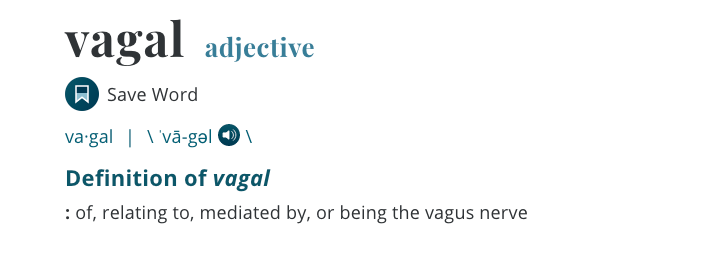
Credit: merriam-webster.com

Silly little dictionary! Don’t you know vagal can’t possibly be a word if the New York Times says it ain’t?

For further fascinating facts, check out the Spelling Bee Master.

What’s your favorite g.n.a.w. from today’s puzzle?

My Two Cents

The word vagal reminds me of the vagus nerve, and in turn the word vagus makes me reminisce about my days as a medical school undergraduate in Venezuela, way back when in the 1990s. Specifically one episode early in my student life.

The first year of med school we had morning anatomy lectures that were held in a very large and cavernous auditorium. This class started really early, maybe 8:00 or 8:30 am, which meant I was getting out of bed two hours earlier and was still half-asleep when I’d arrive.

Add to that fact that the lights were usually dimmed so we could see the slide show (made with real slides back then!), and the conditions were perfect for me to fall asleep at some point during the lecture.

One morning the professor was talking about the autonomous nervous system. I was sitting with my friend Isaac more or less in the center of the auditorium, but a ways up. We promptly let the darkness embrace us and dozed off to the hum of the lecturer’s droning voice.

When the professor reached the part of lecture regarding the vagus nerve, he mentioned how it bifurcated into the left and right branches, the former ending in the stomach and the latter reaching all the way to the solar plexus.

At that point he said (in Spanish, but I’ll translate): “So we have the right vagus and the left vagus”, and extended his arms forward and to the sides in a dramatic flourish. The lights happened to turn on at that moment.

Here I pause to explain something about the name of this nerve in Spanish. And in English, for that matter. The term vagus was borrowed from New Latin vagus nervus, literally, “wandering nerve”. That’s because this long cord snakes through the neck, chest and abdomen, connecting to a bunch of things inside you as it meanders along.

In English the word vagus may remind you of the term vague, and you’d be correct in assuming they are related. In Spanish the nerve is called vago.

Aside from also meaning “vague”, vago is a word used to refer to people who wander about, or spend their time idling. It translates as… bum.

When the anatomy professor spread out his arms and said “vago derecho y vago izquierdo” one could have interpreted it as “the bum on the right and the bum on the left”.

Cue the lights turning on. And the eyes of about a hundred students settling on Isaac and me, peacefully asleep in class.

Two bums. One on the right, one on the left.

I think to this day that anatomy professor has no idea why the entire auditorium burst out laughing hysterically.

Anyway, that’s what comes to mind when I hear vagal or vagus or vago.

Oh, and also…

We’ve got some nerve!

The vagus, also known by its thuggish moniker pneumogastric nerve, is the longest nerve of the autonomic nervous system in the human body. The autonomic (independent) nervous system regulates key body functions that you normally don’t think about, like your heart rate, your breathing, and your digestion. This way you can spend time meditating about more important issues. For example why the second season of True Detective was such a letdown, or how come no one seems to be able to sack a 74-year-old Tom Brady. (I’m talking about the future here, when he wins his 130th Superbowl ring.)

Back to the vagus nerve. It’s in charge of the muscle movement of all organs from the neck down to the part of the colon (except the adrenal glands). This means that it helps your heart beat, your digestive system process food, your sweating when you’re anxious… well, you get the idea.

Scientists have studied this impressive, multi-talented nerve forever, and have found other interesting uses for it.

For example, a vagotomy (slicing the vagus nerve) used to be performed on people to treat their ulcers. Now it’s practically obsolete, as medical treatments have surpassed it in ease and effectiveness. However, vagotomy still seems to be an option for weight loss and would work as alternative to gastric bypass surgery, a much more radical and complicated procedure.

For the past 25 years, stimulation of the vagus nerve in the chest has been used as therapy for seizures in epilepsy patients. It’s also being looked into for treating drug-resistant cases of clinical depression.

To top it off, the vagus nerve is also involved in the “diving reflex”, a set of reactions your body has to being immersed in chilly water without breathing.

Which brings us to this cool scene from the early days of the TV show E.R. (around the 0:58 mark, if you want to skip ahead):

So, if your heart ever starts fluttering uncontrollably and someone dunks your face into ice-cold water, please thank them. And your vagal reaction, as well.

And yet… despite my fond memories and even an episode on TV from a show featuring George Clooney, the editors of the Spelling Bee saw vagal and said: “Gee, Not A Word”.

Check out my previous entry on words that g.n.a.w. at you:

Spelling Bee
Medicine
George Clooney
Language
Vagus Nerve
Recommended from ReadMedium