avatarAvi Kotzer

Free AI web copilot to create summaries, insights and extended knowledge, download it at here

3182

Abstract

as to do with a “running press”. Or “current” in the sense of “occurring now”. Or maybe it just sounded fancy Frenchy to publishers in the 18th century.</p><p id="72c9">There are a few notable newspapers that used that name. None are in France, and two still exist.</p><p id="70d6">In England, the <b><i>Hexham Courant</i></b> is a weekly that serves the Tynedale area in Northumberland. It started publishing in 1864 and now focuses on local news and people.</p><p id="37b7"><b><i>The New-England Courant</i></b> was one of the first newspapers in the American colonies. It was founded by James Franklin in Boston on August 7, 1721. In case you’re wondering, yes, that was Ben’s older brother.</p><p id="8453">Now, James started the paper against the advice of everyone, but everyone was wrong and the rag proved successful and got James out of debt. Partly because he was able to exploit his 12-year-old brother as an apprentice and jack-of-all-trades. However, the relationship between the two brothers soured (I wonder why!) and three years before it closed Benjamin left for Philadelphia.</p><p id="acec">The <i>Courant </i>was the newspaper in which Ben Franklin wrote his famous articles under the pen name of <a href="https://franklinpapers.org/framedVolumes.jsp">Silence Dogood</a>. A few of Ben’s pieces got his brother in trouble and James had to spend some time in jail for refusing to disclose the identity of the writer behind the pen name.</p><p id="6d04">James’s paper was the first to include literary and humorous content. It was also the most expensive one at the time, at 4 pence daily — equivalent to a tenth of a millionth of a half-penny in today’s money. But because it consisted of a single sheet of paper printed on both sides, I’m sure a lot of the subscribers still felt they were being robbed.</p><p id="2ec9">Many viewed the <i>Courant</i>’s content as “talking trash,” just like other newspapers during this time (and newspapers today). But it set the tone for the next 100 years or more of American journalism, marking a break with its poorly written predecessors and contemporaries.</p><p id="7392">However, James Franklin got tired of his constant battles with prudish New England residents. He fought the law and the law won. So, in 1726 the elder Franklin brother shuttered down his newspaper.</p><p id="a851">Finally, the <b><i>Hartford Courant</i></b> is the largest daily newspaper in Connecticut, and is considered the oldest continuously published newspaper in the country. It’s a vesper (morning) newspaper reporting regional news.</p><p id="e586">It began as a weekly called the “Connecticut Courant” on October 29, 1764 and became a daily in 1837. In 1979 it was bought by the Times Mirror Company. Then it got further swallowed by a bunch of media conglomerates until it ended up as part of the Tribune Publishing group. I’m sure eventually it will be owned by Amazon, or Google… or maybe even <a href="https://blog.medium.com/medium-acquires-social-ebook-platform-glose-cf2e94485d8">Medium</a>!</p><h2 id="9ab7">It’s all about the attitude</h2><p id="c703"><i>Courant</i> is also a term used in heraldry to indicate attitude, or the posi

Options

tion in which the figure on the crest (usually a real or imaginary animal) appears. Like many of the heraldic terms, the word comes from the French. And its origin is very similar to the noun meaning “newspaper”.</p><p id="b854">Below are lions <i>rampant</i>, or rearing up:</p><figure id="2e99"><img src="https://cdn-images-1.readmedium.com/v2/resize:fit:800/1*hEVe--TUE9N3EKux7Zudfw.png"><figcaption>Credit: wikipedia.com</figcaption></figure><p id="3f44">Next up is a lion <i>couchant</i>, or crouching lion. And right next to him is the hidden dragon, which you can’t see because… he’s really good at hiding.</p><figure id="eb42"><img src="https://cdn-images-1.readmedium.com/v2/resize:fit:800/1*7jZLX2HkPQD4nd4j_x4lnw.png"><figcaption>Still crediting wikipedia.com</figcaption></figure><p id="56d1">And this is a lion <i>courante</i>, or running:</p><figure id="9d5b"><img src="https://cdn-images-1.readmedium.com/v2/resize:fit:800/1*_F1HBIrBInXC37KO4NoeWw.png"><figcaption>Once again: wikipedia.com</figcaption></figure><p id="d1c8">Finally, we have the lion <i>coward</i>, easily identified by the tail between his legs and for keeping company with a young Kansas girl, her dog, a straw fella and a tin guy.</p><figure id="7fd0"><img src="https://cdn-images-1.readmedium.com/v2/resize:fit:800/1*qhGnKwaaPPWRjs0a_-4h4Q.png"><figcaption>And finally… credit goes to wikipedia.com</figcaption></figure><p id="e736">Certain terms in heraldry are specific to the animal or beasts shown. For example, <i>volant</i> is mostly used with birds and especially with eagles. <i>Naiant</i> (swimming) describes fish, but can also be used with aquatic fowl such as geese, ducks, and swans.</p><p id="69af">So… today we’ve learned about a word that’s very useful if you own a newspaper or if you want to <a href="https://elitetitles.co.uk/earl_countess.html">buy a title</a> in Great Britain and get yourself a nifty coat of arms (or legs or any other body part).</p><p id="2da1">Or you could decide to start your own newspaper and design a logo with a running animal, thus killing two birds with one stone. But please, <b>do not </b>take me literally and throw any rocks at any flying or non-flying feathered or non-feathered creatures.</p><p id="2e4f">And to support the oldest continuously running newspaper in the U.S., perhaps we should all subscribe to the <i>Hartford Courant</i>.</p><p id="8bf4">But first we should ask permission from the editors of the Spelling Bee, who saw <i>courant</i> and said: “<b>G</b>ee, <b>N</b>ot <b>A</b> <b>W</b>ord”.</p><p id="11f2">Check out my previous entry on words that g.n.a.w. at you:</p><div id="7302" class="link-block"> <a href="https://readmedium.com/bilbo-e2776fab8392"> <div> <div> <h2>Bilbo</h2> <div><h3>Not a nice hobbit, but rather a terrible habit</h3></div> <div><p>medium.com</p></div> </div> <div> <div style="background-image: url(https://miro.readmedium.com/v2/resize:fit:320/1*hGj6WL0AdubwKEpZS7TReg.png)"></div> </div> </div> </a> </div></article></body>

Courant

A newspaper by any other name just isn’t the same

Photo by LOGAN WEAVER on Unsplash

Today’s New York Times Spelling Bee letters: A, C, N, O, R, T, and center U (all words must include A).

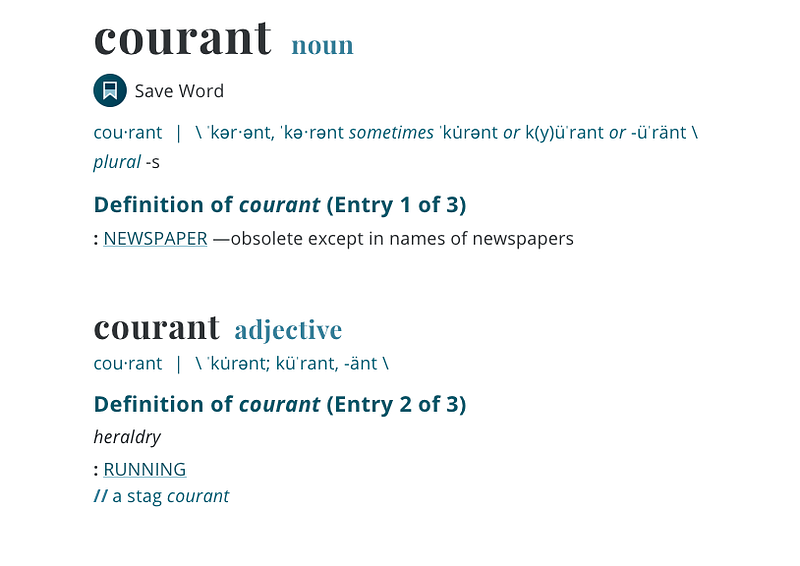
Merriam-Webster says…
Credit: merrian-webster.com

Silly little dictionary! Don’t you know courant can’t possibly be a word if the New York Times says it ain’t?

For further fascinating facts, check out the Spelling Bee Master.

What’s your favorite g.n.a.w. from today’s puzzle?

My Two Cents

I figured if I placed a photo of a hot guy I might draw some attention to this article about an archaic word for “newspaper”. I mean, at least I included a newspaper plastered on the wall.

Plus, it’s Valentine’s Day. Happy Valentine’s Day to all those who enjoy photos of hot guys. To those who don’t, you can search for your own photos. But please do so after reading my column.

I speak from experience when I say regular players of the Spelling Bee likely get some of their biggest kicks when they find “the pangram”. The pangram is the word that uses all seven letters in the puzzle. Some pangrams may have more than seven letters, as the rules allow you to repeat the same letter in a word. (For example, with today’s letters you could spell account, which has two c’s in it.) And some puzzles have more than one pangram.

Finding the pangram is probably second in ecstasy only behind seeing the glorious “Queen Bee” message indicating you’ve spelled all the possible words in the puzzle. All the possible words, that is, except for the g.n.a.w.s that we discuss in this column; the words that were not accepted.

It’s particularly frustrating when a “non-word” is a pangram. Pangrams give you bonus points and are always worth at least 14.

Today’s topic, courant, is a pangram. It’s also what Spelling Bee players call a “perfect pangram”. In other words, it uses each of the seven letters exactly once.

Extra! Extra! Read all about it!

Courant the noun, in the sense of a newspaper, comes from the French courante, the feminine form of courant (current, running) from present participle of courir (to run).

How courant became a synonym for newspaper is not clear to me, though. Perhaps it has to do with a “running press”. Or “current” in the sense of “occurring now”. Or maybe it just sounded fancy Frenchy to publishers in the 18th century.

There are a few notable newspapers that used that name. None are in France, and two still exist.

In England, the Hexham Courant is a weekly that serves the Tynedale area in Northumberland. It started publishing in 1864 and now focuses on local news and people.

The New-England Courant was one of the first newspapers in the American colonies. It was founded by James Franklin in Boston on August 7, 1721. In case you’re wondering, yes, that was Ben’s older brother.

Now, James started the paper against the advice of everyone, but everyone was wrong and the rag proved successful and got James out of debt. Partly because he was able to exploit his 12-year-old brother as an apprentice and jack-of-all-trades. However, the relationship between the two brothers soured (I wonder why!) and three years before it closed Benjamin left for Philadelphia.

The Courant was the newspaper in which Ben Franklin wrote his famous articles under the pen name of Silence Dogood. A few of Ben’s pieces got his brother in trouble and James had to spend some time in jail for refusing to disclose the identity of the writer behind the pen name.

James’s paper was the first to include literary and humorous content. It was also the most expensive one at the time, at 4 pence daily — equivalent to a tenth of a millionth of a half-penny in today’s money. But because it consisted of a single sheet of paper printed on both sides, I’m sure a lot of the subscribers still felt they were being robbed.

Many viewed the Courant’s content as “talking trash,” just like other newspapers during this time (and newspapers today). But it set the tone for the next 100 years or more of American journalism, marking a break with its poorly written predecessors and contemporaries.

However, James Franklin got tired of his constant battles with prudish New England residents. He fought the law and the law won. So, in 1726 the elder Franklin brother shuttered down his newspaper.

Finally, the Hartford Courant is the largest daily newspaper in Connecticut, and is considered the oldest continuously published newspaper in the country. It’s a vesper (morning) newspaper reporting regional news.

It began as a weekly called the “Connecticut Courant” on October 29, 1764 and became a daily in 1837. In 1979 it was bought by the Times Mirror Company. Then it got further swallowed by a bunch of media conglomerates until it ended up as part of the Tribune Publishing group. I’m sure eventually it will be owned by Amazon, or Google… or maybe even Medium!

It’s all about the attitude

Courant is also a term used in heraldry to indicate attitude, or the position in which the figure on the crest (usually a real or imaginary animal) appears. Like many of the heraldic terms, the word comes from the French. And its origin is very similar to the noun meaning “newspaper”.

Below are lions rampant, or rearing up:

Credit: wikipedia.com

Next up is a lion couchant, or crouching lion. And right next to him is the hidden dragon, which you can’t see because… he’s really good at hiding.

Still crediting wikipedia.com

And this is a lion courante, or running:

Once again: wikipedia.com

Finally, we have the lion coward, easily identified by the tail between his legs and for keeping company with a young Kansas girl, her dog, a straw fella and a tin guy.

And finally… credit goes to wikipedia.com

Certain terms in heraldry are specific to the animal or beasts shown. For example, volant is mostly used with birds and especially with eagles. Naiant (swimming) describes fish, but can also be used with aquatic fowl such as geese, ducks, and swans.

So… today we’ve learned about a word that’s very useful if you own a newspaper or if you want to buy a title in Great Britain and get yourself a nifty coat of arms (or legs or any other body part).

Or you could decide to start your own newspaper and design a logo with a running animal, thus killing two birds with one stone. But please, do not take me literally and throw any rocks at any flying or non-flying feathered or non-feathered creatures.

And to support the oldest continuously running newspaper in the U.S., perhaps we should all subscribe to the Hartford Courant.

But first we should ask permission from the editors of the Spelling Bee, who saw courant and said: “Gee, Not A Word”.

Check out my previous entry on words that g.n.a.w. at you:

Courant
Spelling Bee
Heraldry
Newspaper
Franklin
Recommended from ReadMedium