
Bilbo
Not the nice hobbit, but rather a terrible habit
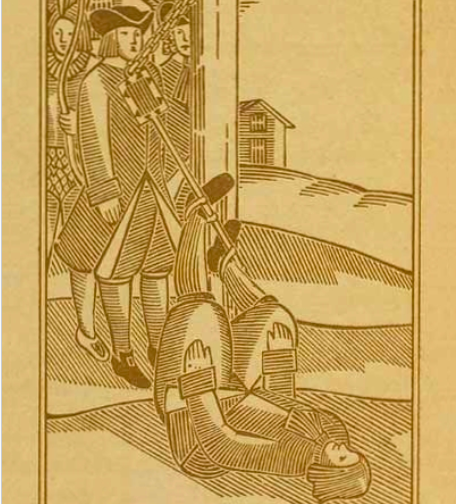
Today’s New York Times Spelling Bee letters: E, F, I, L, N, O, and center B (all words must include B).
Merriam-Webster says…
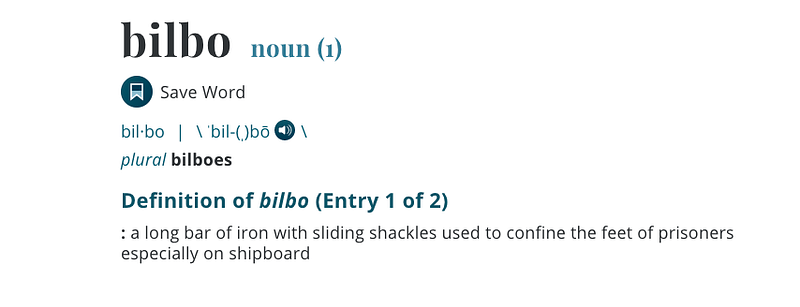
Silly little dictionary! Don’t you know bilbo can’t possibly be a word if the New York Times says it ain’t?
For further fascinating facts, check out the Spelling Bee Master.
What’s your favorite g.n.a.w. from today’s puzzle?
My Two Cents
The word bilbo instantly conjures up small men with hairy feet. No, I don’t have a fetish for that kind of stuff, and if you do, that’s completely fine by me.
Naturally I’m referring to Bilbo Baggins, the hobbit that started everything for me, if not for the entire franchise of the Lord of the Rings (LOTR, for those in the know). The series consists of three thick tomes with an estimated 19,804 pages and a trifecta of movies that, if shown back to back, would take up an entire four-day weekend.
I’m exaggerating, of course. But not by much.
My introduction to Tolkien’s magnum opus was the Ralph Bakshi animated film made in 1978, which also served to introduce me to the awesome Ralph Bakshi. That version is notable for being incomplete (it includes only The Fellowship of the Ring and the first half of The Two Towers) and the use of rotoscoping, a technique in which the movie is shot in live-action first and afterwards traced onto animation cels.
A couple of years later I got a boxed set of the paperback novels that included the “prequel” Hobbit. And here is where I confess that I’ve never read the entire epic nor watched the movies (because I wanted to read the entire epic first). I read the Hobbit twice and I’ve gotten through The Fellowship halfway.
I know, I know. Cue the finger-pointing and snarky stage whispers.
You done? Good, now we can move on to discussing some words.
bilbo and bilboes
Although the first definition Merriam-Webster gives is for the iron shackles, we’ll start with the second meaning, which is “sword”. Not just any sword, but a sword that traditionally made in Bilbao, a city in the northern Basque region of Spain. And when I say “region”, I respectfully mean autonomous community, in case there are any Basques reading this column.
It’s theorized the name bilbo came from a shortening of the city’s name. Later the word became used for all swords that had cup hilts, like the bilbo shown below:
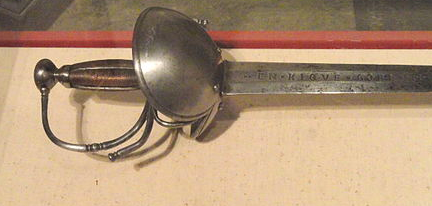
This cut-and-thrust sword became extremely popular in America, thanks in large part to Don Diego de la Vega, also known as Zorro.
The first meaning of bilbo, usually used in the plural form bilboes, refers to “iron restraints placed on a person’s ankles”. These shackles have been used to restrain prisoners for different purposes, even up to modern ages. Their name also comes from the city of Bilbao, as legend has it that they were originally made there before being brought to England by the ships of the Spanish Armada.
The Oxford English Dictionary vehemently disagrees and claims the word was used in England much earlier.
Bilboes are a pair of “U”-shaped iron bars with holes through which an iron rod is inserted. The rod was usually secured by a padlock and could be fastened to a wall. Bilboes were infamously used on slave ships, usually limited to securing the strongest slaves or those that were suspected to be likely to revolt.
The shackles were also used for public punishment and humiliation in Britain and colonial America. In England there is a written document explaining how bilboes were meant to “punyssche transgressours ageynste ye Kinges Maiesties lawes”. This sounds like whoever wrote this rule was not only very upset with someone else, but also very drunk.
Bilboes famously appear Hamlet (Act V, Scene 2: “Methought I lay worse than the mutinies in the bilboes”).
Other Bilbos
There are a number of Bilbos with capital Bs.
- We’ll start with the well-known yet fictional Bilbo Baggins, who stole the one ring from Gollum and started all that mess with Frodo, Gandalf, et al.
- The city of Bilbao is know as Bilbo in the Basque language. The Basque language (Euskera, in Basque) is fascinating, as it is completely unrelated to any other language in the world. Some theorize it may be the last remaining descendant of the prehistoric Europe.
- Bilbo is also the name of a Scottish band, best know for being the opening act of a much bigger Scottish band, the Bay City Rollers. Bilbo’s biggest hit, She’s Gonna Win, peaked at 42 in the UK. Interestingly, the band’s reunion attempt several years ago was stopped in its tracks due to a complaint by Tolkien’s estate regarding the use of the name Bilbo.
What can we surmise from this lexical exercise? Well, you can use Bilbo with a capital B when talking about the hobbit
That’s because the editors of the Spelling Bee saw bilbo and said: “Gee, Not A Word”.
Check out my previous entry on words that g.n.a.w. at you: