
Vaccine Aspiration — Why Is This Not Being Done?
Recent evidence revealed the importance of aspirating the vaccine before the jab is delivered into your arm.
A recent article in the Daily Mail caught my attention. Scientists believe they have solved the mystery behind the extremely rare blood clots caused by adenovirus vaccines such as the Oxford-AstraZeneca and Johnson & Johnson/Janssen vaccine.
And it’s so easy to prevent this from happening.
All you got to do is ask your pharmacist, doctor, or nurse to ASPIRATE when the jab is delivered into the arm.
I’ll explain why.
The Evidence
First of all, evidence showed that vaccines definitely saved thousands of lives during this pandemic, however, we also have to look objectively at adverse effects after vaccination such as extremely rare conditions characterized by thromboembolic events (blood clots).
Therefore, let’s summarize some facts stated in the article based on information from the Medicines and Healthcare products Regulatory Agency (MHRA).
From 4 January to 4 August:
- AZ administered across the UK
- 24.8 million first doses; 23.9 million second doses
- 412 suspected cases of CVST (Cerebral Sinus Vein Thrombosis) have been reported across the UK. Only 43 suspected cases were after the second dose of AZ vaccine
- The overall incidence of CVST → 14.9 per million (after first dose), 1.8 per million (after second dose)
- CVST is a complication of COVID-19 infection → 42.8 per million
- As of 11 August, there were 73 fatal cases from the 412 suspected cases
- ChAdOx1 — adenoviral vector — interacts with CAR and PF4 with implications for thrombosis with thrombocytopenia syndrome
After studying these facts, it’s fair to say that developing life-threatening blood clots after vaccination is rare. However, there is the possibility that there could be a lot more cases and death related to blood clots that haven’t been reported to the authorities.
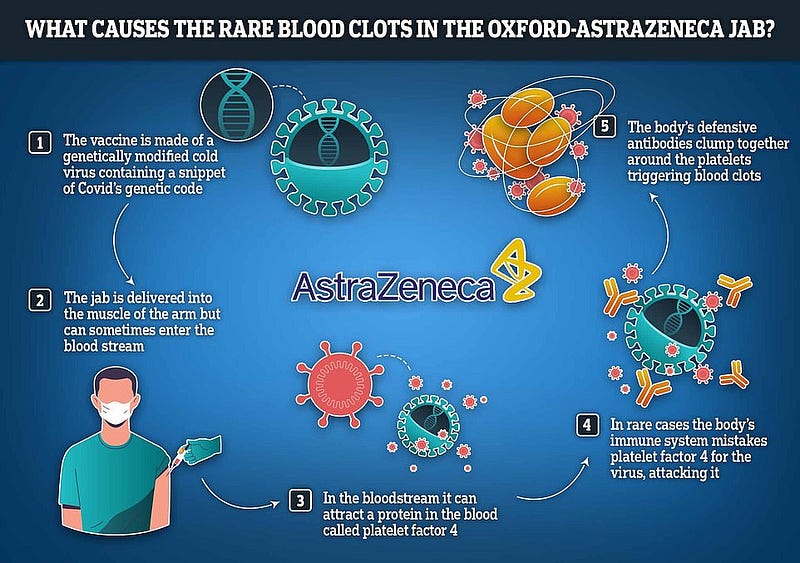
Before diving deeper into the biology of these life-threatening blood clots, I want to comment on the illustration above.
The illustration states that the jab is delivered into the muscle of the arm but can sometimes enter the bloodstream. Well, yes, if the vaccination is delivered wrongly, which is very rarely, a blood vessel can be hit and the content of the vaccine will enter the bloodstream.
However, it is really quite simple to prevent this from happening. By simply aspirating the injection — drawing back of the syringe — the person delivering the jab can simply check if the injection punctured a blood vessel (if blood enters the syringe after drawing back, a blood vessel is punctured).
But apparently, aspiration prior to delivering the jab is not necessary, as stated in my country the Netherlands for example. The Dutch National Institute of Public Health and Environment (RIVM) states:
“Checking for puncture of a blood vessel prior to vaccine injection is not necessary”
So, in my opinion, the wrong vaccination protocols are being applied. By simply aspirating the injection, the possibility of developing blood clots after vaccination dramatically reduces to the lowest minimum.
Blood Clots After Vaccination
As part of the largest vaccination campaign in history, vaccines derived from the chimpanzee adenovirus are widely used to boost the body’s immune system.
Ultra-rare side effects, including thrombosis with thrombocytopenia syndrome (TTS) and heparin-induced thrombocytopenia (HIT), were not seen in phase 3 trials.
Adenovirus vaccines contain a genetically altered virus that delivers a portion of the Covid virus’s genetic code which the body then learns to recognize and prepare itself for a real infection from the virus without infecting the human body itself.
Adenoviruses deployed as vaccination vectors against the SARS-CoV-2 bind to platelet factor 4 (PF4), a protein implicated in the pathogenesis of HIT.
Platelet factor 4
This chemokine — signaling protein that communicates from one cell to another — is released from activated platelets during platelet aggregation and promotes blood coagulation. PF4 also has a role in wound repair and inflammation.
Moreover, the PF4 has an extremely positive surface and the adenovirus is extremely negative, i.e., the two things fit together quite well.
A recently published study investigated vaccine-induced immune thrombotic thrombocytopenia (VITT), also known as TTS, and revealed PF4’s capability of forming stable complexes with clinically relevant adenoviruses.
Computational simulations demonstrated an electrostatic interaction mechanism with PF4, which was confirmed experimentally by surface plasmon resonance.
Professor Alan Parker, an expert in the use of adenoviruses for medical applications from Cardiff University’s School of Medicine, said:
“VITT only happens in extremely rare cases because a chain of complex events needs to take place to trigger this ultra-rare side effect. Our data confirms PF4 can bind to adenoviruses, an important step in unravelling the mechanism underlying VITT.”
Recent case reports show that more than 90% of the patients presenting with TTS tested positive for PF4 antibodies. A ChAdOx1 (adenovirus)/PF4 complex could induce anti-PF4 autoantibodies.
In this potential mechanism, small quantities of ChAdOx1 enter the blood either when the vaccine is administered intravenously or through minor capillary injuries.
This proposal goes some way toward explaining why TTS is observed so rarely, because it may require a series of low-frequency stochastic interactions.
First between small numbers of adenovirus particles entering the blood/lymph and then monocytes and/or B cells, which may only occur in individuals who are predisposed toward the generation of anti-PF4.
Dr. Will Lester, a consultant hematologist at University Hospitals Birmingham NHS Trust, praised the “very detailed” research saying it helps explain the “most likely initial step” in clotting.
He commented:
“Many questions still remain unanswered, including whether some people may be more susceptible than others and why the thrombosis (clotting) is most commonly in the veins of the brain and liver, but this may come with time and further research.”
Conclusion
The extremely rare blood clots caused by adenovirus vaccines such as the Oxford-AstraZeneca and Johnson & Johnson/Janssen vaccine are now explained by scientific studies.
The accumulation of blood clots after vaccination could be prevented by simply asking your pharmacist, doctor, or nurse to ASPIRATE when the jab is delivered into the arm.
This dramatically reduces the chance of developing blood clotting.
This is just advice. I’m a biomedical student, not a medical doctor. However, the evidence is there showing that these vaccine complications can easily be prevented.
Thank you for your interest in science! Feel free to put questions, comments, and suggestions for future articles in the comment section.
If you want to support:
- If you are not a Medium member yet, you can my referral link so I can get a part of your fees from Medium, you don’t pay any extra.
- Subscribe to my Newsletter to get best tutorials, research, education, and scientific-based tools for everyday life directly in your email inbox.
While you’re here, check out one of my other articles.


