
Using Religious Experiences As a Defense of Christianity
Ultimately, it’s a display of superiority bias

I have written quite a few articles on Medium examining the Christian faith critically. Some Christian readers have responded by sharing their personal encounters with God. They talk about witnessing healing or exorcisms, which led them to (further) trust in Jesus.
Experiences are seen as more important and more reliable
The point seems to be that it does not matter how many errors are in the Bible or how absurd the Christian doctrines are, they can all be overlooked because of the powerful spiritual experiences they’ve had.
Some individuals don’t feel the need to present their beliefs as logical or rational. They simply say, “That is what I experienced. Do you really expect me to doubt my own experience?”
This attitude can make it seem as if I am being unreasonable by asking them to be more critical of their own senses and consider alternative explanations for their spiritual encounters.
However, I do not intend to impose my judgment standards on them. I understand that nobody appreciates being treated that way.
Instead, I appeal to their own standards of judgment.
What about other religions?
Sometimes, Christians can become so engrossed in their own faith and religious community that they forget about the existence of other religions. They need to be reminded that supernatural encounters and witnessing miracles are not exclusive to Christianity. People from various religious backgrounds also report such experiences with their deities.
In light of this, I pose a question to Christians: Should individuals from other religions trust their own spiritual encounters just as devout Christians trust theirs?
Exorcism
For example, a few Christians told me that they witnessed with their own eyes demons leaving a person’s body after they (or other Christians) cast it out using the name of Jesus. It might seem like compelling evidence of the power of Jesus, right?
Yet the practice of exorcism is not exclusive to Jesus’ followers. In Taiwan, exorcism is widely practiced in folk religion, often casually referred to as Taoism. You can easily spot shop signs reading “收驚” (“exorcism”) all over, especially in smaller towns.


People who are believed to be “possessed” by demons may show fear towards the temple or shamans who act as channels for benevolent and powerful deities like Guan Yu. During the exorcism rites, the demons are commanded to leave the person’s body in the name and by the power of the benevolent deities.
As for the effectiveness of these rites, there are instances where they appear to work. There is no indication that Christian exorcisms enjoy higher success rates than exorcisms in other religions.
Christians might say that in other religions, exorcisms are only successful because it is the demons who are casting out demons. However, this explanation is already refuted by Jesus in the Bible. When some Jews attempted to explain away the successes of Jesus’ disciples in performing exorcisms by attributing it to the power of the prince of demons, Beelzebul, Jesus addressed and dismissed this reasoning (Luke 11:14–20).
Even if it is plausible that demons can cast out demons, the question then becomes: How Do Christians know that they themselves are not casting out demons by demons?
Healing
Many major and lesser-known religions have their own testimonies of healing. Asclepius, an ancient Greek god, was known for his power of healing. People suffering from ailments would visit Asclepius’ temple with the hope of receiving his healing touch while they slept there overnight. Those fortunate enough to experience healing would express their gratitude by bringing back clay replicas of the body parts that had been healed as offerings to the temple.
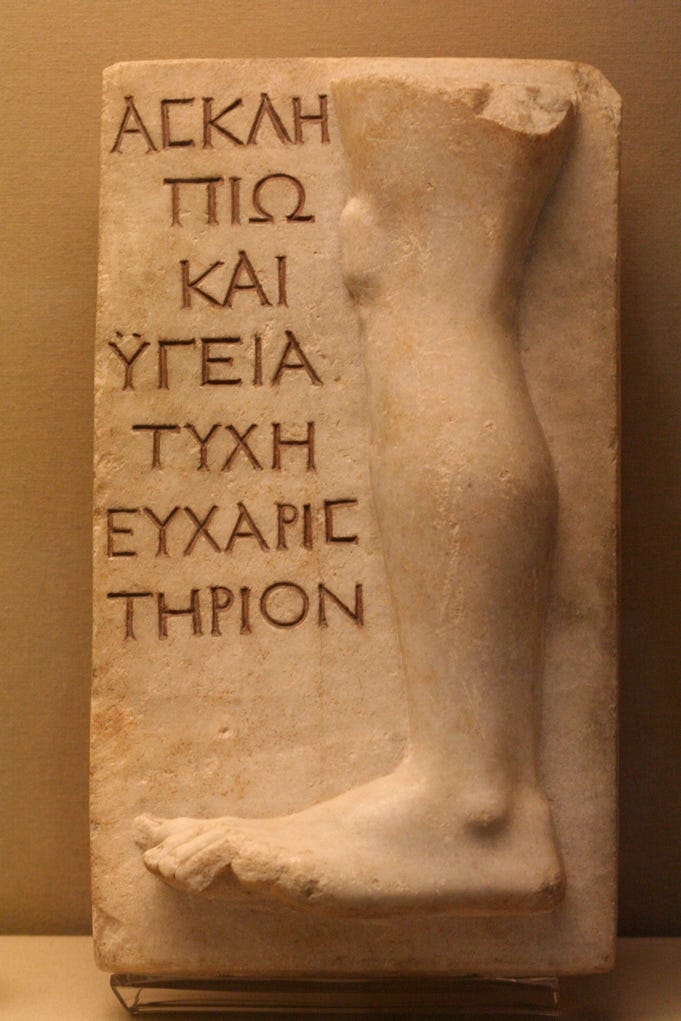

The so-called miraculous healing can occur without evoking deities, as shown by Derren Brown, a former Christian turned atheist. In his performances, he is known for seemingly performing miracle healings. However, he openly explains that these healing experiences could be attributed to a surge of adrenaline and other pain-reducing hormones. You can find several videos showcasing his “ministry” on Netflix.
When Christians share their healing testimonies with me, I often inquire about their thoughts on healing testimonies from other religions. Not surprisingly, many of them respond by suggesting that demons could also be behind the miracles reported in those other religious contexts.
The readers by now could predict what I would say in response: How do you know that your own healing experience is not the work of the demons?
Seriously, if you think you can trust your religious experiences to tell you who the real God is, why can’t you agree that people from other religions can also use their religious experiences to confirm the power of their deities? If you think I am being unreasonable in asking you to distrust your experience, why is it that you find no difficulty in claiming that other people’s wonderful experiences actually come from the evil spiritual force?
The intent of this line of questioning is not to give Christians a hard time. I am genuinely curious about any valid explanations that may exist, as I have struggled to find reasonable answers myself. Unfortunately, I’ve noticed that most Christians tend to veer off-topic or avoid further discussion at this point.
On a side note, it’s both amusing and unfortunate that in the Christian religion, Jesus is often praised for healing lepers in the past, while the remarkable achievements of modern medicine in eradicating leprosy worldwide receives little attention.
Nowadays, when sick Christians undergo treatments in hospitals and recover, they tend to attribute their healing to God rather than acknowledging the hard work of the medical team and the countless research and experiments that formed the basis of their treatment.
Circular reasoning
One response from a Christian deserves a short treatment:
“But for me, so much of it was experiential. And what I encountered, much of it supernatural, on my personal faith journey while aligning with what I read in the scriptures, was sufficient evidence I needed to accept Jesus as truth.” Sungho Yoo, July 11, 2023
In other words, the reason why Christians can trust their experiences, according to Yoo, is that they confirm the teachings in the Bible.
But this still does not resolve the issue. People from other religions also have their own sacred texts and traditions that validate their experiences. For instance, if Buddhists have a vision of Buddha, it could serve as confirmation of what is written in Buddhist scriptures.
Again, if all major religions have scriptures that their followers can use to confirm their respective experiences, what’s so special about Christianity?
Because the Bible can be verified to be true, but not other religious texts?
As stated at the beginning of this article, I have written quite a few articles critiquing the trustworthiness of the Christian Bible. It is in this context that some Christians appeal to their experiences as if their experiences can nullify any glaring errors and inconsistencies in the Bible.
When Christians use their religious experiences to prove the Bible’s truth, and then turn to the Bible to validate those same experiences, it creates a logical fallacy called “circular reasoning.”
Let me repeat the question I pose at the beginning of this article: Should individuals from other religions trust their own spiritual encounters just as devout Christians trust theirs?
I have yet to hear from any Christian giving me an affirmative answer. This indicates that there is a double standard or illusory superiority at play.
Conclusion
Some Christians contend that seeking God’s wisdom should not be done through human wisdom (e.g. 1 Corinthians 2:4–7). They advocate for humility, allowing us to be receptive to God’s wisdom and revelation.
However, from what I have observed, the replacement for human wisdom is not necessarily “divine wisdom,” but rather personal interpretations of subjective experiences. Among Christians, what appears as an act of seeking divine wisdom is often little more than trusting one’s own fleeting emotions and personal biases. Ironically, while doing so, they also casually dismiss the experiences of others.
Christians, you don’t have to know a lot of scientific methods or logical reasoning, but at least be consistent in your standards of judgment.