
Using Nuclear Power For MHD/EHD Propulsion
Background Research
Before I dig into the new information I implore you to read my other articles on magnetohydrodynamics (MHD) and electrohydrodynamics (EHD) in order to understand this article. In this article I will hopefully finally wrap up my arguments for why MHD/EHD propulsion makes sense by showing you this NASA document that explores the topic in depth. I will then begin the journey into nuclear powered craft. Buckle up.
How MHD can explain no sonic boom https://readmedium.com/how-mhd-can-explain-the-difficult-to-explain-no-sonic-boom-of-uap-205af0fff4be
Cube-in-a-sphere Explanation https://readmedium.com/cube-in-a-sphere-uap-potentially-explained-using-ufo-patents-and-advances-in-nanotechnology-i-4133ebb3dbd7
Actual Demonstrations of MHD https://readmedium.com/actual-demonstrations-of-magnetohydrodynamics-being-used-to-create-nonconventional-flight-a-strong-93d74fa6ab83
Nuclear Power
“Separating Propulsive Mass and Energy for Space Applications” is a less than 10 page 2022 NASA report worth reading. It covers magnetohydrodynamics and electrohydrodymic propulsion and nuclear thermionic avalanche cells (NTAC) which are basically the newest “nuclear batteries” that can be as small as a button. The same report discusses LENR in a very serious manner and acknowledges it’s worthy of study with credible results although not fully understood. The report has 25 references.
The document covers many advanced concepts that I have been trying to convey in my previous articles. This isn’t the only NASA document like this. It’s a relatively simple read. There are other more complex ones. NASA has made it clear that rocket technology is not the technology of the future. We can’t realistically go beyond Mars with rocket technology and we likely will not go to mars with conventional rocket technology alone. The writing is on the wall and it’s a product of math. Nuclear power and electric propulsion are the logical new combination of technology for future space missions.
Utilization of advanced nuclear batteries — Advanced nuclear batteries have two major benefits/improvements over earlier versions and reactors: order of some 25 to a factor of a 100 times less weight for the same power, and far more power than previous nuclear batteries. These batteries scale up to megawatts and their light weight enables viable high thrust and high Isp electromagnetic propulsion. They could also be used to power energy beaming as well as thermal or electric propulsion.
The concluding remarks from the report are below.
Conventional rockets combine propulsive mass and energy and have a “terminal” Isp of some 450 seconds using H2/O2. Separating propulsive mass and energy in various ways enables much higher Isp values. Full exploitation of this separation of propulsive mass and energy for space requires high energy densities not yet readily available. The characteristics/capabilities of the new, advanced nuclear batteries would enable higher thrust levels, higher Isp, a greater scope in regard to propulsive mass possibilities, lighter weight, and, due to advantageous scaling, a greater scope of applications beyond propulsion to ISRU and habitats with applicability to the outer solar system.
https://ntrs.nasa.gov/api/citations/20220002207/downloads/NASA-TM-20220002207.pdf
I did some digging into the new batteries and found this from the NASA website.
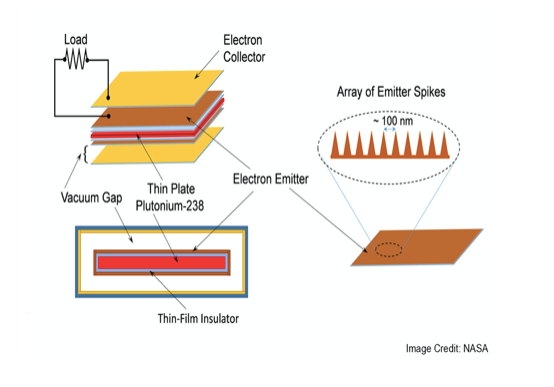
For a smart phone battery size, the invented compact thermionic (CTI) cell requires about 5 g maximum of 238Pu. Such small quantities are more readily available and producible, and could be reused for recycling when the CTI cell is dismantled. The emitter surface is topologically modified to have array of spikes, achievable using current semiconductor microfabrication technology.
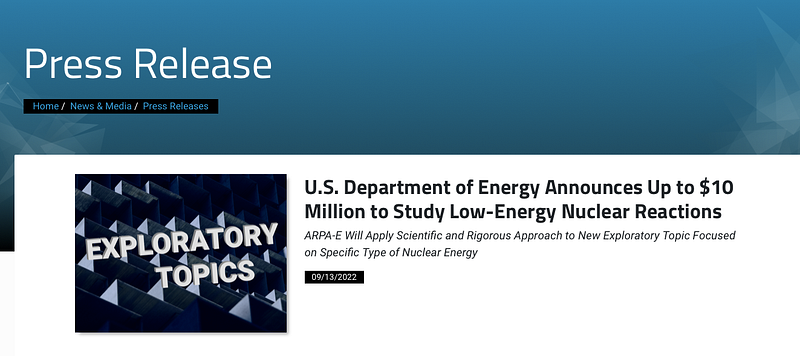
If the mention of low energy nuclear reactions (LENR) aka “cold fusion” is a surprise to you I would also like to point out that the DIA has a few reports very open to the possibility of LENR and the DOE recently announced $10M in funding for it.
Some people have trouble wrapping their head around electromagnetic propulsion technology and the truth is it requires high energy density so some form of nuclear powered compact reactor is going to have to end up inside one of these things until we figure out more advanced concepts such as anti-matter. The good news is that nuclear power is more than sufficient to get the job done. The real hurdles are figuring out how to do it safely. After all, depending on what design you use this could literally be a flying dirty bomb of radioactive material that takes generations to decay. Some nut job in area 51 could’ve experimented with one of these designs for all we know already, but let’s hope the UAP’s being reported in residential areas aren’t using old school (or even new school) plutonium nuclear technology. And before you get too scared, there are ways to use nuclear technology that doesn’t run any radioactive risk. The most foolproof being what’s called aneutronic fusion. Unfortunately, that’s still being worked on but a few outfits think they are close. I might have to do an article devoted entirely to fusion in the future.
For now, we are stuck in the realm of nuclear power before fusion technology. This means either “nuclear batteries” like the ones mentioned earlier or fission reactors. We have figured out how to make compact fission reactors. We use them on submarines. We also use nuclear batteries already in outer space. NASA actually plans to demonstrate a compact fission reactor on the moon by 2026. https://www.nasa.gov/press-release/nasa-announces-artemis-concept-awards-for-nuclear-power-on-moon
The newest options becoming available certainly make the propulsion concepts using MHD/EHD I’ve been discussing look far more achievable. In a lot of ways, what NASA has envisioned very much would look and behave a lot like what some UAP are described as. I’m not sure if that is an argument for UAP being secret human technology or actual ET probes. I suspect the former, but there’s certainly some arguments for the latter as well. We’ll have to keep an open mind and continue searching on that front, but for now let’s continue researching the upcoming advances in compact nuclear reactors. Whether this is what we are actually witnessing when we see UAP or a convenient new technological advancement that happens to explain them is also worthy of an entire article.
NASA may have licensed the technology to Black Rock Energy. https://insideunmannedsystems.com/nasa-plans-to-license-patents-for-new-power-cell-suitable-for-uas/
They licensed the patents to this company apparently after it appears considering Black Rock, however, it’s possible they licensed to both. https://www.tamerspace.com/our-team
Can Nuclear Batteries Be Economically Competitive in Large Markets?
Bet you didn’t expect me to go here. I think I’ve uncovered something interesting while researching this topic. My first lead was this paper titled “Can Nuclear Batteries Be Economically Competitive in Large Markets” published in 2021. This isn’t directly related to propulsion technology, but understanding where the technology is relative to the market is actually a great way to understand the feasibility of this idea. A growing market is known to do great things for technological innovation. Profitable applications means more technological progress and usually better economies of scale.
The abstract states:
We introduce the concept of the nuclear battery, a standardized, factory-fabricated, road transportable, plug-and-play micro-reactor. Nuclear batteries have the potential to provide on- demand, carbon-free, economic, resilient, and safe energy for distributed heat and electricity applications in every sector of the economy. The cost targets for nuclear batteries in these markets are 20–50 USD/MWht (6–15 USD/MMBTU) and 70–115 USD/MWhe for heat and electricity, respectively. We present a parametric study of the nuclear battery’s levelized cost of heat and electricity, suggesting that those cost targets are within reach. The cost of heat and electricity from nuclear batteries is expected to depend strongly on core power rating, fuel enrichment, fuel burnup, size of the onsite staff, fabrication costs and financing. Notional examples of cheap and expensive nuclear battery designs are provided.
This is a very technical analysis that basically creates a kind of formula to draw a line when/how this technology will become cost competitive in major global markets. It’s basically predicting that it’s within reach in some markets if done correctly and already competitive in some small select markets such as military applications.
It concludes:
If nuclear is to play a meaningful role in the decarbonization of the U.S. and global economy, its development and deployment paradigms have to evolve towards smaller, simpler, more flexible and affordable reactors. In this paper we focused on nuclear batteries, a new class of compact micro-reactors that are factory-fabricated, transportable, plug-and- play and operating autonomously. If they can be demonstrated and commercially deployed well within the end of the decade, as is currently planned, NBs appear to be ideally positioned to provide heat and electricity to myriad of energy users across all sectors of the economy. The NB success in these large markets will depend crucially on their economic competitiveness with alternatives.
It turns out NASA isn’t the only organization interested in these things. There’s huge benefits to this type of technology for industrial processes. This particular technology type can’t realistically be used to say power your house or car, but it could be used to power a large industrial process. And it would be better for the environment than the alternative, which is burning natural gas. There are huge markets for industrial processes such as metals recycling, hydrogen production (which has added benefits for hydrogen fuel cell technology) and other chemical production such as fertilizer production as well as cement production that can cause a lot of pollution. These processes require heat for chemical reactions and will likely be some of the first major adopters of this kind of technology because there is no need to even bother converting the heat into electricity. Once a nuclear battery that is cost competitive with natural gas is created it will quickly be adopted by these industrial manufacturers for purely profit motivated reasons. A very large portion of the cost to recycle metal or manufacture cement is the energy. It’s an added bonus that they are no longer burning fossil fuels. Perhaps they will be given some economic incentives to implement this and use it for PR purposes as well. Even though the nuclear batteries are designed in a way that doesn’t come with the risk of a nuclear catastrophe like events from the past, we know it would be difficult to convince the public to trust this technology anyway. So this looks like a very natural way to transition the technology.
So I thought to myself to search for anybody working towards this and found Radiant Nuclear. They only very recently raised some funding and plan to have the first every redesign of a compact reactor in 50 years ready for market by…2026 (the same target as NASA to demonstrate compact reactors on the moon.) First of all the first ever redesign of a compact reactor in 50 years using current technology is going to be very exciting. Also, I suspect it’s the first ever PUBLIC redesign. Being the sleuth that I am I went to linkedIn and compiled a list of their employees, investors and members of the board of directors. I have to say that this list tells a very interesting story. It’s full of former SpaceX employees and nuclear physicists. It has employees listed who briefed Biden during his transition. It has people with bizarre resumes like interned at the federal reserve and negotiated peace talkes in Sierra Leon. It has a member of the board who is a nuclear physicist who is also the member of the board for a company that claims it will revolutionize the cement industry. Recall what I said about that industry likely being one of the first adopters for this technology if it becomes cost competitive.
I just want to say to all the naysayers out there that have continually tried to claim that the MHD/EHD propulsion using compact nuclear reactors I’ve been trying to explain is impossible, you are wrong. I’ve provided more than enough information that the most qualified people in energy and propulsion agree with me. NASA and DOE namely. It’s theoretically possible. It’s technologically feasible. It’s literally being planned in the open. It hasn’t ever been publicly demonstrated with every part cohesively, but there’s little reason to believe it’s not possible. It’s even trending towards economically viable. If you’re not convinced yet that this isn’t 1000 years away technology I can’t help you. This may only be 10 years away and that’s publicly. It’s not at all unreasonable to suspect there’s some secret version of this being developed somewhere.
IF YOU ENJOY MY WORK PLEASE FOLLOW ME ON MEDIUM
You don’t have to join Medium to read my work, but if you do use the link below.


