
Actual Demonstrations Of Magnetohydrodynamics Being Used To Create Nonconventional Flight: A Strong Case For The Potential Physics Behind UAP
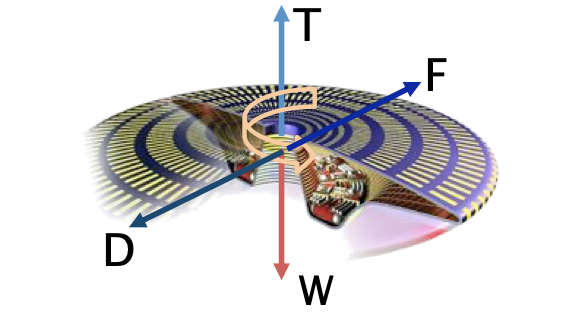
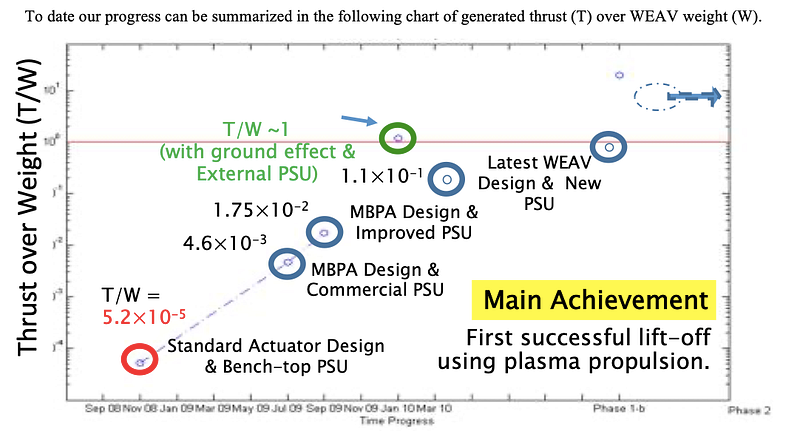
Wingless Electromagnetic Air Vehicle (WEAV) is a heavier-than-air flight system which can self-lift, hover, and fly reliably with no moving components. WEAV was invented in 2006 by Dr. Subrata Roy, plasma physicist, aerospace engineering professor at the University of Florida, and has been a subject of several patents. WEAV employs no moving parts, and combines the aircraft structure, propulsion, energy production and storage, and control subsystems into one integrated system. An early prototype of the WEAV was able to sustain hovering flight a few millimeters above the ground for approximately 3 minutes. Prototypes of varying radii were also successfully tested, suggesting scalability of the design.
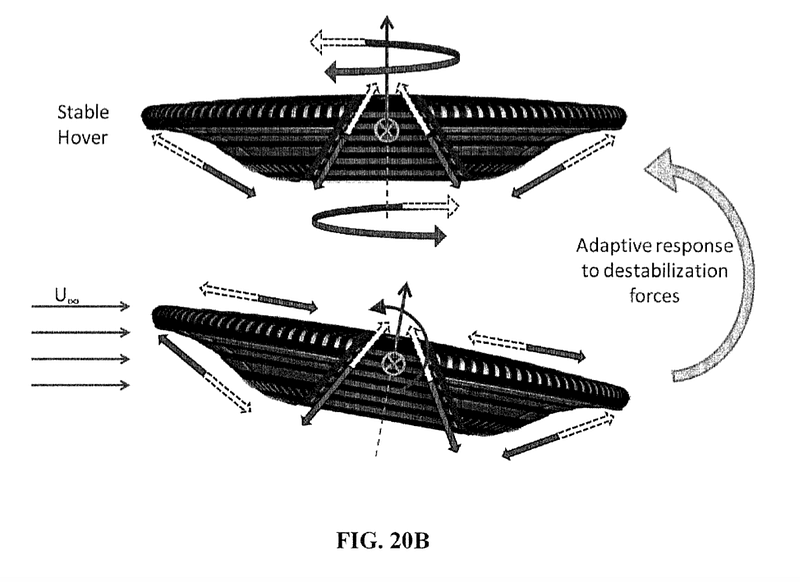
This was funded by and demonstrated to the Air Force. From the document:
It will support AFRL strategic vision of 2015–2030 to “deliver precision effects: ubiquitous, swarming sensors and shooters” and will be relevant to the WMD sensing ISR missions.
With a flight profile similar to a spinning disk, WEAV will be able to soar for long periods of time and utilize EHD thrust to acquire and maintain desired altitude and attitude. This revolutionary concept is based on the use of an electro-(or magneto) hydrodynamic (EHD/MHD) thrust generation surface that is coated with multiple layers of dielectric polymers with exposed and/or embedded electrodes for propulsion and dynamic control. This technology has the unique capability of imparting an accurate amount of thrust into the surrounding fluid enabling the vehicle to move and react. Thrust is instantaneously and accurately controlled by the applied power, its waveform, duty cycle, phase lag and other electrical parameters. Once the applied power is removed the thrust vanishes. Combining the EHD/MHD technology with emerging batteries and thin-film photovoltaics provides both energy source and storage in the same structure. https://web.archive.org/web/20130517063830/http://www.dtic.mil/dtic/tr/fulltext/u2/a564120.pdf

I’ve done posts in the past explaining how this type of propulsion is possible and it fits the description of many UFO’s. Obviously this proof of concept isn’t as advanced, but I’ve explained in other posts how the use of more energy dense fuels/batteries such as nuclear batteries or even nuclear fusion would allow for this type of propulsion to be way more feasible. I’ve also touched on how vacuum aerogel is being researched and could create lighter than air craft that would work exceptionally well using this propulsion technology. It’s also been pointed out that such craft could also utilize power beaming technology as well. The point is that it’s both theoretically and technologically feasible.
“But that’s not practical,” you might say. My response is that it would make for great stealth air craft so it’s definitely practical. It explains no wings, propellers, noise or signature of any kind. It explains perfect hovering, stopping on a dime and quick alterations. It even explains the lack of sonic boom. It can also be used to become invisible to radar, but not IR which is another one of the observations. It sounds like a very practical stealth craft to me. In fact, it’s conceivable if you equipped such a craft with radar deflectors for spoofing you could essentially make a craft that can spoof and go invisible at the same time, which would be insanely confusing if it was used to swarm.
Lighter Than Air Solar (LTAS) of Nevada and Walden Aerospace
It turns out this kind of propulsion technology was demonstrated to DOD and DOE in 1977 at Nellis AFB by Micheal K. Walden.
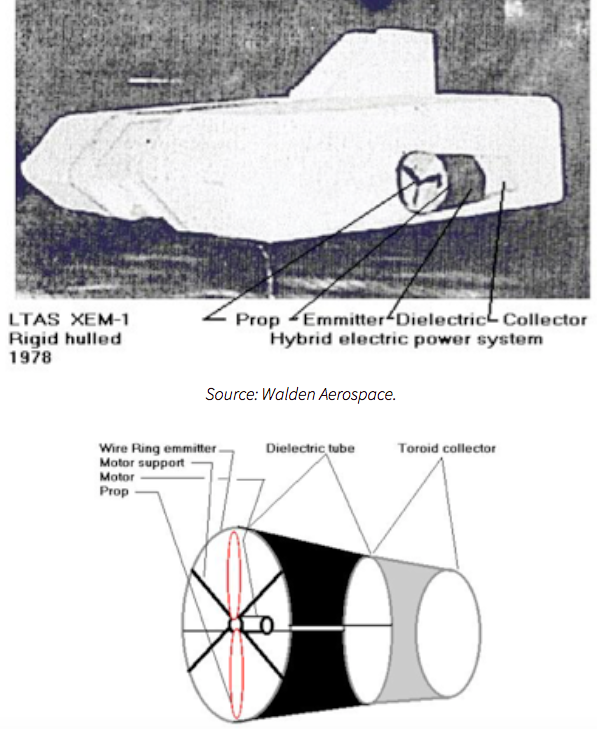
The subscale XEM-1 proof-of-concept demonstrator.
After leaving LTAS in 2005, Michael Walden founded Walden Aerospace. In the 1990’s he was still apparently experimenting with using EHD/MHD on large lighter than air craft that he called The Big Black Delta. It was presumably shaped like a triangle.
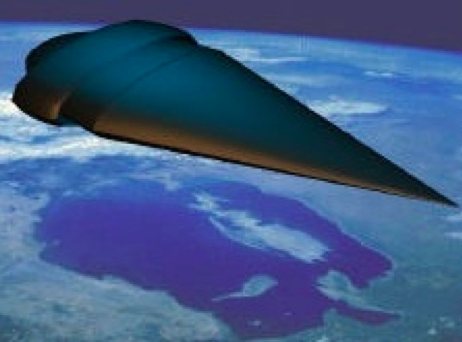
“Walden Aerospace Electro Kinetic (EK) omnidirectional thrust drive and drag reduction system. This propulsive system allows for the near silent operation of the BBD type craft and reduces or eliminates the sonic pressure shockwave of such a craft operating at supersonic / hypersonic speeds. When operating at lower speeds or when hovering, the Walden EK drive allows the BBD to maneuver without the need for external aerodynamic surfaces or moving parts. Drag reduction and boundary layer control due to the EK drive field allow the Walden BBD design to quickly accelerate and stop silently.” http://walden-aerospace.com/Military_Technology.html
Apparently Michael was involved with NIDS and wrote a paper “Hypothesis — Big Black Deltas, DOD not ET” published in 2002. At least according to his website. The links look broken. Below is direct quotes.
It should be noted that the “2004 Phase one Technologies goals” of the DARPA HULA/WALRUS program exactly match the technological systems as outlined in the 2002 NIDS / Walden paper.
DARPA said advances in envelope and hull materials, buoyancy and lift control, drag reduction and propulsion combined to make this concept feasible. Technologies to be investigated in the initial study phase included vacuum/air buoyancy compensator tanks, which provide buoyancy control without ballast, and electrostatic atmospheric ion propulsion.
While “Aerospace experts” at the time of the 2002 NIDS paper publication said that they did not think the Walden EK drive was possible, It should be noted that Mr. Walden had not only built and flown a self powered rigid composite aero shelled airship with such a drive a quarter century before he wrote the NIDS article, he built and flew another newer EK technologies flight test airship model with FULLY skin integrated (electronically steered with no external aero surfaces and no moving parts) EK propulsion in 2003 and let members of the NIDS board of directors fly it as proof of the concept in his paper in august of 2003.
He goes on to say he wasn’t awarded the contract but Lockheed Martin and Aeros Aeronautical Systems Corp was instead then claims they violated some of his patents. I can’t really speak to the veracity of those claims, but I find it interesting. I guess it’s an unexpected part of searching for “UFO patents.”
YouTube version of this post: https://youtu.be/_nrS3XWR2bw


