Using Factor Trees to Find GCFs and LCMs
Today we’ll look at an easy method for finding the greatest common factor and least common multiple of two or more numbers.
Watch or read below 🙂
Free AI web copilot to create summaries, insights and extended knowledge, download it at here
2007
Abstract
1*u5r1-IQdd4zMsk1YBxHyxw.png"><figcaption></figcaption></figure><p id="8d77">When finished I write all the circled numbers together in a <b>prime factorization. </b>If you have multiples of any number, use exponents to group them together.</p><figure id="8350"><img src="https://cdn-images-1.readmedium.com/v2/resize:fit:800/1*bYTiRR8qucqpZ9lg6_wgLg.png"><figcaption></figcaption></figure><p id="fc7b">Note that the prime factorization should multiply to the original number.</p><figure id="2c79"><img src="https://cdn-images-1.readmedium.com/v2/resize:fit:800/1*PVeXAAhh_MStgjzZk2nl1w.png"><figcaption></figcaption></figure><h1 id="42e7">Finding the Greatest Common Factor</h1><p id="28f2">The <b>GCF </b>is the largest number that divides into both values without a remainder. Let’s find the <b>GCF of 120 and 45.</b></p><p id="e1a0"><b>Step 1: </b>Draw the factor trees for both numbers.</p><figure id="b70f"><img src="https://cdn-images-1.readmedium.com/v2/resize:fit:800/1*lGBvcURKSPmaSnkBlkuqYg.png"><figcaption></figcaption></figure><p id="e7fe"><b>Step 2: </b>Write out the prime factorizations for each.</p><figure id="e39b"><img src="https://cdn-images-1.readmedium.com/v2/resize:fit:800/1*KLU7q5J6fvo15dr0p8y5mA.png"><figcaption></figcaption></figure><p id="320a"><b>Step 3</b>: The <b>GCF will be the</b> <b>prime factors that are common to both factorizations multiplied together</b>. In this example, both factorizations have one 3 and one 5, therefore the GCF is 3 x 5 or 15.</p><figure id="a1b1"><img src="https://cdn-images-1.readmedium.com/v2/resize:fit:800/1*9PQI2iuJlcc_tjhb3w1bew.png"><figcaption></figcaption></figure><p id="2f69"><i>Note: The Greatest Common Factor and Greatest Common Divisor are exchangeable terms.</i></p><h1 id="2466">Finding the Least Common Multiple</h1><p id="8795">The <b>LCM, least common multiple, </b>is the smallest value that two or more numbers multiply into. Let’s find the LCM of 120 and 45.</p><p id="2942">Begin by using factor trees to write out ea
Options
ch number’s prime factorization. We have already found the prime factorizations for 120 and 45:</p><figure id="4f55"><img src="https://cdn-images-1.readmedium.com/v2/resize:fit:800/1*KLU7q5J6fvo15dr0p8y5mA.png"><figcaption></figcaption></figure><p id="8fe9">The <b>LCM will be the product of the largest multiple of each prime that appears on at least one list.</b> For example we have a 2, 3 and 5, so I’ll choose the largest multiples of each and find their product.</p><figure id="b417"><img src="https://cdn-images-1.readmedium.com/v2/resize:fit:800/1*jU7jNPPJ_0jfSi9WSw7UaA.png"><figcaption></figcaption></figure><p id="f117">Therefore the least common multiple of 120 and 45 is 360.</p><p id="8cdc">Both of these processes can be used to find the GCF or LCM of more than two numbers, simply take into consideration all prime factorizations.</p><h2 id="35b4">❤ STAY CONNECTED ❤</h2><p id="ead0"><i>Stay up-to-date with everything Math Hacks is up to!</i></p><p id="2278"><a href="https://www.instagram.com/mathhacksco">Instagram</a> | <a href="https://www.facebook.com/Math-Hacks-513137915801590">Facebook</a> | <a href="https://twitter.com/mathhacksco">Twitter</a></p><p id="704b"><i>Next Lesson: <a href="https://readmedium.com/left-to-right-mental-addition-strategy-c325e566cea#.fnq4c7i8r">Left-to-Right Mental Addition Strategy</a></i></p><div id="b8ea" class="link-block"> <a href="https://www.youtube.com/channel/UC1IUdHJjVZfXIkpSXB6iRXw"> <div> <div> <h2>Math Hack is now on YouTube! </h2> <div><h3>Join me as we tackle math together one problem at a time. Spreading math love + self-empowerment. Subscribe for new…</h3></div> <div><p>www.youtube.com</p></div> </div> <div> <div style="background-image: url(https://miro.readmedium.com/v2/resize:fit:320/0*jJxk4aMp9-vv9aU_)"></div> </div> </div> </a> </div></article></body>
Today we’ll look at an easy method for finding the greatest common factor and least common multiple of two or more numbers.
Watch or read below 🙂
To find the GCF and LCM you first must know how to write out factor trees. I’ll walk you through the making of a factor tree for the number 60.
A factor tree breaks down a number into its prime components. You can think of these components as the unique building blocks of the number.
Begin by writing down the number. Underneath it write down any factor pair that multiplies to the number. For example, I’ll write down 6 and 10 on the branches because 6 x 10 = 60.
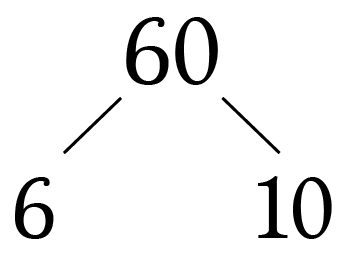
Next repeat the process with the new branches. Since 2 x 3 = 6 and 5 x 2 = 10, I’ll write the factors underneath their respective branches. When I come to a prime number — a number whose only factors is 1 and itself — I circle it indicating that the branch is finished.
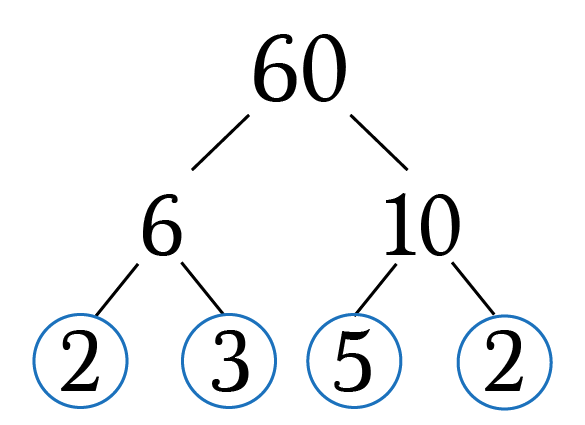
When finished I write all the circled numbers together in a prime factorization. If you have multiples of any number, use exponents to group them together.

Note that the prime factorization should multiply to the original number.

The GCF is the largest number that divides into both values without a remainder. Let’s find the GCF of 120 and 45.
Step 1: Draw the factor trees for both numbers.
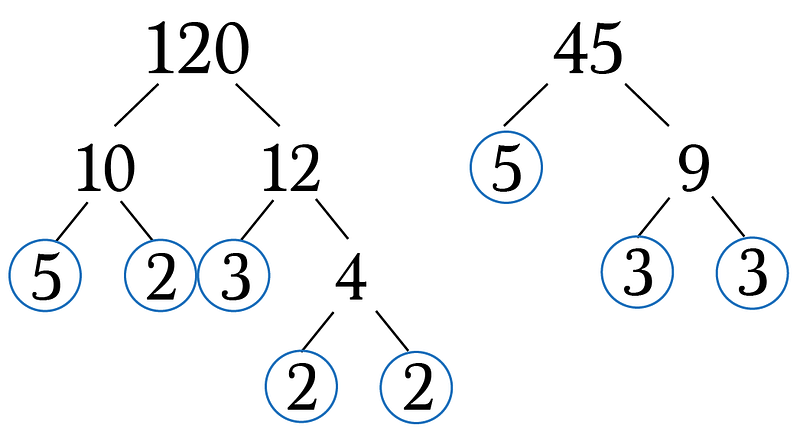
Step 2: Write out the prime factorizations for each.

Step 3: The GCF will be the prime factors that are common to both factorizations multiplied together. In this example, both factorizations have one 3 and one 5, therefore the GCF is 3 x 5 or 15.

Note: The Greatest Common Factor and Greatest Common Divisor are exchangeable terms.
The LCM, least common multiple, is the smallest value that two or more numbers multiply into. Let’s find the LCM of 120 and 45.
Begin by using factor trees to write out each number’s prime factorization. We have already found the prime factorizations for 120 and 45:

The LCM will be the product of the largest multiple of each prime that appears on at least one list. For example we have a 2, 3 and 5, so I’ll choose the largest multiples of each and find their product.

Therefore the least common multiple of 120 and 45 is 360.
Both of these processes can be used to find the GCF or LCM of more than two numbers, simply take into consideration all prime factorizations.
Stay up-to-date with everything Math Hacks is up to!
Instagram | Facebook | Twitter
Next Lesson: Left-to-Right Mental Addition Strategy