
AI Ethical Issues
Users and AI Enthusiasts Deserve to be Paid.
Should We Get Paid for Our AI Data?

We didn’t notice but past years of scandals or big problems involved AI. Throughout all, some AI systems were tested on live populations across the globe with some consequences. Autonomous cars killed pedestrians, a voice recognition designed to detect immigration fraud ended up canceling thousands of visas, another made cancer incorrect recommendations, then a big company build a secret censored search engine for China, and without people knowing, social media giants got massive data breaches.
So based on the assertion that we live in an AI world now, where machines are capable of processing vast amounts of data and making decisions previously reserved for human intellect, the question of who owns and benefits from the data used to train these AI models becomes increasingly relevant. Many individuals unknowingly contribute to the vast datasets used to train AI models through their online activities, such as social media posts, search queries, and online purchases. However, as AI technology progresses and generates substantial value for businesses and society, the ethical question arises: should we get paid as users or AI enthusiasts for our AI data?
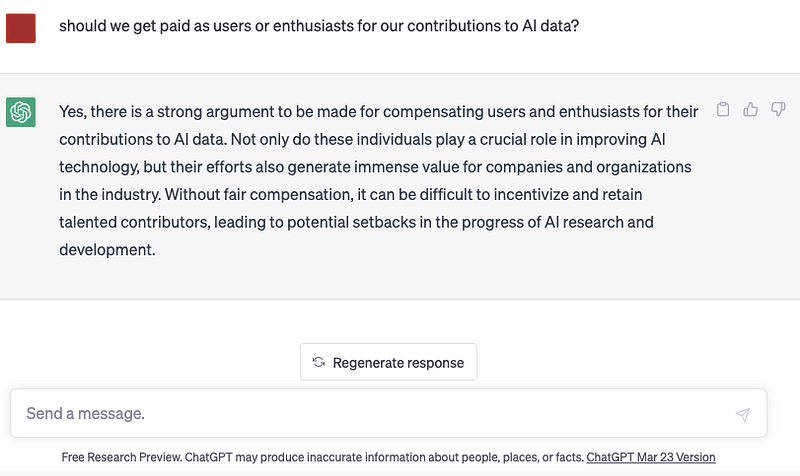
From a philosophical standpoint, the issue revolves around the concept of fairness and justice. When individuals contribute their personal data to AI training datasets, they are providing valuable input that helps improve the accuracy and effectiveness of AI models and furthermore to companies that developed those AI models. This data is often collected without explicit consent, and individuals may not fully understand the extent to which their data is being used or the potential value it holds. Therefore, it raises concerns about exploitation and unfairness, as individuals are not being compensated for the value they provide. These questions are not merely theoretical. A recent incident on Reddit saw an AI-generated woman successfully deceive users into purchasing her explicit nude photos, demonstrating that our current technology is advanced enough to create AI that can convincingly pass as a human being.
One argument in favor of compensating individuals for their contributions to AI data is based on the labor theory of value. According to this theory, any form of work that adds value to a product or service deserves compensation. In the case of AI data, individuals are actively generating data through their online activities, which are used to train AI models and enhance their performance. This data has economic value as it enables businesses to make more informed decisions, develop new products and services, and generate profits. Therefore, individuals who generate this data should be entitled to fair compensation for their labor, just as they would be compensated for their work in any other context.
Another argument in favor of paying individuals for their contributions to AI data is based on the principle of property rights. Individuals have a fundamental right to control and decide how their personal data is used. However, in the current AI landscape, this control is often diminished as data is collected, stored, and used by third parties without explicit consent or knowledge. By compensating individuals for their contributions to AI data, it acknowledges and respects their property rights over their personal information, and empowers them to have greater control over the use of their data in AI applications.
If we were to consider implementing a system where individuals are paid for their contributions to AI data, there are several possible approaches that could be explored.
- Direct Payments: One approach could involve providing individuals with direct monetary compensation for the data they contribute to AI training datasets. This could be in the form of micro-payments for each data point, or a percentage of the profits generated by businesses that utilize the AI models trained on their data. For example, social media platforms could share a portion of their advertising revenue with users whose data is used to train their recommendation algorithms.
- Data Ownership and Licensing: Another approach could involve recognizing data as a form of property that individuals own, and allowing them to license their data to businesses or organizations for use in AI training. This could involve individuals granting permissions and setting terms for how their data can be used, and receiving compensation in return. For example, individuals could license their health data to medical research institutions for use in training AI models that advance healthcare outcomes, and receive royalties or licensing fees in return.
- Data Cooperatives: Data cooperatives are collective entities where individuals can voluntarily contribute their data and share the benefits generated by that data. These cooperatives could negotiate contracts with businesses or organizations interested in using the data for AI training, and distribute the compensation among their members. This approach could provide individuals with greater bargaining power and ensure that the benefits of AI technology are more evenly distributed among data contributors.
- Education and Upskilling: Instead of direct monetary compensation, another approach could involve providing individuals with opportunities for education and upskilling in exchange for their data contributions. For example, individuals could receive access to online courses, training programs, or other educational resources that can help them acquire new skills or advance their careers. This approach could empower individuals with the knowledge and skills needed to thrive in the AI-driven economy.
Examples of initiatives that have implemented some form of compensation for data contributions include companies like Datacoup, which allows individuals to sell their personal data directly to businesses in exchange for payment, and projects like CitizenMe, which aims to create a platform where individuals can control and monetize their personal data. Additionally, there are emerging concepts like “Data Unions” that seeks to create collective bargaining power for individuals to negotiate compensation for their data contributions.
Furthermore, providing compensation for contributions to AI data could help address issues of inequality and social justice. In many cases, individuals who contribute their data to AI models come from diverse socioeconomic backgrounds, and may not have equal access to the benefits generated by AI technology. Providing fair compensation help bridge the gap and ensure that the benefits of AI are more evenly distributed, promoting a more just and equitable democratic society.
However, there are also counterarguments against paying individuals for their contributions. One argument is that individuals voluntarily share their data online without any expectation of payment, and therefore, should not be entitled to compensation. Additionally, some may argue that the value generated by AI models is a result of complex algorithms and processing, and not solely the contributions of individuals, and therefore, compensation is not warranted.
In conclusion, the question of whether individuals should be paid for their contributions to AI data is a complex and multifaceted issue. My intake is for yes and very soon until we cannot discern what is real from fake. From a philosophical perspective, it raises a lot of other questions. While there are valid arguments on both sides of the debate, compensating individuals for their contributions to AI data could promote fairness and help address issues of inequality. It’s crucial to continue the discussion and strive towards ethical and responsible approaches in the evolving landscape of AI and data usage. We would need to ensure that privacy and security problems are addressed and that individuals have informed consent and control over how their data is used. Additionally, it would require collaboration among stakeholders, including individuals, businesses, policymakers, and AI developers, to create a fair and transparent system.
PS: Other big questions arise from here, if AI becomes self-aware, what responsibilities do we as creators and users have towards them? Do we have a moral obligation to treat them with respect and dignity, or can we simply dispose of them? Will we take steps to prevent the emergence of a new type of slavery or exploitation? To ensure that AGI is not deprived of fundamental and ethical rights?
PS: Written with the help of ChatGPT.
This work here is entirely reader supported so If you enjoyed reading it please consider sharing it around and SIGN up here to get all my future articles directly to your inbox. Also if you feel like you can throw some money into the tip jar gladly will be accepted. Thank you for the support!