
The mysterious Britons successfully resisted the Romans. Why were they conquered by the Anglo-Saxons?
The culture of the Britons, although not among the oldest in Europe, is without a shadow of a doubt one of the most interesting. It began to develop in the Iron Age, and significant transformations among the people of the British Isles began only during the invasions of the Romans. When the Anglo-Saxons, Saxons and Jutes became interested in that land, the twilight of their culture took place. Who were the Britons? What was their life like? These and other questions are answered below.
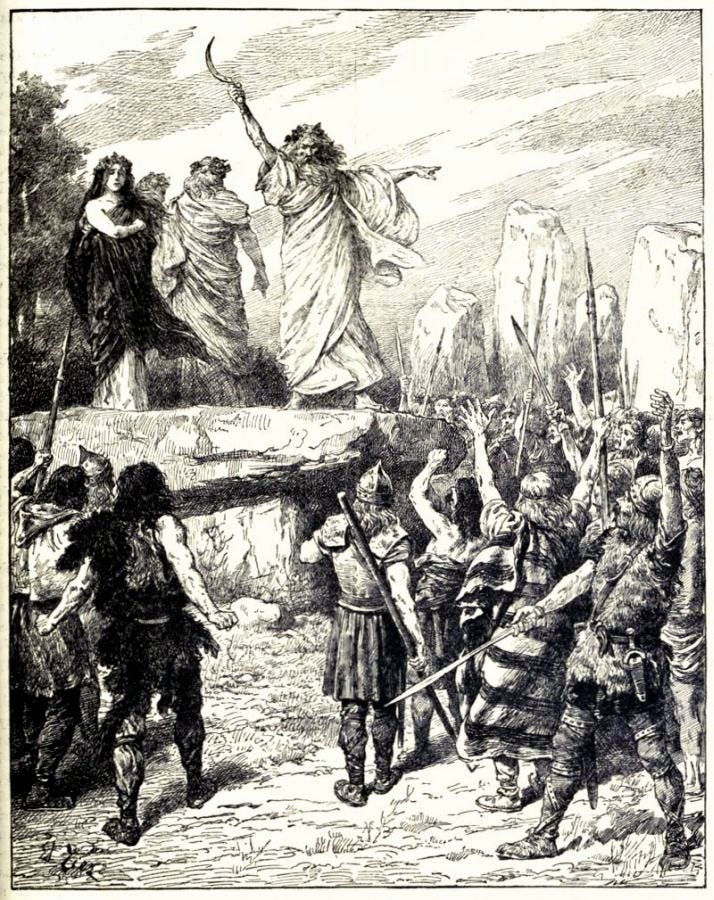
Researchers studying Brythonic culture do not face an easy task. No sources written down in the Brythonic language have survived to our time. The state of modern knowledge is based on the analysis of texts created in other cultural circles and the results of archaeological research.
Who were the Britons?
Speaking of the Britons, by this we mean the Celtic people who settled the British Isles before the Germanic tribes invaded these lands. In the Middle Ages there was a view that the Britons were descended from the Trojans, or more specifically — from the refugees from Troy. At this point it should be added that such news was proclaimed by the people themselves. This is not particularly surprising, because at that time virtually all great cultures were looking for their Trojan roots. What does modern science say about this?
The Britons, or in fact their ancestors appeared in the British Isles in the Iron Age already. We are talking about the Celts, who arrived there from central Europe. Not so long ago there was a widespread view of the forceful conquest of the British Isles. Today we already know that in this case we should rather talk about assimilation and integration. Celtic emigration was dictated by economic considerations — the Iron Age was a time of implementation of new technologies and rapid development of trade.
So can it be said that the Britons are Celts? Not necessarily. Research points to the heterogeneous origin of this people. After arriving in the British Isles, the Indo-European Celts began to mix with the non-Indo-European people who inhabited the area before them — the Picts.
Research shows that the influx of Celtic people took place in two waves. The first positioned itself between the 8th and 5th centuries BC. The Celts quite quickly managed to dominate the entire region and around 500 BC the majority of the population already spoke the Celtic language. The second occurred between the second and first centuries BC.
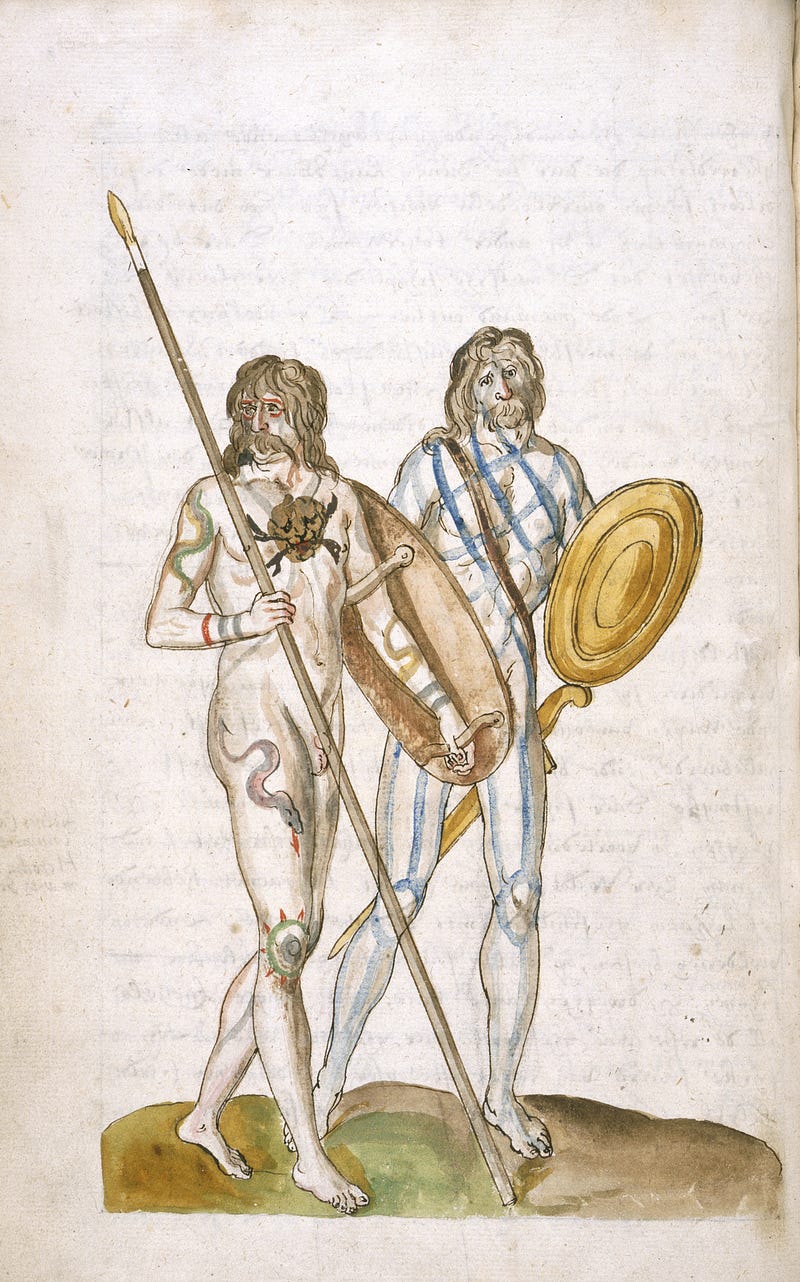
What was the life of the Britons like?
In the initial phase, the Britons were mainly engaged in cattle breeding and herding. Only with the arrival of the second wave of Celts in the British Isles did agriculture become widespread and the use of money began.
It should be mentioned that the Britons never managed to create a unified state. During their reign, the ancestral-tribal system prevailed, and any ties between individual clans were impermanent. Individual tribes established fortified strongholds.
The highest status in the tribes was held by kings. Bards — singers transmitting ancient stories, bards and druids — were held in high esteem. The latter served as priests. Lower in the hierarchy were craftsmen and farmers. The lowest in the social system were slaves.
Achievements of the Britons
The influx of Celts led to a marked increase in population in the British Isles. According to experts, at the peak of Brythonic rule, the land there may have been inhabited by up to 2 million people.
During the Middle Iron Age, the central part of southern Britain saw the largest number of burial sites. Extensive fortified settlements were surrounded by massive ramparts and moats. In their area, clusters of houses, religious sites and granaries were erected.
The development of construction testifies to the social and economic empowerment of the Brythons. Their convenient geographic location made it easier for them to establish trade relations. Natural resources also played a huge role in this regard. The Britons exploited rich deposits of metals, including precious ones, and produced elaborately decorated weapons and ornaments from them.
They had particularly good relations with Gaul, but also traded with Mediterranean countries, as evidenced by the ornamentation they used, clearly borrowed from those areas.
British language
The Britons spoke the Brythonic language, a primitive, now extinct speech classified in the Brythonic subgroup of Celtic languages. It was spoken in areas of southern and central Britain, as far south as Scotland. It was probably also spoken in the north of Scotland. Its contemporary continuation is the Cornish, Welsh and Breton languages.
We know very little about the British language. Indeed, no specific written sources have survived to our time. Only small finds, such as the inscription adorning a metal necklace, discovered in 1979, provide some knowledge.
Brythonic religion
The Brythonic religion was directly derived from Celtic beliefs and was polytheistic in nature. Deities were divided into male deities, who were associated with the sky and exercised guardianship over individual tribes, and female deities, who were associated with the earth and fertility. While individual tribes may have worshipped different male gods, female gods were universal beings, worshipped by all Britons.
Until the Roman invasion, the Britons did not build permanent temples. The places of their religious worship were natural areas. It should be mentioned here, however, that shrines and shrines built before Roman times have been found in the areas occupied by the Britons, although, on the other hand, there is no shortage of evidence of outdoor “temples” either. It is therefore possible that the Brythonic religion did not maintain continuity or homogeneity. This may also be indicated by the debatable cult of sacrifices.
Many scholars express the belief that the Britons offered sacrifices to their gods. However, at this point it should be mentioned that these were mostly animal sacrifices. It is true that archaeological research has also revealed the custom of human sacrifice. However, the evidence of these practices is so scarce that, according to the current state of knowledge, they should be regarded as incidental cases.
An important place in the beliefs of the Britons was occupied by the cult of warriors. The Britons, like other Celtic tribes, provided fallen tribesmen with weapons, which clearly indicates that they believed in an afterlife. This is also confirmed by the custom of decapitating the corpse and splitting the skull — such action was supposed to enable the soul of the deceased to make a posthumous journey.
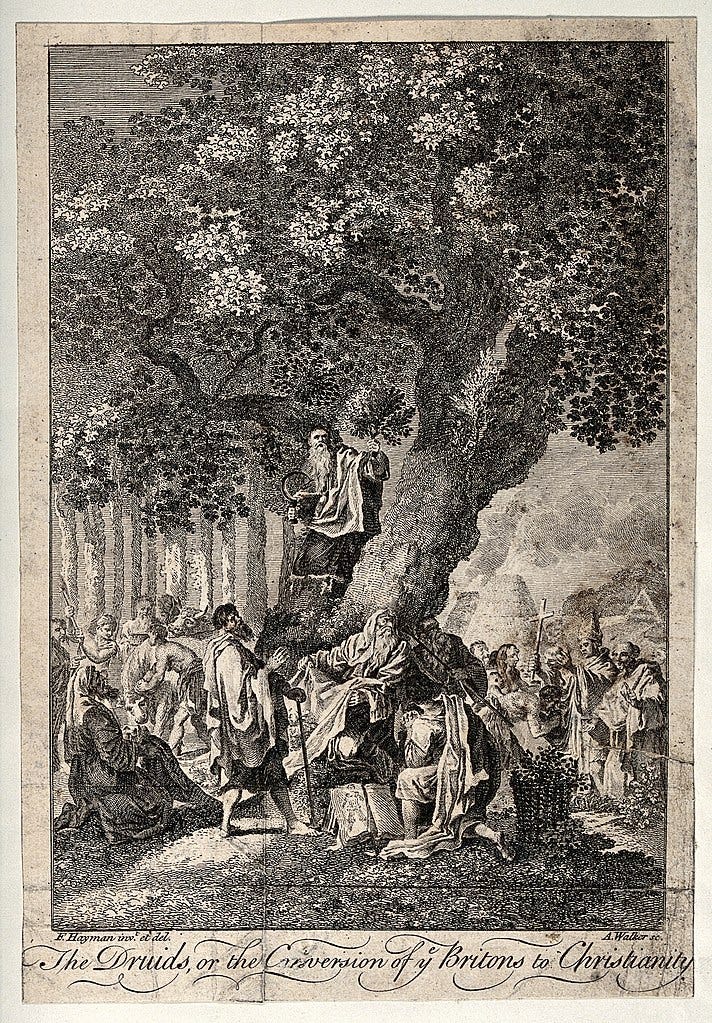
The spiritual guides of the Brythas were druids, acting as priests. Most likely, they were the ones who offered sacrifices. On the side of the druids was also the practice of rituals, to which Celtic tribes gave magical meaning, and divination.
The decline of the Brythonic culture
The Britons lived in relative peace for a long time, and their developed trade ensured their prosperity. Their weaknesses, however, are to be found in the lack of a centralized structure. Individual tribes often competed with each other, which certainly did not strengthen them. However, it cannot be said that the decline of Brythonic culture was solely related to their weakness, for ironically, it was their extensive trade contacts that largely contributed to their decline.
Roman invasions
Merchants trading in Mediterranean countries came to the attention of Gaius Julius Caesar. The Roman leader recognized that the wealth of the tribes, which did not form a permanent political and military union, would be an easy target for him. In 55 BC he invaded their lands, but the Roman campaign lasted only four days. Intense storms that hit Britain at the time forced him to retreat. He returned there the following year, but also this time quickly withdrew his troops. The failure of his next campaign was determined by the situation in Gaul, where his legions met strong resistance from local tribes.
The actual conquest of the Britons did not occur until 43 AD, when Emperor Claudius entered Britain at the head of a 50,000-strong army. The 11 kings then made an act of surrender, and Rome made the Britons its vassals, gradually imposing its own culture and religion on them.
The invasion of the Germanic tribes
The Britons remained under Roman influence for almost four centuries. Circa. 400 AD. The British Isles became the target of an invasion by Germanic tribes. The Anglo-Saxons, Saxons and Jutes managed to capture almost the entire territory of Britain. By the end of the fifth century, the islanders were assimilated. Those who did not want to adopt the new culture had to flee to the north or west, where they joined the Celts not under Roman rule.
Cool that you made it to the end of this article. I will be very pleased if you appreciate the effort of creating it and leave some claps here, or maybe even start following me. It would be nice if you also left a tip! Thank you!


,_f.8v_-_BL_Add_MS_28330.jpg)
