avatarDark Energy Articles

Free AI web copilot to create summaries, insights and extended knowledge, download it at here

2286

Abstract

/wiki/File:Dmitri_Mendeleev_(1834%E2%80%931907).jpg">Wikimedia Commons</a>]</figcaption></figure><h1 id="3daa">What was Dmitry Mendeleev famous for?</h1><p id="486d">Mendeleev was a man of many quirks. He did not like to get a haircut. He did it only once a year, when the hot weather was approaching. He would then shave to zero, so that he wouldn’t bother with trifles for the next 12 months. He wore, following Leo Tolstoy’s example, voluminous, loose clothing.</p><p id="bb84">He worked at night, went to bed around four o’clock and got up around noon. He used his free time to… making suitcases, which he glued with a substance he invented. He was irritable, making quarrels over trivial matters, such as throwing himself at a waiter in a restaurant over being served hot tea.</p><p id="12e4">In 1876, he fell obsessively in love with 17-year-old Anna Popova. He threatened suicide if she didn’t want him. He was 26 years older than her and already had a wife and two children. Mendeleev promised his wife, in exchange for a divorce, an apartment in St. Petersburg, a dacha on the Gulf of Finland and all his earnings from the university.</p><p id="3269">When he won her consent, he immediately married his beloved Anna, although he did not obtain a divorce until a month later. He was thus a bigamist. The pop who performed the wedding took a 10,000 ruble bribe. He was expelled from the Church for this.</p><p id="0ac6">Despite the divorce, <b>the scholar was a bigamist all the time, because the rules allowed remarriage only 7 years after the divorce</b>. But the whole affair went to pieces. When someone wrote a petition to the tsar that he wanted to get married early like Mendeleev, the tsar replied: <b>“It is true that Mendeleev has two wives, but after all, I have only one Mendeleev!”.</b></p><figure id="e42a"><img src="https://cdn-images-1.readmedium.com/v2/resize:fit:800/1*HHS2jvZx51K5-6RaW-60vw.jpeg"><figcaption>The first Mendeleev table in the discoverer’s notes made in 1869 — [Photo: Aljuh, <a href="https://creativecommons.org/licenses/by-sa/4.0">CC BY-SA 4.0</a>, via <a href="https://commons.wikimedia.org/wiki/File:Mendeleev_mauscrit_original.jpg">Wikimedia Commons</a>]</figcaption></figure><h1 id="5512">What did Mendeleev discover?</h1><p id="b98c">In a

Options

ddition to his achievements in chemistry, physics, metrology, economics and engineering, Mendeleev was the discoverer of coal and iron ore deposits in the Donbass and co-founder of Russia’s first refinery. Wanting to pass on scientific knowledge to ordinary people in Russia, he traveled from village to village by train — in third class — meeting with peasants and giving scientific advice on cultivation and farming.</p><p id="d1d6">In 1887, he made a solo flight in a hot air balloon in an attempt to observe a solar eclipse. He had never flown in a balloon before and had no idea how to land.</p><p id="b91d">In 1893, he took over as director of the Central Bureau of Weights and Measures, which employed women in positions of responsibility. He introduced the metric system in Russia. He is said to have been the one who determined that vodka should have a strength of 40 percent. The label “Russian Standard” informs that<i> “vodka was created according to the standards created in 1894 by the world-famous chemist Dmitry Mendeleev.”</i></p><p id="333c">He remained professionally active until his last days. He died of influenza six days before his 73rd birthday, on February 2, 1907, in St. Petersburg. At the time, Anna read to him “Journey to the North Pole” by Jules Verne.</p><div id="b4ab" class="link-block"> <a href="https://readmedium.com/barnards-star-among-the-most-intriguing-objects-in-the-universe-994dede4be45"> <div> <div> <h2>Barnard’s Star: Among the Most Intriguing Objects in the Universe</h2> <div><h3>Barnard’s star is undoubtedly one of the most fascinating objects in the entire Universe. Although we cannot see it…</h3></div> <div><p>medium.com</p></div> </div> <div> <div style="background-image: url(https://miro.readmedium.com/v2/resize:fit:320/1*JXOaVfFD0Igi1cX2nHvPvg.jpeg)"></div> </div> </div> </a> </div><p id="d39f"><b>Cool that you made it to the end of this article. I will be very pleased if you appreciate the effort of creating it and leave some claps here, or maybe even start following me. It would be nice if you also left a tip! Thank you!</b></p></article></body>

154 years ago Dmitry Mendeleev presented the periodic table

Dmitry Mendeleev left behind more than 1,500 scientific papers. The most important of these changed the way we think about how our world is ordered. On March 6, 1869, the scientist presented the periodic table of elements.
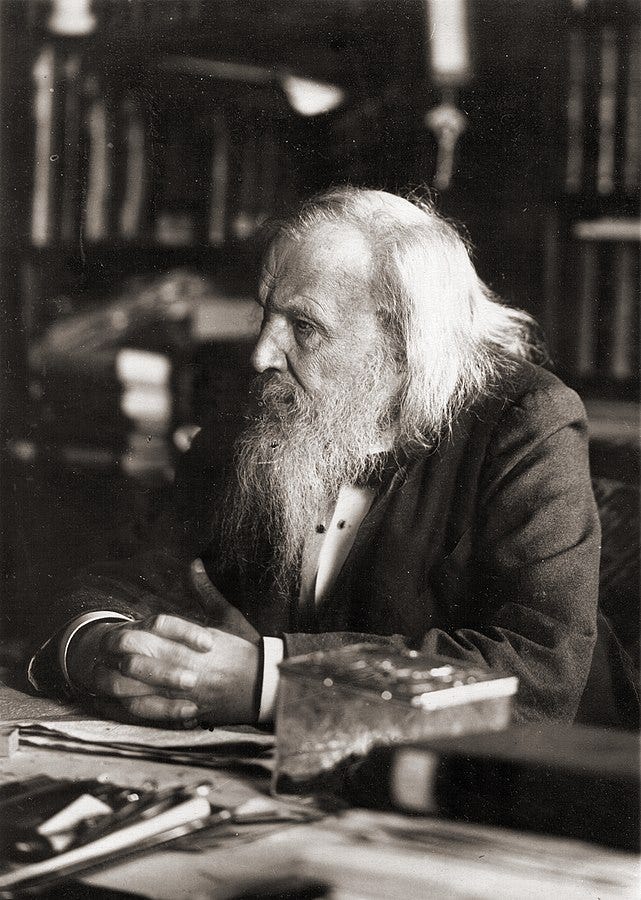
[Photo: See page for author, Public domain, via Wikimedia Commons]

In Mendeleev’s time, it was known that there were 63 elements. It was noticed that there were some similarities between some of them. Dmitry Mendeleev worked on the concept of ordering the elements.

“When they are arranged in order of increasing atomic weight, some properties periodically recur,” he noted.

How did Mendeleev create the periodic table?

The scientist pulled out a pile of old business cards, and on the back of each one he wrote the name of one element, its chemical symbol, atomic mass and all its physical and chemical properties known so far. And with these “cards” he began to arrange elemental solitaire. It turned out that when he arranged the elements in the table according to their atomic masses, then their properties repeated periodically. After such ordering, however, there remained blank spaces in the table where, Mendeleev guessed, there were yet to be discovered elements.

He was right. Just a few years later, in 1875, gallium was discovered. After another four years, scandium, and in 1886, germanium. The properties of these elements and their compounds were just as the scientist had predicted theoretically. It was a triumph of his theory. The periodic table was first presented on March 6, 1869.
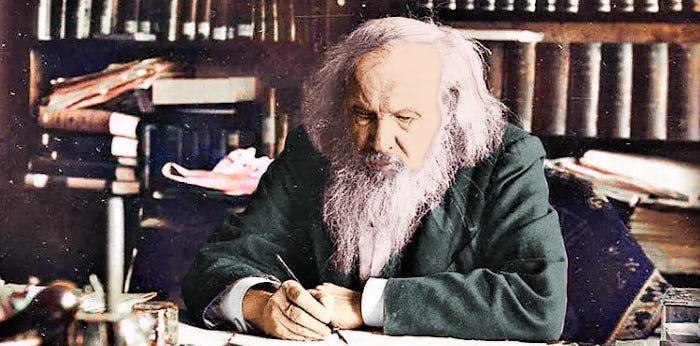
[Photo: https://pixel17.com, CC BY-SA 2.0, via Wikimedia Commons]

What was Dmitry Mendeleev famous for?

Mendeleev was a man of many quirks. He did not like to get a haircut. He did it only once a year, when the hot weather was approaching. He would then shave to zero, so that he wouldn’t bother with trifles for the next 12 months. He wore, following Leo Tolstoy’s example, voluminous, loose clothing.

He worked at night, went to bed around four o’clock and got up around noon. He used his free time to… making suitcases, which he glued with a substance he invented. He was irritable, making quarrels over trivial matters, such as throwing himself at a waiter in a restaurant over being served hot tea.

In 1876, he fell obsessively in love with 17-year-old Anna Popova. He threatened suicide if she didn’t want him. He was 26 years older than her and already had a wife and two children. Mendeleev promised his wife, in exchange for a divorce, an apartment in St. Petersburg, a dacha on the Gulf of Finland and all his earnings from the university.

When he won her consent, he immediately married his beloved Anna, although he did not obtain a divorce until a month later. He was thus a bigamist. The pop who performed the wedding took a 10,000 ruble bribe. He was expelled from the Church for this.

Despite the divorce, the scholar was a bigamist all the time, because the rules allowed remarriage only 7 years after the divorce. But the whole affair went to pieces. When someone wrote a petition to the tsar that he wanted to get married early like Mendeleev, the tsar replied: “It is true that Mendeleev has two wives, but after all, I have only one Mendeleev!”.
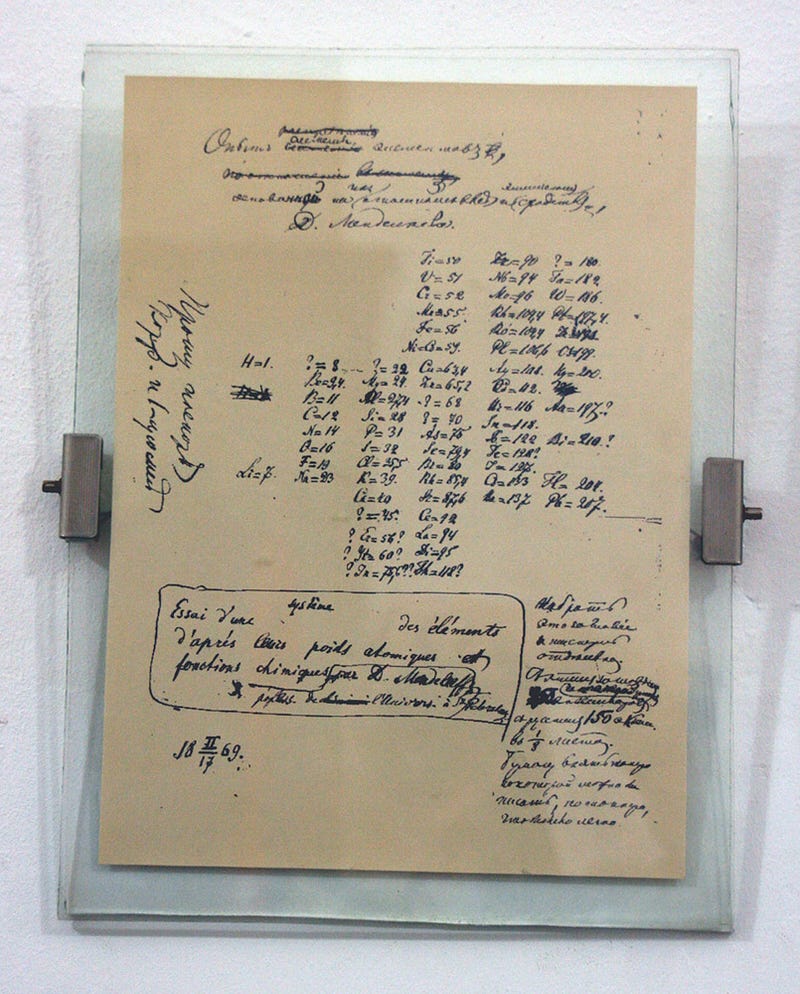
The first Mendeleev table in the discoverer’s notes made in 1869 — [Photo: Aljuh, CC BY-SA 4.0, via Wikimedia Commons]

What did Mendeleev discover?

In addition to his achievements in chemistry, physics, metrology, economics and engineering, Mendeleev was the discoverer of coal and iron ore deposits in the Donbass and co-founder of Russia’s first refinery. Wanting to pass on scientific knowledge to ordinary people in Russia, he traveled from village to village by train — in third class — meeting with peasants and giving scientific advice on cultivation and farming.

In 1887, he made a solo flight in a hot air balloon in an attempt to observe a solar eclipse. He had never flown in a balloon before and had no idea how to land.

In 1893, he took over as director of the Central Bureau of Weights and Measures, which employed women in positions of responsibility. He introduced the metric system in Russia. He is said to have been the one who determined that vodka should have a strength of 40 percent. The label “Russian Standard” informs that “vodka was created according to the standards created in 1894 by the world-famous chemist Dmitry Mendeleev.”

He remained professionally active until his last days. He died of influenza six days before his 73rd birthday, on February 2, 1907, in St. Petersburg. At the time, Anna read to him “Journey to the North Pole” by Jules Verne.

Cool that you made it to the end of this article. I will be very pleased if you appreciate the effort of creating it and leave some claps here, or maybe even start following me. It would be nice if you also left a tip! Thank you!

Biography
History
Physics
Life
Science
Recommended from ReadMedium