avatarDark Energy Articles

Free AI web copilot to create summaries, insights and extended knowledge, download it at here

3215

Abstract

Serpentine and is<b> 6 light years away from Earth.</b> Thus, we are talking about the closest star to Earth of all that make up this constellation and the fourth closest star to Earth in the night sky.</p><figure id="ecff"><img src="https://cdn-images-1.readmedium.com/v2/resize:fit:800/1*XRA_5FddjihJvRpBPubn2A.jpeg"><figcaption>[Photo: Marskell, Poppy, User:Richard-59, <a href="http://creativecommons.org/licenses/by-sa/3.0/">CC BY-SA 3.0</a>, via <a href="https://commons.wikimedia.org/wiki/File:Barnard%27sStarSize_en.jpg">Wikimedia Commons</a>]</figcaption></figure><h1 id="6d42">Who was Edward Emerson Barnard?</h1><p id="f938">Where did the name of this star come from? The object was named in honor of Edward Emerson Barnard. He was the American astronomer who in 1916 discovered that the object was the fastest-moving celestial body as seen from Earth.</p><figure id="738c"><img src="https://cdn-images-1.readmedium.com/v2/resize:fit:800/1*uxFUFCWEjF6ZvEXjxt_zkg.jpeg"><figcaption>[Photo: The original uploader was SITCK at Luxembourgish Wikipedia., Public domain, via <a href="https://commons.wikimedia.org/wiki/File:EdwardEmersonBarnard.jpg">Wikimedia Commons</a>]</figcaption></figure><p id="8885">It should be noted that this discovery was not the only one in E.E. Barnard’s rich scientific output. The American astronomer, who specialized in astrometry, discovered his first comet in 1881, followed by 15 more in the following years. In 1889 he took the first photograph of the Milky Way using a large aperture lens. Three years later he discovered Jupiter’s fifth moon, Amalthea. This achievement earned him an honorable position in the history of astronomy — E.E. Barnard is the second historical discoverer of the natural satellites of this gas giant after Galileo.</p><p id="1873">Interesting facts about Barnard’s successes can be multiplied and multiplied. The American cataloged many nebular-type objects, and craters on the Moon and Mars, as well as many other objects, are named after him.</p><h1 id="64d0">What surrounds Barnard’s Star?</h1><p id="fea7">Let’s return to Barnard’s Star itself. Back in the early 1960s, Peter van de Kamp put forward the thesis that there would be at least one gas giant in its surrounding orbit. Based on perturbations in the star’s own motion, the American astronomer concluded that at least one object of Jupiter’s mass or even greater was orbiting it. In 1973 van de Kamp’s postulates were challenged, and in 1995 it was conclusively proven that celestial bodies with masses above 10 Jupiter masses could not orbit Barnard’s Star.</p><p id="1081">Subsequent studies (conducted in 1999 and 2003) have significantly reduced the range of possible properties of objects that could orbit the star, but have not conclusively ruled out the possibility of planets in its orbit.</p><p id="3774">On November 15, 2018, the journal Nature reported the detection of a signal that could come from an exoplanet orbiting Barnard’s Star (it was named GJ 699 b). According to a team working under Ignasio Ribas of the Institute of Space of Catalonia (IEEC),<b> the object would have 3.2 Earth masses</b>. The estimated time to circle the parent star was set at 233 days.</

Options

p><figure id="233d"><img src="https://cdn-images-1.readmedium.com/v2/resize:fit:800/1*K7CnXM9ASuJ8zWJKVorfwg.jpeg"><figcaption>GJ 699b — [Photo: KKolaczynski, <a href="https://creativecommons.org/licenses/by-sa/4.0">CC BY-SA 4.0</a>, via <a href="https://commons.wikimedia.org/wiki/File:GJ_699b.jpg">Wikimedia Commons</a>]</figcaption></figure><p id="0143">The hypothetical <b>super-Earth</b> would provide favorable conditions for the development of primitive life forms, but recently its existence has been increasingly questioned. In 2021, a paper was published attributing the existence of the signal to the activity of the star itself. A 2022 publication, on the other hand, indicates that the signal may be an artifact resulting from a combination of activity and signal sampling.</p><h1 id="e464">A flare on Barnard’s Star</h1><p id="21fc">Many main sequence stars of spectral type M show activity in the form of solar-like flares. Due to its age, Barnard’s Star did not show activity for a long time. This changed on July 17, 1998, when astronomers observed a phenomenon that allowed it to be classified as a flare star.</p><p id="2e89">According to the researchers, the temperature of the flare was 8,000 K. Although many stars of spectral type M show more activity, such an intense flare is something unusual for an object that has existed for little less time than the Universe itself.</p><h1 id="e5d0">How to observe Barnard’s Star?</h1><p id="87be">Barnard’s Star is located close to the celestial equator, which means that it can be observed from almost anywhere on Earth. Almost, because the only exception is around the South Pole. However, it must be remembered that, like any other red dwarf of spectral type M4, this object remains invisible to the unaided eye.</p><div id="edf1" class="link-block"> <a href="https://readmedium.com/rare-animals-have-been-spotted-on-the-korean-peninsula-some-havent-seen-humans-in-70-years-2f674654b40f"> <div> <div> <h2>Rare animals have been spotted on the Korean Peninsula. Some haven’t seen humans in 70 years</h2> <div><h3>The demilitarized zone between North and South Korea was established exactly 70 years ago. To mark the occasion, new…</h3></div> <div><p>medium.com</p></div> </div> <div> <div style="background-image: url(https://miro.readmedium.com/v2/resize:fit:320/1*Rmu8YgK9AVylaWFLrWU0YQ.jpeg)"></div> </div> </div> </a> </div><p id="d514"><b>Cool that you made it to the end of this article. I will be very pleased if you appreciate the effort of creating it and leave some claps here, or maybe even start following me. It would be nice if you also left a tip! Thank you!</b></p><figure id="e494"><img src="https://cdn-images-1.readmedium.com/v2/resize:fit:800/1*QCQqlZr6doDP-cszzpaSpw.png"><figcaption><a href="https://www.buymeacoffee.com/oconnel">https://www.buymeacoffee.com/oconnel</a></figcaption></figure><figure id="92a2"><img src="https://cdn-images-1.readmedium.com/v2/resize:fit:800/1*fxkd_sjXknSGRO4TY0S9Mg.png"><figcaption></figcaption></figure></article></body>

Barnard’s Star: Among the Most Intriguing Objects in the Universe

Barnard’s star is undoubtedly one of the most fascinating objects in the entire Universe. Although we cannot see it with the naked eye, it is among the most studied celestial bodies. Scientists have long suspected that there might be a planetary system around it, and while successive theses on the subject have collapsed, new ones keep popping up in their place. What do we know about Barnard’s Star? I answer this question below.
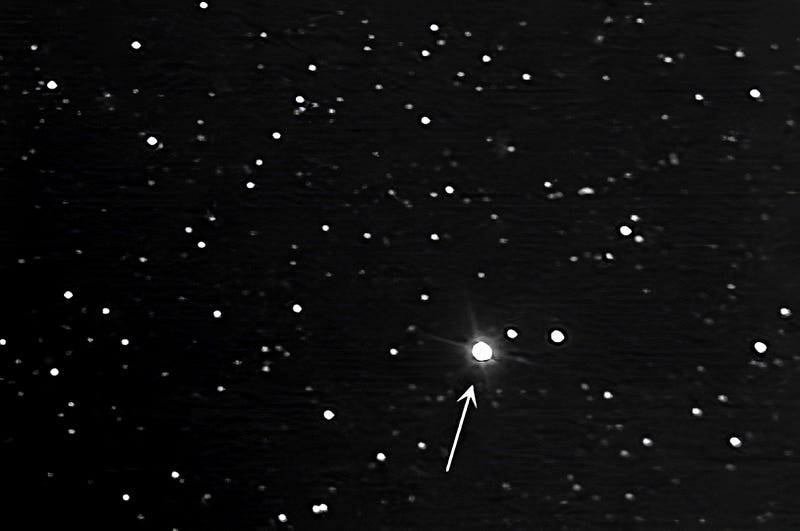
[Photo: Steve Quirk, Public domain, via Wikimedia Commons]

If the assumptions of Project Daedalus (the theoretical study of which was developed in 1973–1978) were realized, we would soon know the answers to many of the questions about Barnard’s Star that have troubled scientists since the day it was discovered. Unfortunately, interstellar travel, even unmanned travel, poses problems that modern science cannot solve. For the time being, Barnard’s famous Star will not unveil all its secrets. But this does not mean that the current state of knowledge about this object is zero.

What do we know about Barnard’s Star?

The evolution of stars is a long process, even by galactic standards. Barnard’s star is among the oldest known stars. Its age is estimated at about 7–12 billion years, which means it is much older than the Sun and not much younger than the Universe.

The object is categorized as a red dwarf of spectral type M4. The observed stellar magnitude of Barnard’s Star is 9.51m. This means that it exhibits only 1/27th the brightness of the faintest star that can be observed with the naked eye (under conditions of good visibility).

Its mass closes in the range of 0.15–0.17 solar masses, and its temperature is 3134 degrees Kelvin. This is not much, especially if we contrast this value with the temperature of the photosphere of the solar system’s central star, which exceeds 5,000 kelvin (the exact value is 5,778 K).

In the course of evolution, Barnard’s Star has already lost much of its rotational energy. Based on periodic changes in brightness, scientists have estimated that it rotates once every 130 days. By comparison, the rotation period of the Sun slightly exceeds 25 days.

The star’s own motion is 10.4 angular seconds per year. Taking into account its distance from the Sun, it should be said that the tangential speed of this celestial body is 90 km/s. In the course of its lifetime, it moves against other stars by 0.25 degrees, which is about half the diameter of the Moon. It is worth mentioning that the value of this object’s own motion is the highest known, so Barnard’s Star should be considered the fastest moving celestial body in the sky.

Where in the Universe is Barnard’s Star located? The light red dwarf is located in the constellation Serpentine and is 6 light years away from Earth. Thus, we are talking about the closest star to Earth of all that make up this constellation and the fourth closest star to Earth in the night sky.
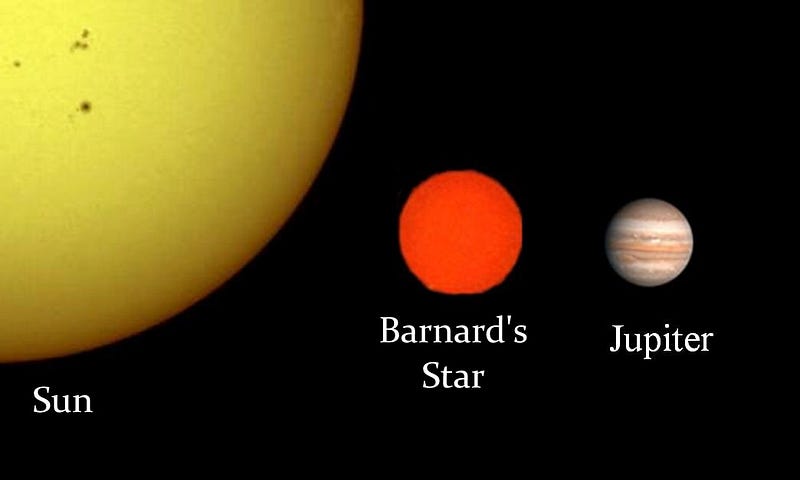
[Photo: Marskell, Poppy, User:Richard-59, CC BY-SA 3.0, via Wikimedia Commons]

Who was Edward Emerson Barnard?

Where did the name of this star come from? The object was named in honor of Edward Emerson Barnard. He was the American astronomer who in 1916 discovered that the object was the fastest-moving celestial body as seen from Earth.

[Photo: The original uploader was SITCK at Luxembourgish Wikipedia., Public domain, via Wikimedia Commons]

It should be noted that this discovery was not the only one in E.E. Barnard’s rich scientific output. The American astronomer, who specialized in astrometry, discovered his first comet in 1881, followed by 15 more in the following years. In 1889 he took the first photograph of the Milky Way using a large aperture lens. Three years later he discovered Jupiter’s fifth moon, Amalthea. This achievement earned him an honorable position in the history of astronomy — E.E. Barnard is the second historical discoverer of the natural satellites of this gas giant after Galileo.

Interesting facts about Barnard’s successes can be multiplied and multiplied. The American cataloged many nebular-type objects, and craters on the Moon and Mars, as well as many other objects, are named after him.

What surrounds Barnard’s Star?

Let’s return to Barnard’s Star itself. Back in the early 1960s, Peter van de Kamp put forward the thesis that there would be at least one gas giant in its surrounding orbit. Based on perturbations in the star’s own motion, the American astronomer concluded that at least one object of Jupiter’s mass or even greater was orbiting it. In 1973 van de Kamp’s postulates were challenged, and in 1995 it was conclusively proven that celestial bodies with masses above 10 Jupiter masses could not orbit Barnard’s Star.

Subsequent studies (conducted in 1999 and 2003) have significantly reduced the range of possible properties of objects that could orbit the star, but have not conclusively ruled out the possibility of planets in its orbit.

On November 15, 2018, the journal Nature reported the detection of a signal that could come from an exoplanet orbiting Barnard’s Star (it was named GJ 699 b). According to a team working under Ignasio Ribas of the Institute of Space of Catalonia (IEEC), the object would have 3.2 Earth masses. The estimated time to circle the parent star was set at 233 days.
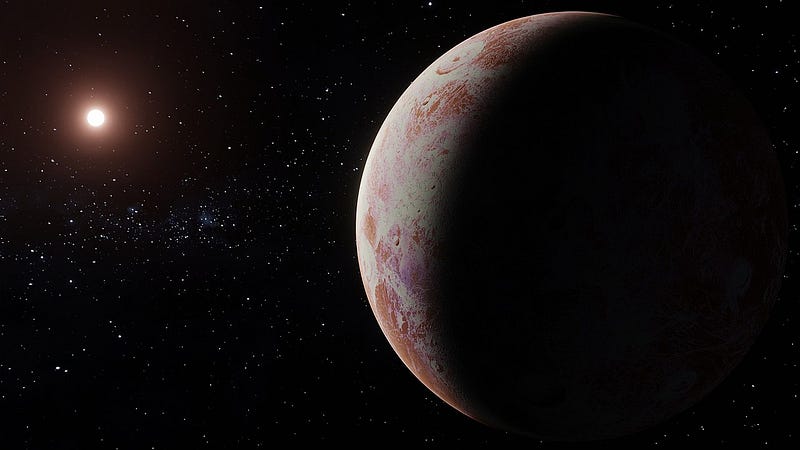
GJ 699b — [Photo: KKolaczynski, CC BY-SA 4.0, via Wikimedia Commons]

The hypothetical super-Earth would provide favorable conditions for the development of primitive life forms, but recently its existence has been increasingly questioned. In 2021, a paper was published attributing the existence of the signal to the activity of the star itself. A 2022 publication, on the other hand, indicates that the signal may be an artifact resulting from a combination of activity and signal sampling.

A flare on Barnard’s Star

Many main sequence stars of spectral type M show activity in the form of solar-like flares. Due to its age, Barnard’s Star did not show activity for a long time. This changed on July 17, 1998, when astronomers observed a phenomenon that allowed it to be classified as a flare star.

According to the researchers, the temperature of the flare was 8,000 K. Although many stars of spectral type M show more activity, such an intense flare is something unusual for an object that has existed for little less time than the Universe itself.

How to observe Barnard’s Star?

Barnard’s Star is located close to the celestial equator, which means that it can be observed from almost anywhere on Earth. Almost, because the only exception is around the South Pole. However, it must be remembered that, like any other red dwarf of spectral type M4, this object remains invisible to the unaided eye.

Cool that you made it to the end of this article. I will be very pleased if you appreciate the effort of creating it and leave some claps here, or maybe even start following me. It would be nice if you also left a tip! Thank you!


https://www.buymeacoffee.com/oconnel
Space
Universe
Science
Life Lessons
Research
Recommended from ReadMedium